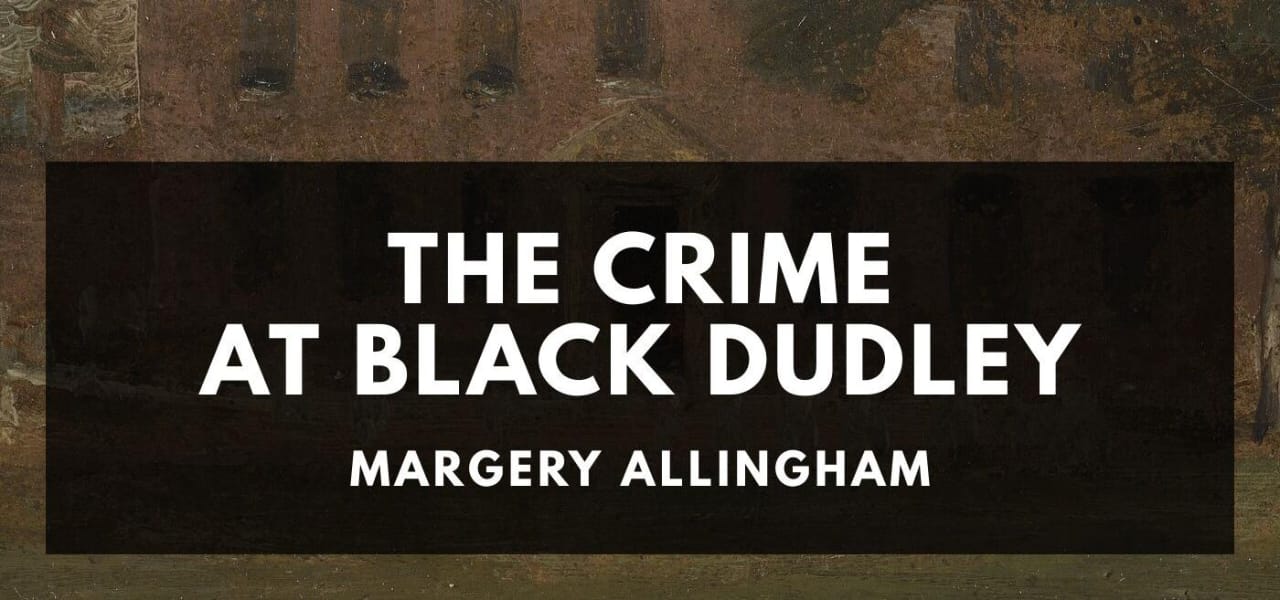
The year 1929 was a watershed moment for the British mystery novel. While the world was reeling from the onset of the Great Depression, the "Golden Age" of detective fiction was entering its most sophisticated phase. Amidst this backdrop, a twenty-four-year-old Margery Allingham published The Crime at Black Dudley (released in the United States as The Black Dudley Murder).
While often overshadowed by her later, more psychologically complex masterpieces like The Tiger in the Smoke, this debut novel serves as a fascinating archaeological site for genre enthusiasts. It marks the first appearance of Albert Campion, a character who would evolve from a high-pitched "silly ass" caricature into one of the most profound figures in 20th-century crime fiction.
The Gothic Framework: Setting the Scene
Allingham begins her career by leaning heavily into the "Country House Mystery" tradition, but she does so with a subversive, almost atmospheric intensity. The Black Dudley mansion itself—a desolate, sprawling estate in the wilds of Suffolk—is more than a backdrop; it is a character.
The plot centers on a weekend house party hosted by Wyatt Petrie, an academic whose guests are a motley crew of socialites, scholars, and shadows. The weekend takes a turn for the macabre during the performance of the "Black Dudley Ritual," a mock-medieval ceremony involving a ceremonial dagger. When the lights go out and the dagger finds a human heart instead of a bolster, the house is plunged into a lockdown orchestrated by a gang of sophisticated international criminals.
The Campion Paradox: From Sidekick to Icon
Perhaps the most striking element for a modern reader of The Crime at Black Dudley is that Albert Campion is not the protagonist. The story is primarily seen through the eyes of George Abbershaw, a sober, professional pathologist.
In this first outing, Campion is an enigma—a pale, bespectacled young man with a foolish grin and a penchant for nonsensical chatter. He is introduced as a peripheral figure, someone the other guests view with a mixture of amusement and irritation. He claims to be a "universal uncle" and a man of mystery, hinted to be of royal or aristocratic lineage (a thread Allingham would tease for decades).
However, as the tension at Black Dudley escalates, the reader begins to see the "Campion mask" slip. While George Abbershaw attempts to solve the murder through logic and science, Campion maneuvers through the criminal underworld with a surprising, lethal competence. This duality—the vacuous socialite masking a sharp, dangerous intellect—would become the blueprint for the "Gentleman Sleuth," a trope Allingham helped perfect.
Themes and Literary Texture
The Crime at Black Dudley is notable for its blend of two distinct sub-genres: the whodunit and the adventure thriller.
The Locked-Room Atmosphere: The first half of the book operates as a classic puzzle. The guests are trapped, a murder has been committed, and the culprit must be among them. Allingham excels at building claustrophobia, using the ancient architecture of the house to mirror the psychological entrapment of the characters.
The International Syndicate: The second half shifts gears into a high-stakes thriller involving "The Simister Gang." This transition reflects the era's anxiety regarding organized crime and the "Moriarty-esque" mastermind.
Class and Post-War Disillusionment: Though the tone is often light, there is an undercurrent of post-WWI weariness. The youth at Black Dudley are searching for excitement to fill a void, stumbling into a reality far more violent than their parlor games.
Structural Analysis: The Mechanics of the Plot
Allingham’s plotting in this debut is ambitious, if occasionally clunky compared to her later work. The "Ritual" is a brilliant narrative device; it provides the necessary chaos for a murder to occur while also grounding the story in an eerie, folkloric tradition.
Allingham’s Prose: A Cut Above
What separates Allingham from many of her contemporaries—the "Big Four" of the Golden Age (Christie, Sayers, Marsh)—is her descriptive prowess. She possesses a "writerly" quality that elevates the material. Her descriptions of the Suffolk landscape and the decaying grandeur of Black Dudley are visceral.
"The house was a Great Silence, a vast, cold, stony thing that seemed to have been waiting for centuries for just such a night as this."
This attention to atmosphere ensures that even when the plot becomes reliant on the tropes of 1920s pulp fiction, the reader remains grounded in a believable, albeit heightened, reality.
Historical Significance and Legacy
To read The Crime at Black Dudley today is to witness the birth of a legend. It is fascinating to see Campion before he became the refined, melancholic figure of The Fashion in Shrouds. Here, he is raw, irritating, and brilliant.
The novel also serves as a bridge between the Victorian sensationalist novel and the modern psychological thriller. Allingham wasn't just interested in who did it; she was interested in the why and the social rot that allowed such crimes to flourish.
While some critics argue that the "thriller" elements of the book's second half distract from the initial mystery, this hybridity is exactly what makes the book unique. It refuses to be just one thing, much like its elusive hero.
A Must-Read for Genre Historians
The Crime at Black Dudley is not just a debut; it is a declaration of intent. Margery Allingham proved that she could play by the rules of the Golden Age while simultaneously stretching them. For those who enjoy a mystery that offers both intellectual puzzles and atmospheric dread, this novel remains a foundational text. It reminds us that behind every closed door in a grand manor house, there is a secret—and sometimes, the person you least expect is the only one who can unlock it.
"The decisions we make today will shape the world for generations to come."