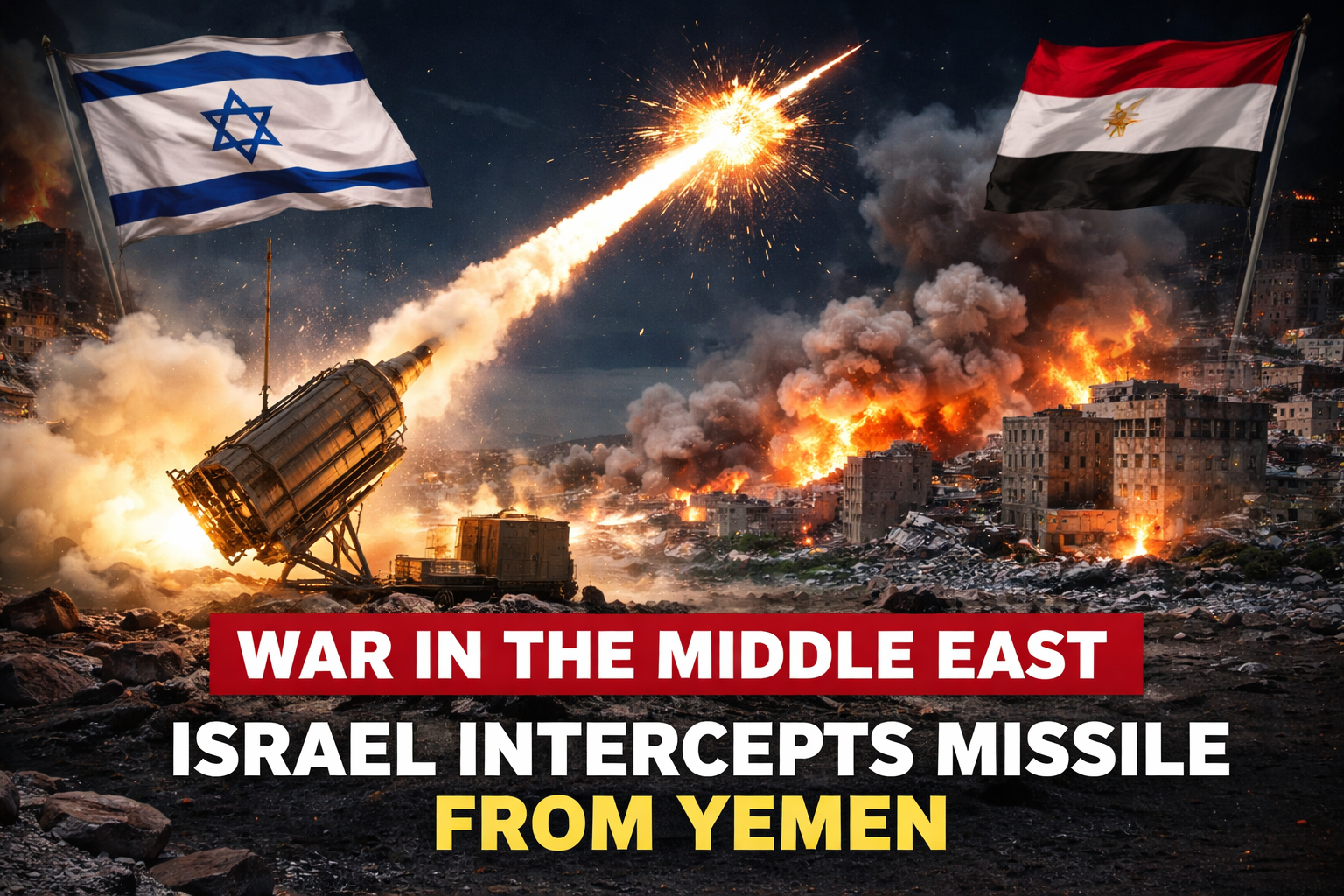
The already intense conflict in West Asia has entered a more dangerous phase as Israel confirmed that it intercepted a missile launched from Yemen. This marks the first time in the current conflict that a projectile has been fired from Yemeni territory toward Israel, signaling a widening of the war beyond its original boundaries.
According to Israeli defense officials, the missile was detected early by the country’s advanced air defense systems and was successfully neutralized before it could cause any damage. While no casualties or destruction were reported, the incident has raised serious concerns about the evolving nature of the conflict.
The attack has been attributed to the Houthi rebels, an Iran-aligned militant group that controls large parts of Yemen. The Houthis later acknowledged their role in the launch, describing it as part of their support for regional allies and opposition to Israeli military actions. Their statement also hinted that such operations could continue if the situation does not de-escalate.
This development is crucial because it adds a new dimension to what was largely seen as a confrontation between Israel and Iran, either directly or through proxies. With Yemen now actively participating, the conflict risks transforming into a broader regional war involving multiple fronts.
Security analysts believe that the Houthis’ involvement is not an isolated move but part of a larger geopolitical alignment. Iran has long been accused of backing the group, and this latest action may reflect coordinated pressure on Israel from different directions. In recent years, the Houthis have developed the capability to launch long-range missiles and drones, making them a significant force despite Yemen’s ongoing internal crisis.
The interception also highlights Israel’s multi-layered defense system, which is designed to handle threats from various directions, including missile and drone attacks. However, experts warn that dealing with simultaneous threats from multiple regions could strain even the most advanced systems over time.
Regionally, the situation is becoming increasingly fragile. Countries across the Middle East are closely monitoring developments, as any further escalation could pull more actors into the conflict. The involvement of non-state groups like the Houthis adds unpredictability, making diplomatic resolution more difficult.
For civilians in affected regions, this escalation brings renewed fear and uncertainty. Air raid sirens, missile interceptions, and rising military activity have become part of daily life in some areas. Meanwhile, global leaders continue to call for restraint, emphasizing the need to prevent a full-scale regional war.
In conclusion, the interception of a missile from Yemen is not just a standalone event—it is a clear indication that the conflict is spreading. With more players entering the battlefield and tensions running high, the coming days will be critical in determining whether the situation can be contained or spirals into a much larger crisis.
"The decisions we make today will shape the world for generations to come."