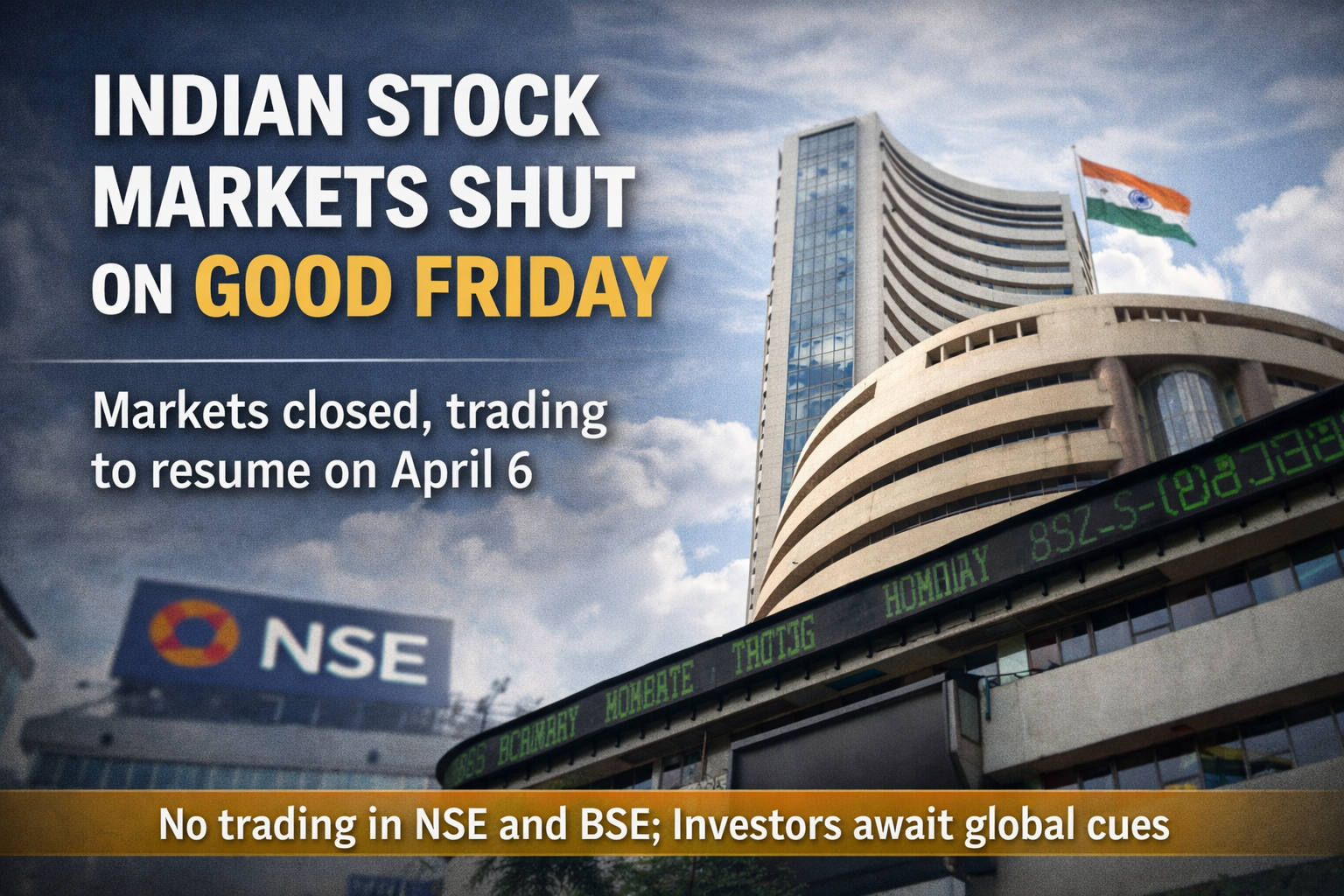
India’s stock markets came to a complete halt on April 3, 2026, as trading was suspended across the country in observance of Good Friday. The closure applied to both major exchanges—the National Stock Exchange (NSE) and the Bombay Stock Exchange (BSE)—bringing all forms of trading activity to a standstill for the day.
This scheduled market holiday affected every segment, including equity markets, derivatives (Futures & Options), currency trading, and commodity exchanges. For a full trading day, investors and traders were unable to execute any transactions, making it a complete pause in domestic financial activity. While such holidays are pre-declared in the stock market calendar, their impact often extends beyond just a day of inactivity.
Good Friday holds religious significance for Christians worldwide, marking the crucifixion of Jesus Christ. In India, it is recognized as a public holiday, which is why financial institutions, including stock exchanges, banking services in many regions, and other official sectors, remain closed. However, what makes this closure particularly noteworthy is not just the holiday itself, but the timing and the broader global context in which it occurs.
Even though Indian markets remain shut, global financial markets—such as those in the United States, Europe, and parts of Asia—may continue trading or react to ongoing developments. This creates a temporary disconnect between domestic and international market activity. During this gap, major global events such as geopolitical tensions, crude oil price fluctuations, inflation data releases, or economic policy announcements can significantly influence sentiment.
For instance, recent volatility in global crude oil prices and ongoing geopolitical tensions in the Middle East have already made investors cautious. If such developments intensify during the holiday, Indian markets may react sharply when they reopen. This often results in what traders call a “gap opening,” where stock indices open significantly higher or lower than their previous closing levels.
From a strategic standpoint, experienced traders usually prepare for such holidays in advance. Many choose to reduce or close short-term positions before the market shuts, especially in volatile conditions, to avoid unexpected losses. On the other hand, long-term investors generally view such breaks as neutral, focusing instead on broader economic fundamentals rather than short-term fluctuations.
Another important aspect is liquidity. A market holiday temporarily reduces trading volume and pauses price discovery, but it does not stop the flow of information. News, earnings updates, and global economic shifts continue to develop, building pressure that gets reflected once trading resumes. This makes the first session after a holiday particularly crucial, as it often sets the tone for the coming days.
Trading in Indian markets is scheduled to resume on Monday, April 6, 2026. Investors will be closely watching global cues, especially movements in international indices, commodity prices, and currency trends. The reopening session could witness heightened volatility depending on the developments that occurred during the break.
In conclusion, while the Good Friday market closure is a routine and predictable event, its implications are far from ordinary. It serves as a reminder that financial markets are deeply interconnected, and even a single day of pause can amplify the impact of global events. For traders and investors alike, such breaks are not just about inactivity—they are about preparation, anticipation, and strategic decision-making in an ever-changing financial landscape.
"The decisions we make today will shape the world for generations to come."