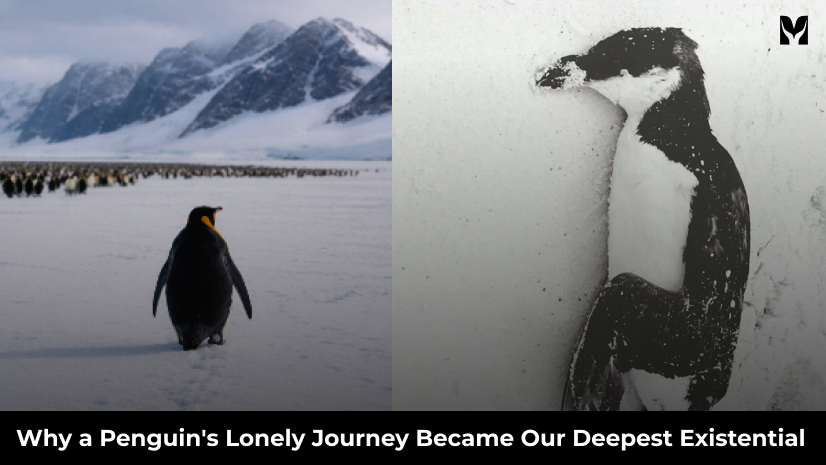
In the vast, silent expanse of Antarctica, a lone figure turns its back on the life-sustaining ocean, on its colony, and on everything it's biologically programmed to do. It begins a quiet, determined march inland, towards what filmmaker Werner Herzog famously described as "certain death." This isn't the opening scene of a new blockbuster; it's a nearly two-decade-old clip that has, in early 2026, inexplicably become the internet's most profound and relatable meme: The Nihilist Penguin.
This humble Adélie penguin, first captured in Herzog's 2007 documentary Encounters at the End of the World, embodies a sentiment so potent that it has transcended its original context, sparking a global conversation about burnout, existential dread, and the quiet refusal to conform.
The Origin Story: Herzog's "Deranged" Vision
Werner Herzog, known for his unique lens on humanity and nature, stumbled upon this enigmatic penguin while filming in Antarctica. Unlike its peers, who instinctively head towards the sea for food and survival, this one penguin chose a different path. It walked, resolutely and alone, inland toward the desolate mountains – a journey of no return, devoid of sustenance or hope.
Herzog's narration of the scene is iconic: he describes the bird as "deranged," an individual seemingly rejecting its very purpose. He muses on the futility of trying to intervene, noting that even if returned to the colony, it would simply turn around and resume its fatal pilgrimage. For years, the clip remained a powerful, if niche, moment in cinematic history. Until now.
Why 2026 Became the Year of the Nihilist Penguin
The sudden resurgence and explosion of the "Nihilist Penguin" meme in January 2026 isn't just a random viral hit; it's a reflection of our collective psychological state.
- The Burnout Antidote: In a world perpetually connected, driven by hustle culture, and demanding constant productivity, the penguin's quiet defiance resonates deeply. It symbolizes the desire to "opt out," to simply walk away from the overwhelming pressures of modern life. For many, its march to nowhere is less about death and more about an escape from the relentless grind.
- Existential Echoes: The internet has rebranded the penguin as a "nihilist" – not because it actively believes in the meaninglessness of existence, but because its actions appear to reject the given meaning of its life (survival, reproduction). This taps into a widespread feeling of existential questioning, especially among younger generations grappling with uncertain futures. "I'm done with this," whispers the penguin, and millions nod in agreement.
- A Symbol of Quiet Quitting and Rebellion: Whether applied to a demanding job, societal expectations, or even personal relationships, the image of the penguin provides a potent visual for "quiet quitting" or a more profound, internal rebellion against imposed norms. It's a testament to the power of a solitary choice, however seemingly irrational.
- The Absurdist Loop: The meme's virality was further amplified by an ill-fated AI-generated image shared by the White House, depicting Donald Trump walking with a penguin toward Greenland. The factual inaccuracy (penguins don't live in the Arctic) only added to the meme's absurdist charm, highlighting how easily narratives can be warped and reinterpreted online.
Science vs. Sentiment: The Real Penguin Story
While we project our deepest anxieties and desires onto the "Nihilist Penguin," the scientific reality is far less philosophical. Zoologists and wildlife experts would likely attribute such behavior to:
- Disorientation: Penguins, like many animals, can become disoriented due to illness, injury, or even geomagnetic disturbances. Their internal "GPS" might simply be malfunctioning.
- Neurological Issues: Brain trauma or disease could lead to confused or self-destructive behaviors.
- Exhaustion or Despair: While anthropomorphic, it's not impossible for an animal to become so weak or distressed that it gives up. However, the "philosophical choice" aspect is purely human interpretation.
Herzog himself, in a follow-up interview, noted that the scientists believed the penguin was "deranged" due to a chemical imbalance or a genetic defect. The poignant, humanistic interpretation was his own.
The Thanatos Connection: A Deeper Dive
Some cultural commentators and psychologists have even drawn parallels between the Nihilist Penguin and Sigmund Freud's concept of Thanatos, the "death drive." This theory posits an unconscious human drive towards an inorganic state, a desire for peace and an end to the tensions of life. In this light, the penguin's march isn't an active pursuit of death, but a cessation of the struggle, a quiet surrender to the elemental silence of the ice.
Ultimately, the Nihilist Penguin is a blank canvas for our collective anxieties. It’s a reflection of a world that feels increasingly overwhelming, where the urge to simply walk away – to embrace a personal "march to nowhere" – becomes a strangely comforting fantasy. Whether it's a cry for help, a rebellion against the mundane, or just a lost bird, its journey has certainly found a home in our hearts, becoming an unlikely icon of our modern existential quandary.
Below is the Instagram Reel link:
"The decisions we make today will shape the world for generations to come."