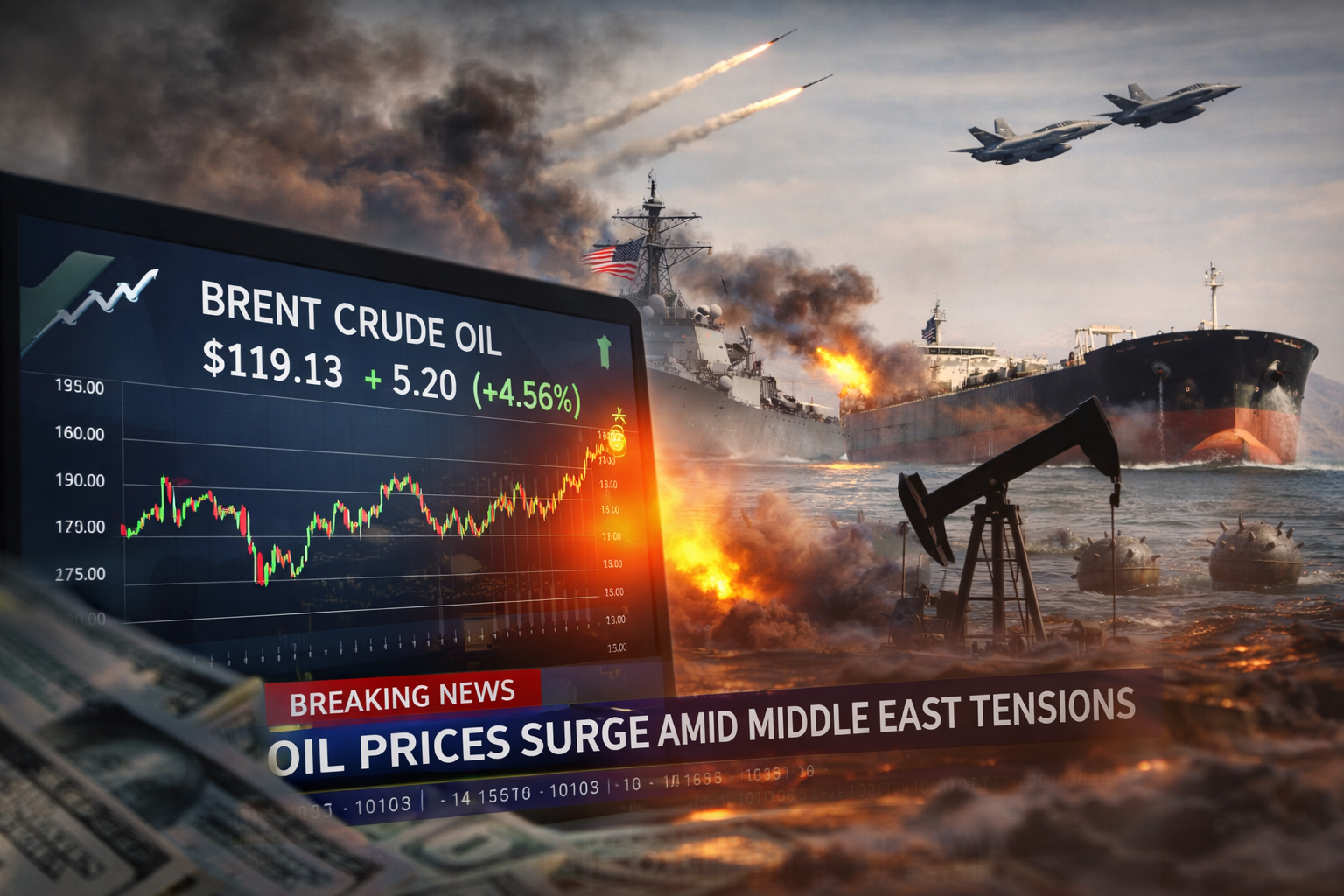
Global financial markets are experiencing significant uncertainty as tensions escalate in the Middle East, particularly around the strategically vital Strait of Hormuz. The situation has raised serious concerns among investors and policymakers because this narrow waterway plays a crucial role in the international oil trade.
The Strait of Hormuz connects the Persian Gulf with the Gulf of Oman and serves as one of the busiest oil shipping routes in the world. Nearly 20 percent of the global oil supply passes through this corridor every day. Any military or political disruption in this area has the potential to affect energy prices and global economic stability.
Recent reports of rising tensions involving Iran and the United States have caused oil markets to react sharply. International crude oil prices initially surged above $110 per barrel, reflecting fears that shipping routes in the region could be disrupted. However, prices later experienced fluctuations as investors responded to diplomatic developments and market speculation.
The volatility in oil prices has also had a direct impact on global stock markets. Major indices in Asia and Europe witnessed fluctuations as investors grew cautious about the potential economic consequences of prolonged geopolitical instability. Energy companies, shipping firms, and aviation sectors are particularly sensitive to changes in crude oil prices, making them among the most affected industries.
In India, financial markets have also felt the ripple effects. The BSE Sensex and the Nifty 50 saw periods of volatility as investors reacted to global developments. Since India imports a significant portion of its crude oil, any rise in international prices can increase import costs and put pressure on inflation.
Analysts believe that the current situation highlights how closely financial markets are tied to geopolitical events. When tensions arise in key energy-producing regions, investors often move toward safer assets such as gold while reducing exposure to riskier markets.
Despite the uncertainty, experts say the long-term impact will depend largely on whether diplomatic efforts can prevent further escalation. If stability returns to the region and oil shipments continue without disruption, markets may gradually stabilize.
For now, financial markets remain on high alert as traders, governments, and energy companies closely monitor developments in the Middle East. The coming weeks will be critical in determining whether the current tensions evolve into a prolonged crisis or ease through international diplomacy.
"The decisions we make today will shape the world for generations to come."