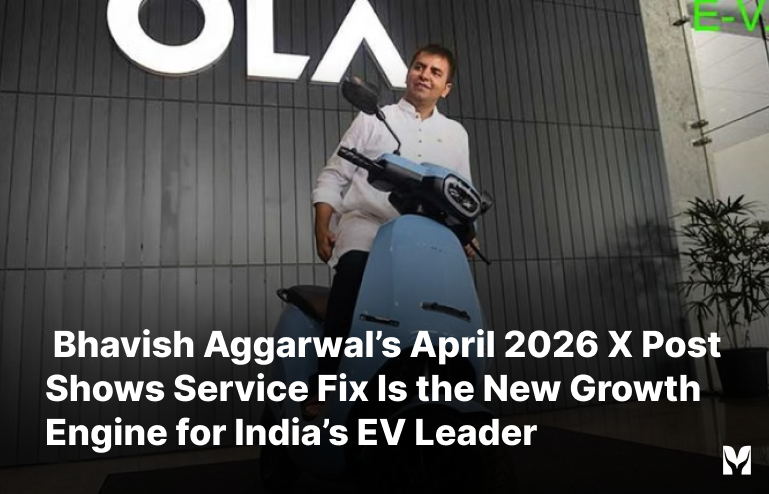
On April 2, 2026, Bhavish Aggarwal, founder and chairman of Ola Electric, posted a 53-second video on X featuring a delighted long-time owner from Karnataka. The customer—standing beside his first-gen Ola S1 Pro that has clocked 83,000 km—praises the product’s reliability, recalls seamless early service, and highlights a smooth upgrade to a Gen-3 model with fast delivery. Aggarwal’s caption is direct and strategic: “As we’re fixing service, great to see genuine customers coming forward and talking about their love for our product. We are making our service as good as our product!”
The timing is no coincidence. Just days earlier, Vahan portal data showed Ola Electric’s March 2026 registrations exploding to 10,117 units—a 150–155% month-on-month rebound from February’s 3,973 units. While the company ranked fifth in the two-wheeler EV segment (behind TVS Motor’s lead), daily orders crossed 1,000 in the final week of March, and cumulative registrations hit one million. Gujarat, the very state that posted a 75% overall EV surge in the same month, contributed meaningfully to this national momentum; its industrial and commuter base has long been fertile ground for affordable electric scooters like Ola’s.
Yet the post isn’t celebrating sales alone. It is a deliberate signal amid a two-year service crisis that Aggarwal himself has publicly acknowledged damaged brand trust. Backlogs once stretched to 14 days; complaints numbered in the tens of thousands monthly. Through the “Hyperservice” overhaul launched in late 2025—closing thousands of small inefficient touchpoints, opening 300+ mega-service hubs, deploying AI diagnostics, retraining technicians, and redesigning parts logistics—Ola has already halved waiting times to 7–8 days and now resolves 80% of tickets on the same day.
The video customer’s story is the proof point Ola wants the market to see: a high-mileage owner who experienced good service early, upgraded seamlessly, and remains loyal. It counters the flood of replies under the same post—many still venting about months-long delays, missing batteries, closed centers, and unresolved job cards. That contrast is telling. Service recovery is real but uneven; trust rebuild takes quarters, not weeks.
Analytically, this moment crystallizes three structural realities for India’s EV sector.
First, product excellence alone no longer wins. Ola’s scooters have always scored on range, design, and price—key reasons Gujarat’s price-sensitive buyers flocked to EVs amid fuel rationing fears in March. But EVs are high-usage assets in a country where daily commutes and small-business logistics dominate. When service fails, total cost of ownership skyrockets. The Hyperservice pivot acknowledges that after-sales is now the primary differentiator, not just the battery or software.
Second, regional surges like Gujarat’s expose the service bottleneck. States seeing 75–111% EV growth are exactly where fleet operators, delivery riders, and daily commuters need vehicles back on the road fast. Ola’s March rebound proves pent-up demand exists; sustained leadership depends on scaling service infrastructure at the same pace as sales. Gujarat’s policy extensions and manufacturing ecosystem give it an edge—Ola must now match that agility locally.
Third, public accountability accelerates execution. Aggarwal’s hands-on X engagement (personally addressing complaints since March) and transparent sharing of customer videos mark a cultural shift. In a market where social media amplifies every delayed repair, turning “genuine customers” into visible advocates builds credibility faster than press releases. It also pressures competitors: TVS, Ather, and Bajaj are watching how quickly Ola converts service metrics into regained market share.
Looking ahead, the next 90 days will be diagnostic. If Hyperservice scales nationally—more technicians, faster spares, consistent 4-hour fixes—Ola’s Q1 FY27 numbers could solidify its rebound and push Gujarat-style surges into other high-potential states. If complaints persist, the trust gap widens and premium pricing power erodes. For investors and policymakers chasing India’s 30% EV target by 2030, the lesson is clear: subsidies and fuel shocks spark adoption; flawless service sustains it.
Ola’s April 2 post isn’t spin—it’s a progress report from the front line of India’s EV maturity curve. The product was never the issue. Making service match it is the real revolution. And in a market where Gujarat just proved scale is possible, the companies that fix service fastest will own the decade ahead.
"The decisions we make today will shape the world for generations to come."