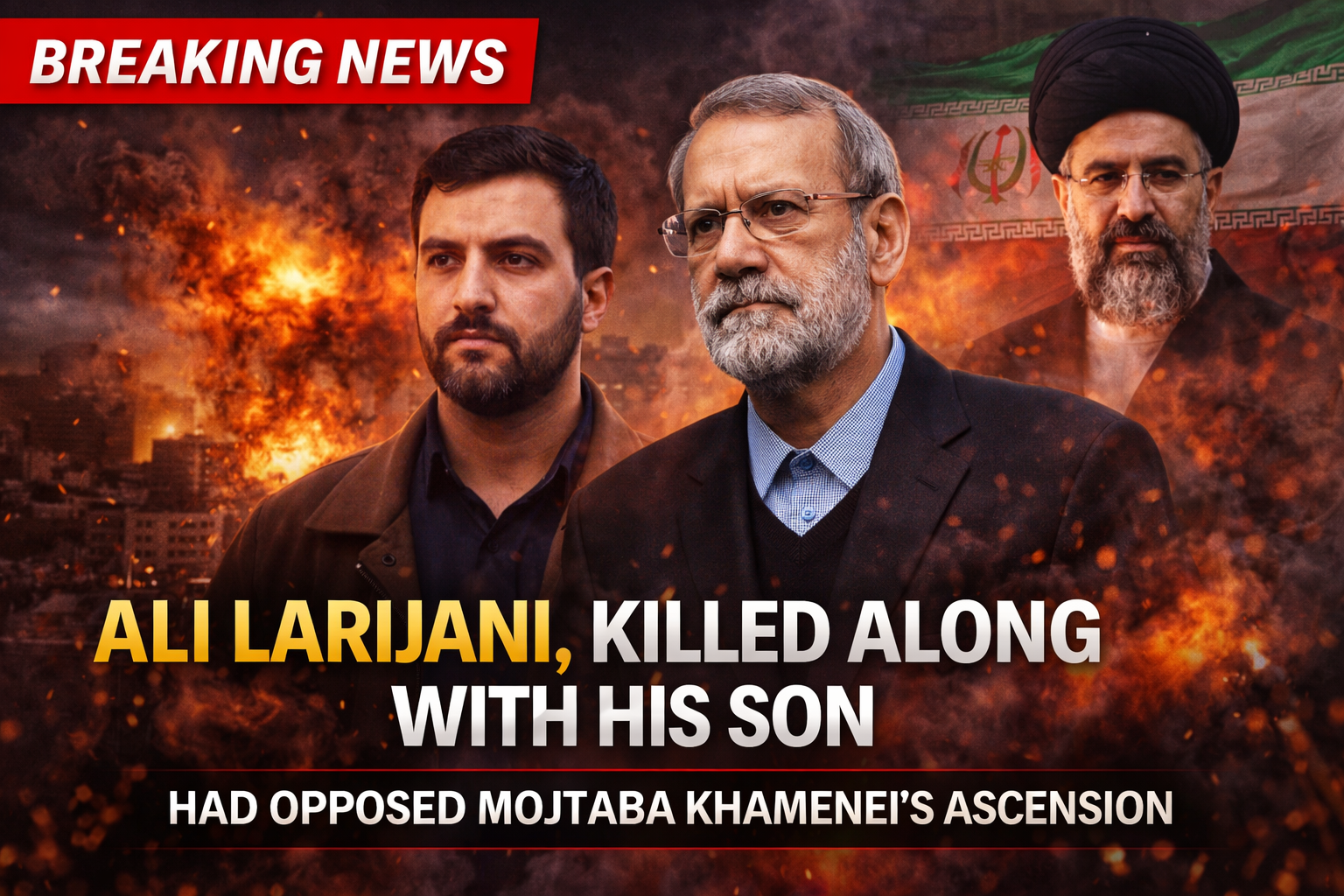
The reported killing of Ali Larijani along with his son has not only intensified the external conflict surrounding Iran, but has also drawn renewed attention to the country’s internal political landscape. As one of Iran’s most prominent and experienced political figures, Larijani’s absence is expected to have far-reaching implications.
Larijani, who held several key positions over the years, was widely regarded as a pragmatic voice within Iran’s political system. His influence extended across both legislative and strategic domains, making him a significant player in shaping national policy. His sudden death, therefore, represents more than a personal loss—it marks a critical moment for Iran’s leadership structure.
Recent discussions in political circles have pointed to Larijani’s reported reservations regarding the potential rise of Mojtaba Khamenei, a figure often speculated to be a future successor within the country’s power hierarchy. While such claims remain part of broader analysis rather than officially confirmed positions, they have added a new dimension to the narrative surrounding Larijani’s death.
The timing of the incident is particularly significant. As Iran navigates heightened tensions with external adversaries, internal cohesion becomes increasingly vital. The removal of a senior leader—especially one perceived as an independent or moderating influence—could alter the balance within decision-making circles. It may also reduce the diversity of viewpoints at a time when strategic clarity is crucial.
Observers note that leadership transitions in Iran are often complex, shaped by a mix of institutional structures, political alliances, and informal influence networks. In this context, Larijani’s death could potentially ease the path for emerging figures, while simultaneously narrowing the space for dissenting or alternative perspectives.
At the same time, the loss of both Larijani and his son underscores the personal cost of the ongoing crisis. Beyond geopolitical calculations and political analysis, the incident reflects the human dimension of conflict—where leadership, legacy, and family intersect in moments of profound uncertainty.
As developments continue to unfold, attention will remain focused not only on Iran’s external posture but also on how its internal political framework adapts to this sudden and significant change. Whether this moment leads to consolidation of power or triggers further debate within the establishment remains an open question.
"The decisions we make today will shape the world for generations to come."