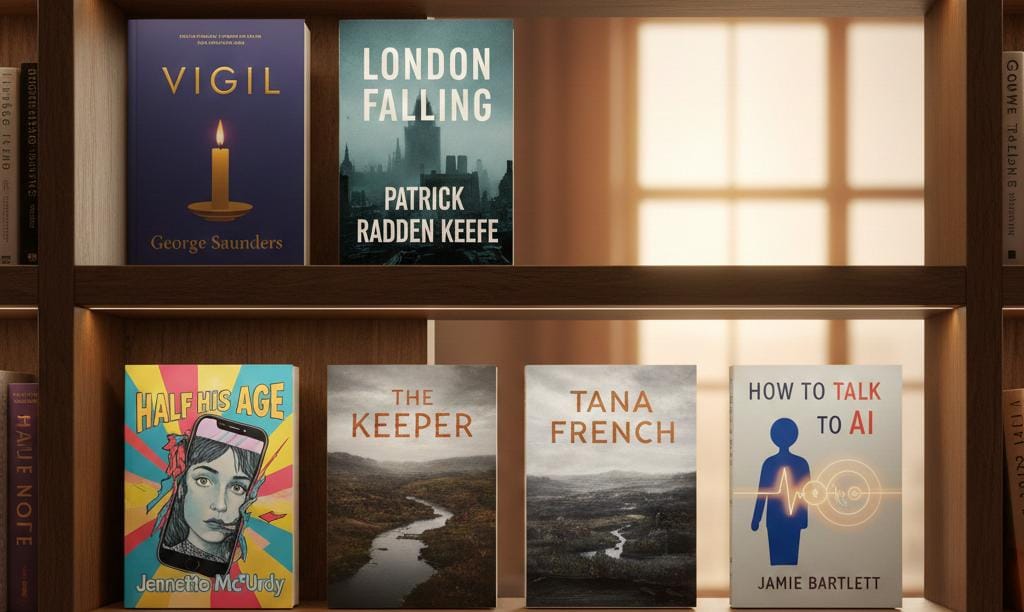
As we move further into 2026, the literary landscape is proving to be a masterclass in emotional depth and technical innovation. This year, we are seeing a profound shift toward stories that explore the intersections of legacy, technology, and the raw human experience.
From the return of Booker Prize winners to memoirs that redefine celebrity narratives, 2026 is a year for the "deep dive"—books that demand your attention and reward you with a new perspective on the world.
1. Vigil: A Novel
A Journey Through the Twilight of Life and the Great Beyond
George Saunders, the Booker Prize-winning author of Lincoln in the Bardo, returns with what is arguably his most ambitious work yet. Vigil takes place over a single night at the bedside of a dying oil tycoon. However, in classic Saunders fashion, the narrative doesn't stay confined to the room. Instead, it expands into a surreal, kaleidoscopic exploration of the protagonist’s consciousness as he is ferried from this world into the next.
The novel balances biting satire of corporate greed with a tender, almost spiritual examination of what it means to leave a legacy. Saunders uses his signature polyphonic style—giving voice to the ancestors, regrets, and forgotten joys that haunt the tycoon’s final hours. It is a haunting yet hopeful read that asks: In the end, what part of us truly remains?
2. London Falling: A Mysterious Death in a Gilded City
A Family's Search for Truth Amidst Oligarchs and Shadows
Patrick Radden Keefe has built a reputation as the modern master of narrative non-fiction (Empire of Pain, Say Nothing). In London Falling, he turns his investigative lens toward the sudden, mysterious death of a 19-year-old boy from a prominent family. What begins as a tragic accident quickly unravels into a sprawling web of international intrigue, involving Russian oligarchs, London’s "dirty money" real estate market, and the secret life the young man was leading.
Keefe’s prose is as sharp as ever, blending the pacing of a high-stakes thriller with the meticulous research of a veteran journalist. It is a devastating portrait of how the ultra-wealthy can bend reality to their will, and the grueling cost of seeking justice in a city where everything—and everyone—has a price.
3. Half His Age
A Daring Debut Novel on Desire, Loneliness, and the Internet
Following the record-breaking success of her memoir I’m Glad My Mom Died, Jennette McCurdy makes her fiction debut with Half His Age. The novel centers on a teenage girl navigating a world of consumerism and digital intimacy, struggling to find a sense of self in a culture that treats young women as commodities.
McCurdy’s transition to fiction is seamless. She retains the dark humor and unflinching honesty that made her memoir a sensation, but applies it to a broader social critique. The book explores the "misguided lengths" people go to for intimacy in an age of isolation. It’s a raw, funny, and at times uncomfortable mirror held up to Gen Z and the platforms that shape them.
4. The Keeper
The Final Chapter of the Cal Hooper Trilogy
Tana French, the "queen of Irish noir," concludes her celebrated trilogy featuring retired Chicago detective Cal Hooper. Set in the brooding, atmospheric village of Ardnakelty, The Keeper finds Cal investigating the death of a young woman found in a local river.
The strength of this novel—and the trilogy as a whole—is the tension between Cal’s desire for a quiet life and the inescapable pull of his moral duty. French excels at "slow-burn" tension, where the danger often comes from long-held local feuds and the suffocating weight of tradition rather than a shadowy villain. It is a masterful exploration of community, secrets, and the impossibility of truly escaping one’s past.
5. The Meaning of Your Life
A Plan to Discover Purpose in an Era of Distraction
Arthur C. Brooks, the social scientist and New York Times columnist, delivers a definitive guide to finding purpose in 2026. Building on his work regarding "second-half-of-life" success, Brooks argues that the modern world is designed to make meaning difficult to find.
The book combines cutting-edge neuroscience with ancient philosophical wisdom to provide a roadmap for readers feeling "stuck" in the treadmill of achievement. It’s not just about being happy; it’s about being useful and connected. In a year where AI and automation are changing the nature of work, Brooks’ focus on human-centric purpose is both timely and essential.
6. Kin
Two Friends, One Tragedy, and the Strength of Shared History
Tayari Jones (An American Marriage) returns with a story that "sparkles with wit and deep feeling." Kin follows two lifelong friends whose paths diverged decades ago, only to be brought back together by a devastating tragedy in their hometown.
Jones is a master of the "interior life," and in Kin, she explores the nuances of Black friendship and the complex ties that bind people to the places they tried to leave behind. The novel is a sweeping journey through history and memory, proving once again that Jones is one of the most vital voices in American literature today.
7. How to Talk to AI (and How Not To)
Navigating the Human-Machine Frontier
As Artificial Intelligence becomes an invisible fabric of daily life, Jamie Bartlett offers a crucial "manual for the new world." This isn't a technical guide on coding; it's a sociological look at how our communication styles are changing.
Bartlett explores the psychological effects of interacting with non-human entities and warns against the "de-skilling" of human empathy. He provides practical frameworks for maintaining agency in a world of algorithms, making this the "must-read" non-fiction title for anyone looking to stay human in a digital-first era.
Why These Books Matter Now
The common thread through the "Must-Reads" of 2026 is authenticity. Whether it is George Saunders exploring the authenticity of the soul or Jamie Bartlett looking at the authenticity of our speech, these authors are responding to a world that feels increasingly fragmented.
Reading in 2026 isn't just a pastime; it’s a way to reclaim our focus and reconnect with the narratives that make us human.
"The decisions we make today will shape the world for generations to come."