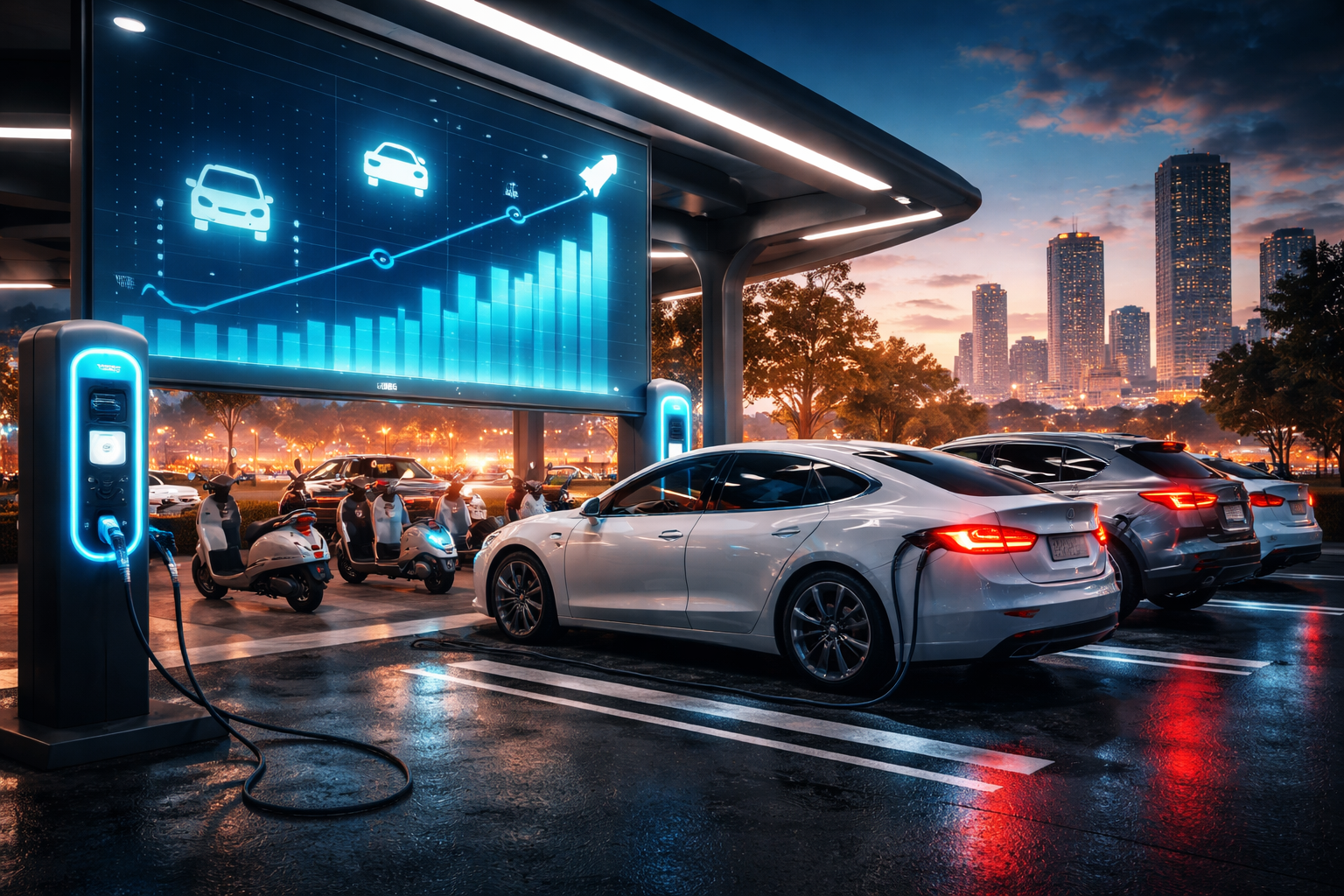
The global electric vehicle (EV) industry in 2026 is no longer just about rapid growth—it is about stability, strategy, and survival. While countries like India are witnessing strong expansion, global markets are entering a phase of correction after years of aggressive optimism.
This contrast is shaping what experts now call the “second phase of the EV revolution.”
India’s EV Market: Growth Engine of the Future
India has emerged as one of the fastest-growing EV markets globally, driven by affordability, policy support, and rising fuel costs.
One of the biggest highlights comes from the electric two-wheeler segment. According to recent reports, India recorded 1.39 lakh EV two-wheeler sales in March 2026, contributing to a 17% year-on-year growth in FY26.
This surge is not accidental—it reflects a deeper shift in consumer behavior. Electric scooters and bikes have become the entry point for EV adoption, especially in urban and semi-urban areas.
At the same time, India is preparing for a massive product expansion cycle, with nearly 30 new EV models expected to launch in 2026.
From affordable hatchbacks to premium SUVs, automakers are betting big on electrification. New launches and testing—such as upcoming electric SUVs tailored for Indian roads—highlight how global players are localizing their strategies.
Infrastructure is also catching up. India’s public EV charging network has expanded rapidly, growing to over 26,000 stations, a nearly fivefold increase in just a few years.
Despite this growth, industry leaders admit that EV adoption in India is still largely policy-driven rather than demand-driven, with government incentives playing a key role.
Global EV Market: A Reality Check Phase
While India accelerates, the global EV market is experiencing a slowdown.
In early 2026, global EV sales declined by around 3% year-on-year, signaling the first signs of demand fatigue after years of exponential growth.
The reasons are clear:
- Reduction in government subsidies
- High upfront costs of EVs
- Slower-than-expected charging infrastructure expansion
Major automakers are now reassessing their strategies. Some companies are delaying EV launches, while others are shifting focus toward hybrid vehicles to balance profitability and sustainability.
However, this slowdown is not a collapse—it is a market correction.
China’s Dominance Reshaping the Global Market
China continues to lead the global EV race, not just in production but in exports.
Leading manufacturer BYD has significantly increased its global ambitions, with overseas sales expected to hit 1.5 million units in 2026, even surpassing domestic sales for the first time.
Chinese EV makers are leveraging:
- Lower production costs
- Strong battery supply chains
- Aggressive international expansion
This has intensified competition in Europe, Asia, and emerging markets like India.
External Factors Driving EV Demand
Interestingly, global events are also influencing EV adoption.
In Europe, rising fuel prices—triggered by geopolitical tensions—have led to a surge in EV demand, especially in the used vehicle segment. Reports indicate that used EV sales nearly doubled in March 2026, as consumers looked for cost-effective alternatives to petrol cars.
This highlights a key insight:
- EV adoption is no longer just environmental—it is economic.
Investment vs Caution: Industry at a Crossroads
Despite short-term challenges, long-term confidence in EVs remains strong.
The global EV market is projected to reach $459 billion in 2026, with steady growth expected in the coming years.
At the same time, companies are becoming more cautious:
- Investments are more targeted
- Focus is shifting to profitability
- Hybrid strategies are gaining importance
Even traditionally conservative automakers are now investing heavily in EV infrastructure and production, signaling that electrification is inevitable—but evolving.
Key Challenges Ahead
Despite momentum, several challenges remain:
- ⚡ High upfront cost of EVs
- 🔌 Charging infrastructure gaps
- 🔋 Battery technology limitations
- 📉 Declining subsidies globally
These factors will determine how quickly EVs transition from early adoption to mass adoption.
The Road Ahead: What to Expect
The EV market in 2026 is entering a mature phase:
- India will likely become a global EV growth hub, especially in two-wheelers
- China will continue to dominate global supply chains
- Global markets will stabilize before the next growth wave
- Innovation in batteries and charging will define the next breakthrough
Experts believe EVs could account for over 27% of global vehicle sales in 2026, marking a significant shift toward electrification.
Conclusion
The EV revolution is no longer about hype—it’s about execution.
India is accelerating, the world is recalibrating, and companies are adapting to a new reality. The transition to electric mobility is still inevitable—but the journey will be slower, smarter, and more competitive than expected.
"The decisions we make today will shape the world for generations to come."