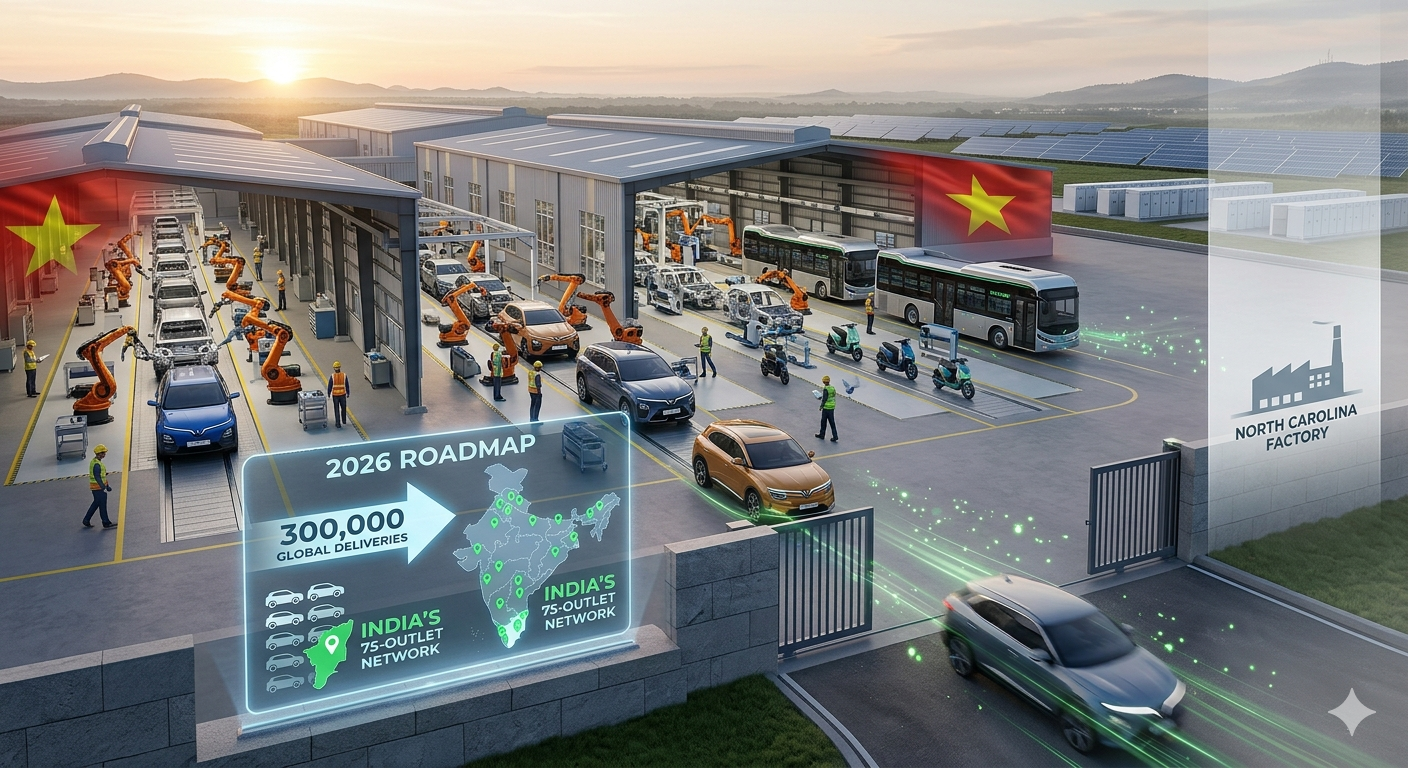
As April 2026 unfolds, VinFast is operating at full throttle—but the engine is running hot. The Vietnamese automaker just posted its full-year 2025 results: roughly 197,000 EV deliveries (beating internal targets), yet a staggering full-year net loss approaching $3.9–4 billion, including a $235 million impairment charge tied to its troubled North Carolina project. Q4 alone saw a $1.34 billion loss, driven by sales incentives, expansion costs, and slower-than-hoped U.S. traction.
Break-even has now been pushed beyond 2027. Yet leadership is unapologetic: they’ve set an ambitious 300,000 global EV delivery target for 2026—roughly 52% growth—and aim to ship at least 2.5 times more electric two-wheelers than in 2025. The message is clear: volume first, profitability later, with Asia (not the West) as the primary battlefield.
At the heart of this strategy sits India—the market where VinFast’s bets feel most tangible and timely. The company’s 400-acre Thoothukudi plant in Tamil Nadu, completed in record time, already assembles VF6 and VF7 SUVs locally with an initial 50,000-unit capacity that can scale to 150,000. A fresh $500 million commitment (part of a $2 billion total India pledge) is now earmarked to add dedicated lines for electric buses and e-scooters by mid-2026. This isn’t just manufacturing; it’s ecosystem building—localization talks for batteries are underway, charging infrastructure is being rolled out with partners like HPCL, and a circular battery value chain is in motion.
Retail is accelerating in lockstep. VinFast opened its 50th showroom (a flagship 3S facility) in Bengaluru just weeks ago and has committed to 75 outlets across 60 cities by year-end—pushing deep into Tier-3 and Tier-4 markets where price-sensitive buyers and fleet operators live. Three new passenger models are confirmed for India in 2026: the Limo Green seven-seater MPV (targeting families and corporates, arriving early in the year), the affordable VF3 micro-EV, and likely the VF5 hatchback. Electric buses are slated for August rollout, with active discussions for fleet orders from states including Tamil Nadu, Maharashtra, Uttar Pradesh, Andhra Pradesh, and Telangana. Battery-swapping e-scooters (Evo, Feliz II, Viper, and Flazz) are also entering the mix as part of a broader ASEAN scooter offensive.
This India blitz isn’t happening in isolation. Globally, VinFast has restructured its portfolio into three clear lanes: volume-driven VF models, commercial/fleet-focused offerings (Limo Green, VF MPV 7), and an ultra-luxury Lac Hong sub-brand anchored by the new 800S and 900S flagships (unveiled March 2026, launches targeted for 2027). Next-generation VF6 and VF7 platforms arrive in H2 2026 with simplified architecture and fewer components to drive down bill-of-materials costs. AI-powered manufacturing and automation are central to the profitability playbook.
Meanwhile, the U.S. story has been quietly recalibrated. Construction on the North Carolina plant resumes this year, but the scope is dramatically smaller: ~1,400 jobs instead of 7,500, a phased 780,000 sq ft footprint, and production delayed to 2028. The move reflects capital discipline after heavy 2025 losses and a U.S. EV market that remains price- and incentive-sensitive.
Analytically, VinFast’s 2026 playbook reveals three structural bets worth watching.
First, Asia-centric volume is the near-term lifeline. Emerging markets like India, Indonesia, Philippines, Thailand, and Malaysia offer lower barriers, supportive policies, and massive two-wheeler/fleet demand—exactly the segments where VinFast’s scooter and MPV launches align. India’s recent EV surge (Gujarat’s 75% jump in March being a prime example) plays directly into this: local manufacturing, aggressive distribution, and ecosystem plays can compress total-cost-of-ownership advantages faster than in saturated Western markets.
Second, cost discipline is now non-negotiable. The shift to next-gen platforms, localization, and AI manufacturing isn’t marketing spin—it’s survival math. With losses mounting and investor patience thinning, every rupee or dong shaved from unit costs buys runway for the 300,000-unit ramp. The Lac Hong luxury halo may help brand prestige, but real scale will come from the affordable end of the lineup.
Third, execution risk is concentrated in India and timing. VinFast has moved with impressive speed on factory and dealer rollout, but delivering consistent quality, service networks, and battery infrastructure across 60+ Indian cities while scaling production will test the organization. Competition from Tata, MG, BYD, and Ola is intensifying; customers will judge on real-world range anxiety, resale value, and after-sales—not just sticker price.
If VinFast nails the India ramp—hitting 75 outlets, localizing components, and delivering those three new models on schedule—2026 could mark the inflection where international sales (currently just ~11% of total) finally contribute meaningfully. Failure to convert ambition into profitable volume, however, risks further dilution and delayed break-even. For India’s EV ecosystem chasing 30% penetration by 2030, VinFast’s factory and bus/scooter push could accelerate localized supply chains and fleet electrification—provided the company delivers on its ecosystem promises.
In the end, VinFast’s 2026 story is less about surviving the losses and more about proving that disciplined, Asia-first scaling can still rewrite the global EV script. The numbers are ambitious, the risks real, but the focus on India feels like the sharpest arrow in their quiver right now.
Disclaimer: This article is based on publicly available company announcements, financial reports, and news coverage as of April 2, 2026. EV delivery targets, financial projections, manufacturing timelines, and market expansion plans are subject to revision due to economic conditions, supply-chain variables, regulatory changes, and competitive dynamics. The content is for informational and analytical purposes only and does not constitute financial, investment, or purchase advice. Readers should consult official VinFast disclosures, regulatory filings, and qualified professionals before making decisions related to electric vehicles or associated markets.
"The decisions we make today will shape the world for generations to come."