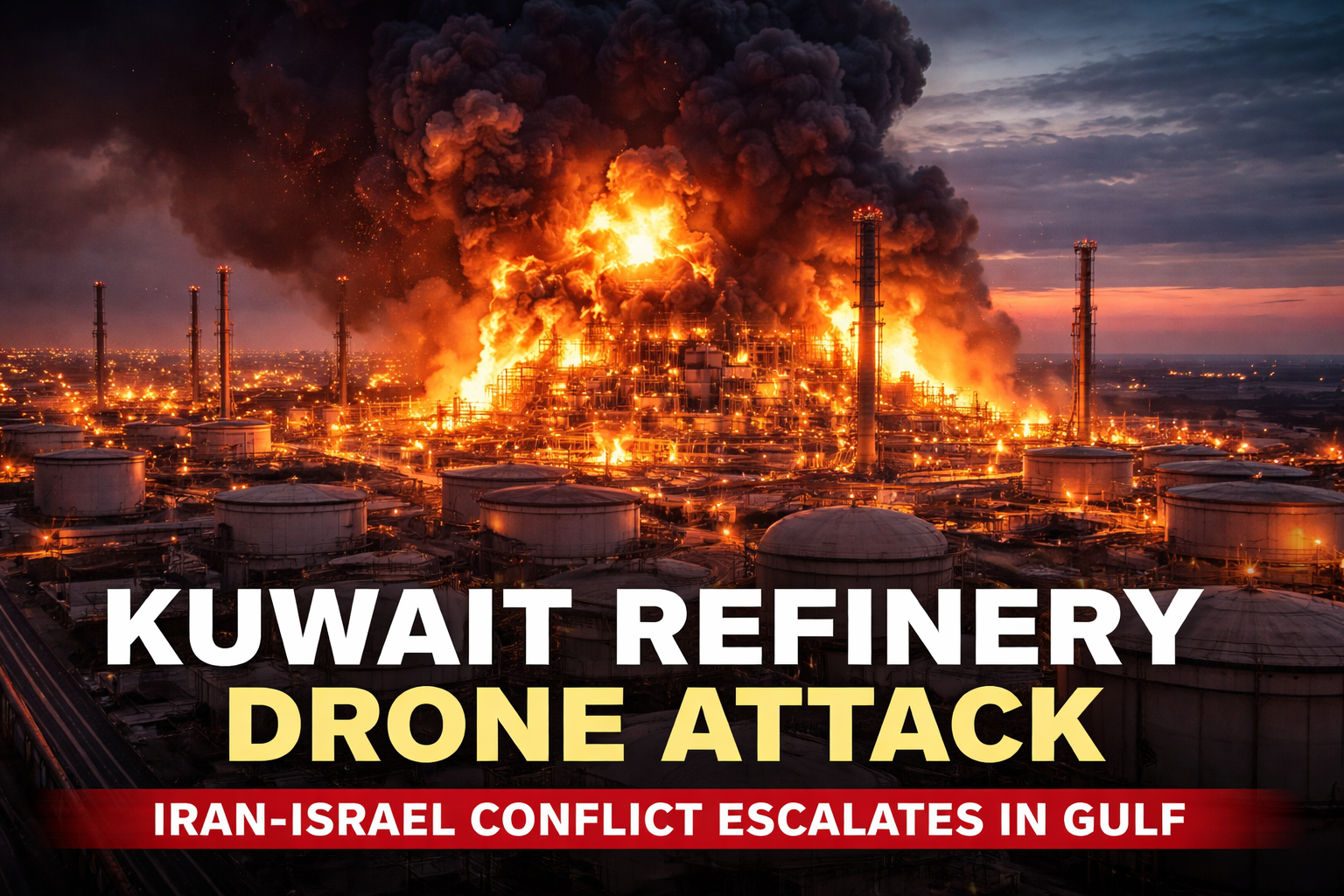
The ongoing conflict between Iran and Israel has taken a troubling new turn, as a major oil refinery in Kuwait came under a drone attack, triggering a fire and raising serious concerns about the widening scope of the war. The targeted facility, Mina Al-Ahmadi Refinery, is one of the largest and most strategically significant oil processing centers in the region.
According to initial reports, drones struck parts of the refinery, leading to an outbreak of fire within the complex. Emergency response teams were quickly deployed, and while the blaze was brought under control, the incident has heightened tensions across the Gulf. Fortunately, there have been no confirmed reports of casualties so far, but the psychological and economic impact is already being felt.
This strike is being viewed as part of a broader escalation pattern in the Iran–Israel conflict. What initially began as targeted military exchanges has now expanded into attacks on critical infrastructure, particularly energy assets. Analysts suggest that such moves are intended to disrupt economic stability and send strong geopolitical signals beyond the immediate battlefield.
The involvement of a Gulf nation like Kuwait marks a significant shift. Traditionally seen as relatively insulated from direct confrontation, Kuwait now finds itself exposed to the spillover effects of a rapidly intensifying conflict. The attack also underscores the vulnerability of oil infrastructure in the region, which plays a crucial role in maintaining global energy supplies.
From a global perspective, the implications are substantial. Any disruption to major oil facilities in the Gulf can lead to volatility in international markets. With energy demand already under pressure, such incidents could trigger price spikes and economic uncertainty far beyond the Middle East.
Moreover, the repeated use of drone technology in these strikes highlights a changing nature of warfare—one that is less predictable and more difficult to defend against. This raises questions about the preparedness of nations to protect critical assets against evolving threats.
As diplomatic efforts struggle to keep pace with military developments, the risk of further escalation remains high. The attack on the Mina Al-Ahmadi refinery is not just an isolated incident—it is a signal that the conflict is entering a more dangerous and expansive phase.
"The decisions we make today will shape the world for generations to come."