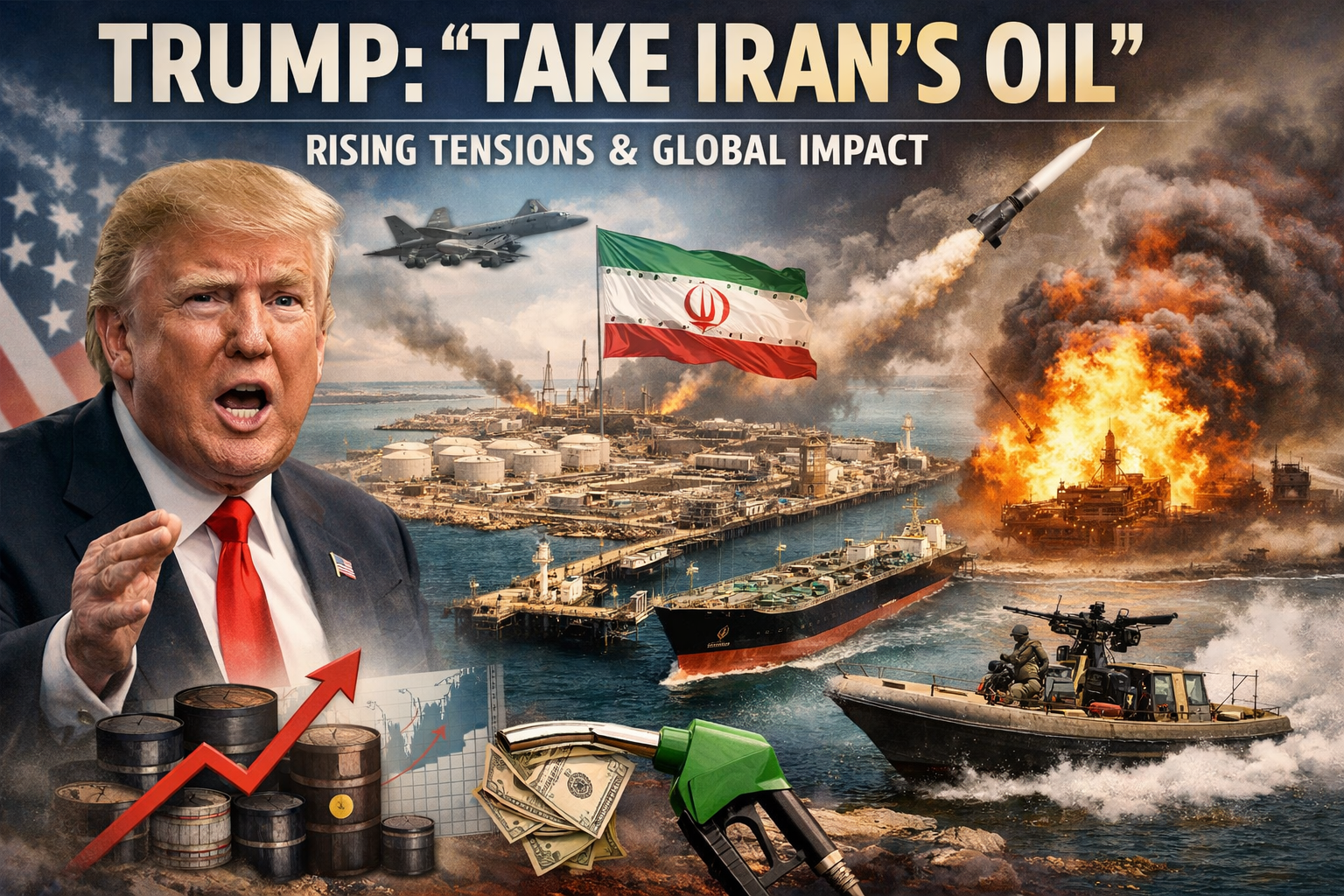
In a statement that has stirred global debate, former U.S. President Donald Trump suggested that the United States could potentially “take Iran’s oil.” The remark comes at a time when tensions in the Middle East are already high, especially involving Iran and its strategic oil infrastructure.
At the center of this discussion lies Kharg Island, a crucial hub responsible for the majority of Iran’s oil exports. Any threat to this location is not just a regional concern but a matter of global significance, as it directly impacts energy supply chains across continent
Understanding the Statement
Trump’s comment is widely interpreted as a signal of aggressive geopolitical strategy rather than a formal policy plan. The idea of “taking oil” implies a potential military intervention or control over critical oil-producing assets. However, such a move would be unprecedented in modern international relations and would likely be considered a violation of global laws and sovereignty.
Can the U.S. Actually Do This?
While the United States possesses one of the world’s most powerful militaries, executing such an operation is far more complex than it sounds. Capturing an oil facility like Kharg Island would not only require significant military resources but also long-term control and defense against retaliation.
Iran is known for its strong regional influence and missile capabilities. Any direct action could trigger a wider conflict, potentially involving neighboring countries and disrupting the already fragile balance in the region.
Global Consequences
If tensions escalate further, the impact would be felt worldwide:
Oil Prices Surge: Any disruption in Iran’s oil exports could push global crude prices even higher, affecting fuel costs in countries like India.
Economic Uncertainty: Rising energy costs can lead to inflation, slower growth, and volatility in financial markets.
Risk of War: A direct confrontation could evolve into a broader regional or even international conflict.
Strategic Pressure or Real Threat?
Many analysts believe that Trump’s statement may be more about strategic pressure than immediate action. Such rhetoric can be used to send a strong message, influence negotiations, or assert dominance without engaging in actual conflict.
However, even words at this level carry weight. In a region as sensitive as the Middle East, statements from influential leaders can quickly escalate tensions and create uncertainty in global markets.
"The decisions we make today will shape the world for generations to come."