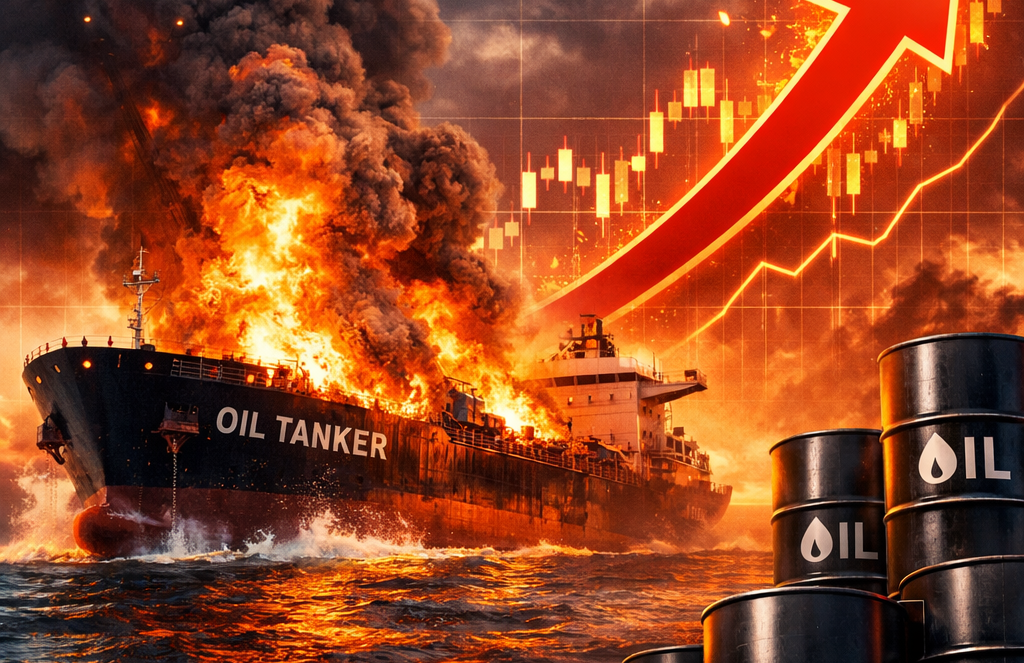
A Sudden Shock to Global Energy Markets
Global oil markets were shaken this week after reports emerged that two international oil tankers were attacked in Iraqi waters, triggering fears of a major supply disruption. The attacks occurred near key oil shipping routes in the Persian Gulf, one of the most important regions for global energy transport.
Following the incident, oil prices surged sharply as traders reacted to the risk of reduced supply and rising geopolitical tensions.
Oil Prices Jump Toward $100
After the attacks, benchmark crude prices rose significantly:
- Brent crude climbed close to $100 per barrel.
- West Texas Intermediate (WTI) surged above $92 per barrel.
In some early trading sessions, oil prices jumped more than 6% in a single day, reflecting panic in energy markets and fears that further attacks could disrupt shipping lanes.
Such sharp moves are rare and typically occur only when markets fear major disruptions to global supply.
Why the Tanker Attacks Matter
The Middle East plays a critical role in global energy supply. A large share of the world's crude oil moves through the Persian Gulf and the Strait of Hormuz, a narrow waterway that carries roughly 20% of global oil supply.
Any attack on tankers or energy infrastructure in this region can quickly cause panic in markets because:
- Shipping routes may become unsafe
- Insurance costs for oil tankers increase dramatically
- Countries may halt exports temporarily
In this case, authorities even halted some oil terminal operations in Iraq after the tanker attacks, adding further pressure on supply.
War and Geopolitical Tensions Behind the Spike
The tanker attacks come amid rising tensions involving Iran, Israel, and the United States, which has intensified fears of a wider regional conflict.
Energy analysts warn that if the conflict expands, it could:
- Reduce oil production in the Middle East
- Block major shipping routes
- Trigger a global energy crisis
Some countries have already begun cutting oil output, further tightening supply and pushing prices upward.
Impact on Global Economy
Higher oil prices affect nearly every part of the global economy. If the surge continues, it could lead to:
- Higher fuel prices worldwide
- Increased inflation
- Higher transportation costs
Rising prices for food and goods
For oil-importing countries like India, a sustained spike in crude oil prices could increase the country’s import bill and put pressure on government finances.
What Investors Are Watching Now
Energy markets are closely monitoring several key developments:
- Whether more tanker attacks occur
- Possible military escalation in the Middle East
- Emergency oil reserve releases by major economies
- Production decisions by major oil producers
Analysts say oil markets could remain extremely volatile in the coming weeks as geopolitical tensions continue to unfold.
Conclusion
The tanker attacks near Iraq have triggered one of the most dramatic oil price jumps in recent months. With crude prices approaching $100 per barrel again, global markets are now on edge.
If tensions continue to escalate in the Middle East, the world could face higher energy prices, increased inflation, and renewed uncertainty in financial markets.
"The decisions we make today will shape the world for generations to come."