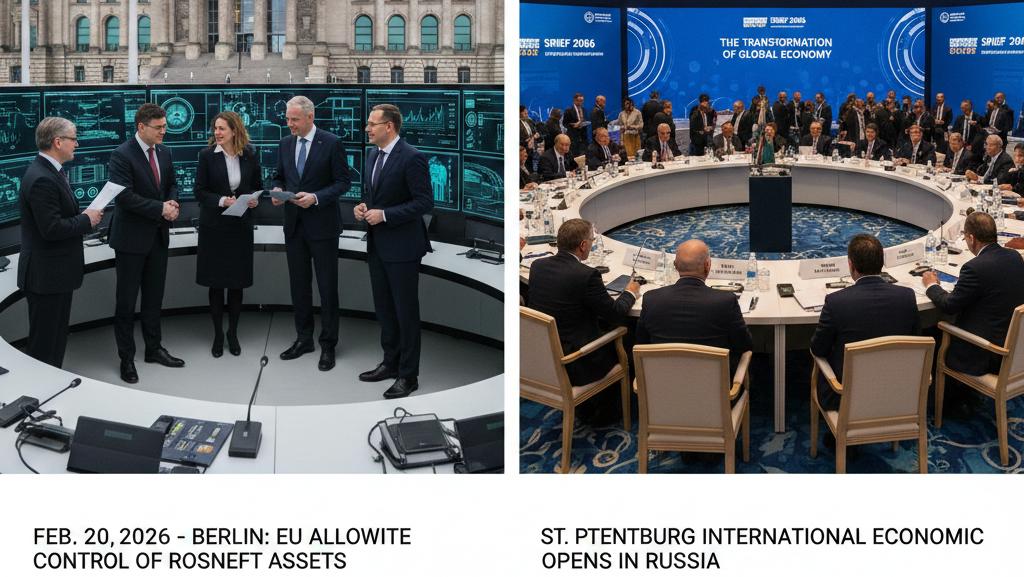
The tectonic plates of European energy security and Russian economic diplomacy shifted in opposite directions. In Brussels, the European Commission granted Germany the legal authority to transition from temporary oversight to long-term "indefinite" control over Russian-owned oil assets. Simultaneously, in the frost-nipped halls of the ExpoForum, the St. Petersburg International Economic Forum (SPIEF) 2026 officially opened its doors, signaling Russia’s finalized pivot away from Western markets toward an intensified partnership with the "Global South."
Berlin’s Strategic "Indefinite" Trusteeship
For nearly four years, the German government has operated under a cloud of administrative uncertainty regarding the PCK Schwedt, MiRo, and Bayernoil refineries. These assets, primarily owned by the Russian state-giant Rosneft, were placed under the trusteeship of the Federal Network Agency in 2022 following the invasion of Ukraine.
Until today, Berlin was forced to renew this status every six months—a bureaucratic "groundhog day" that left investors wary and the supply chains for Berlin’s fuel and the capital’s international airport in constant legal limbo.
The New Legal Framework
The EU’s decision today removes the sunset clause. By authorizing an "indefinite trusteeship," the European Commission has provided Germany with a structural solution that effectively strips Rosneft of its voting rights and operational influence without technical expropriation.
* Asset Breakdown:
* PCK Schwedt: The crown jewel, supplying 90% of Berlin’s fuel.
* MiRo (Karlsruhe) & Bayernoil: Critical nodes in Southern Germany’s industrial heartland.
* The Stake: Rosneft holds a 54.17% majority in Schwedt, which will now be managed by German administrators for the foreseeable future.
This move is a masterstroke of legal engineering. By avoiding outright nationalization, Berlin sidesteps immediate multi-billion-euro compensation claims while ensuring that the refinery—which now processes a blend of Kazakh crude and sea-borne oil via Rostock—remains shielded from Russian interference.
SPIEF 2026: Russia’s New Economic Frontier
While Berlin was cementing its energy independence, St. Petersburg was showcasing its own version of "sovereign economics." The 2026 St. Petersburg International Economic Forum opened today with a distinctively different guest list than in decades past.
Once known as the "Russian Davos," where CEOs from Shell, BP, and Goldman Sachs rubbed shoulders with the Kremlin, SPIEF 2026 has fully embraced its role as the hub for the BRICS+ era.
Key Themes: Technological Sovereignty and New Currencies
The central theme of this year's forum—"The Transformation of the Global Economy: Building New Financial Models"—reflects Russia's drive to insulate itself from the very Western legal systems that allowed Berlin to take control of Rosneft's assets.
> "We are no longer knocking on the door of a house where we aren't welcome," noted a senior Russian official during the opening panel. "We are building a new house with our partners in Riyadh, New Delhi, and Beijing."
>
Saudi Arabia serves as the primary "Guest Country" for 2026, marking the 100th anniversary of diplomatic ties. The presence of a massive Saudi delegation underscores a shared interest in managing global oil prices through the OPEC+ framework, even as Russia's traditional European infrastructure is dismantled.
The Divergent Paths: A Comparative Analysis
The events of February 20, 2026, illustrate a world bifurcating into two distinct economic spheres.
| Feature | The Berlin/EU Approach | The SPIEF/Moscow Approach |
| Energy Strategy | Diversification via Kazakhstan and LNG; decoupling from Russian ownership. | Pivot to Asia/Africa; "de-dollarization" of energy payments. |
| Legal Philosophy | Use of "indefinite trusteeship" to maintain security without seizure. | Developing alternative arbitration systems outside Western jurisdictions. |
| Investment Focus | Modernizing refineries for green hydrogen and biofuels. | High-tech manufacturing, "Buy Russian" initiatives, and sovereign AI. |
The "Kazakh Connection"
Interestingly, the two stories intersect at the PCK Schwedt refinery. While Berlin secures the assets, it is increasingly reliant on crude from Kazakhstan to keep the refinery running. This creates a delicate geopolitical triangle: Germany needs the oil, Kazakhstan needs the transit through Russian pipelines, and Russia needs the transit fees—even as it loses the refinery itself.
The Road Ahead: 2026 and Beyond
The decision by the EU to allow long-term control of Rosneft assets is not just an administrative win for Germany; it is a signal that the "Energy Divorce" is permanent. There is no going back to the pre-2022 status quo. For Rosneft, the loss of these assets is a multi-billion dollar blow, but one that the Kremlin is clearly attempting to offset through the massive trade agreements being signed this week in St. Petersburg.
As SPIEF 2026 continues over the next few days, we expect to see more "Alternative Financial Infrastructure" announcements—perhaps even the debut of a gold-backed or digital BRICS settlement unit.
February 20, 2026, will be remembered as the day the legal and economic architecture of the 20th century was finally traded for something far more fragmented and complex. Germany has secured its fuel for the next decade, but Russia is betting that the rest of the world is ready to move on without the West.
"The decisions we make today will shape the world for generations to come."