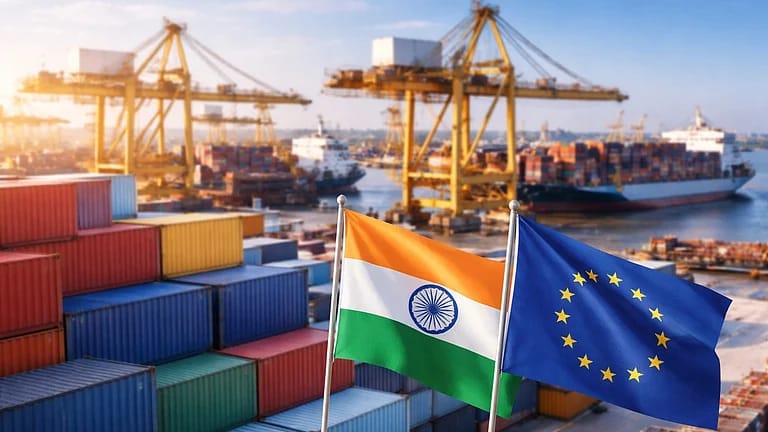
The recently announced India–European Union Free Trade Agreement (FTA) has been described as one of the most ambitious trade pacts India has ever negotiated. Covering trade in goods, services, investment, digital trade, and sustainability, the agreement is expected to reshape economic ties between India and the 27-member European Union.
However, soon after the deal was announced, an important question emerged in policy and business circles:
Will Turkish goods be able to enter India under the India-EU FTA by routing exports through Europe?
This concern has now been clarified by Indian trade officials and experts. The answer is clearly no. Turkish products will not receive tariff benefits under the India-EU FTA. The reasons lie in the legal structure of the agreement and the internationally accepted concept of rules of origin.
What Is the India–EU FTA?
The India-EU FTA is a bilateral trade agreement aimed at reducing tariffs and non-tariff barriers between India and the European Union. Once implemented, the agreement is expected to:
Eliminate or reduce duties on a vast majority of traded goods
Improve market access for services such as IT, finance, and professional services
Strengthen supply chains and investment flows
Promote cooperation in clean energy, technology, and sustainable development
The agreement is limited strictly to India and EU member countries, making its scope legally defined and exclusive.
Why Turkey’s Name Came Into the Discussion
Turkey has a customs union with the European Union, which allows tariff-free movement of certain industrial goods between Turkey and EU countries. Because of this arrangement, concerns arose that Turkish exporters might try to:
Route goods through EU countries
Label them as EU exports
Enter the Indian market at reduced or zero tariffs under the India-EU FTA
Such a scenario, if allowed, could have undermined both Indian industry and the integrity of the trade agreement.
Rules of Origin: The Core Safeguard
The most important safeguard in the India-EU FTA is its rules of origin framework.
Rules of origin define:
Where a product is considered to be “made”
Whether it qualifies for preferential tariff treatment under an FTA
Under the India-EU FTA:
Goods must be wholly produced or substantially transformed within India or the EU
Simple processes such as repackaging, relabelling, or trans-shipment through EU ports do not change the origin of goods
Products manufactured in Turkey remain Turkish in origin, regardless of their shipping route
This means Turkish goods cannot legally qualify for FTA benefits.
Turkey Is Not a Party to the Agreement
Despite its close economic ties with Europe, Turkey is not an EU member and is not a signatory to the India-EU FTA. Trade agreements are legally binding only on their signatories.
Indian officials have clearly stated that:
The FTA is strictly bilateral
No third country can indirectly benefit from it
Any attempt to misuse the agreement will be blocked at customs through origin verification mechanisms
India’s Trade Strategy and Domestic Protection
India has adopted a cautious and strategic approach in recent FTAs to:
Prevent misuse of trade agreements
Protect domestic manufacturing sectors
Encourage genuine value-added trade
Allowing third-country goods to exploit tariff concessions would contradict India’s broader economic goals, including the Make in India initiative and supply-chain resilience.
By enforcing strict origin checks, India ensures that tariff benefits flow only to legitimate EU producers, not external economies.
Impact on Trade and Businesses
For Indian Importers
Lower tariffs will apply only to goods genuinely manufactured in the EU
Clear customs guidelines will reduce uncertainty and misuse
For EU Exporters
Improved access to one of the world’s fastest-growing consumer markets
Stronger competitiveness against non-FTA countries
For Turkish Exporters
No change in current trade conditions with India
Standard tariffs will continue to apply
Any preferential access would require a separate India-Turkey trade agreement
When Will the FTA Come Into Force?
While the agreement has been politically concluded, it will still undergo:
Legal scrubbing
Formal signing
Ratification by EU member states and India
Once completed, the FTA is expected to be implemented in the coming years, marking a new phase in India-EU economic cooper
"The decisions we make today will shape the world for generations to come."