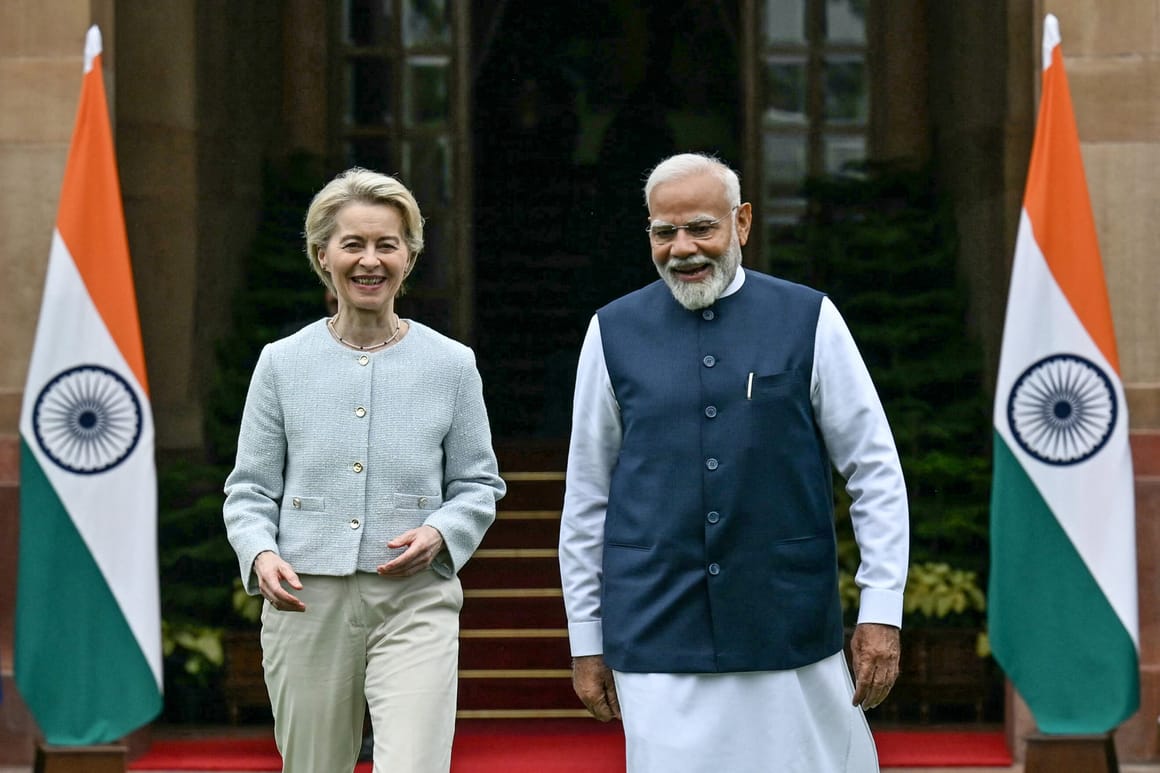
India and the European Union have reached a major breakthrough by closing a long-awaited free trade agreement, a move Prime Minister Narendra Modi has described as a “landmark” moment in bilateral relations. The deal, negotiated over nearly two decades, is being viewed as one of the most significant trade pacts either side has entered in recent years, both in economic scale and strategic impact.
Once fully implemented, the agreement is expected to redefine how two of the world’s largest economic blocs engage with each other in an era marked by supply-chain disruptions, geopolitical uncertainty and shifting global trade patterns.
Why the Deal Is Significant
The European Union is already India’s largest trading partner in goods, while India represents one of the fastest-growing major economies for European businesses. Together, India and the EU account for a substantial share of global GDP and international trade, making this agreement far more than a routine tariff-cutting exercise.
Unlike traditional trade deals, the India–EU pact goes beyond goods and customs duties. It is designed as a comprehensive economic partnership, covering trade in services, investment protection, regulatory cooperation and selected sustainability commitments. This broad scope reflects the changing nature of global trade, where services, technology and standards play an equally important role as physical goods.
Key Features of the Agreement
A central element of the deal is the gradual reduction or elimination of tariffs on a wide range of products. Indian exporters are expected to benefit from improved access to European markets for sectors such as textiles, apparel, leather goods, pharmaceuticals and engineering products. For the EU, the agreement opens greater opportunities in areas like machinery, chemicals, automobiles and high-value industrial goods.
Services trade forms another crucial pillar. India’s strength in information technology, digital services and professional services is likely to gain from clearer rules and reduced barriers. At the same time, European companies could find it easier to invest and operate in India under more predictable regulatory conditions.
Strategic and Geopolitical Dimensions
Beyond economics, the deal carries strong strategic signals. For India, closer trade ties with the EU support its broader goal of diversifying economic partnerships and reducing over-dependence on a limited set of markets. For the EU, the agreement aligns with its Indo-Pacific strategy and efforts to build resilient partnerships outside traditional transatlantic trade routes.
The timing is also notable. With rising protectionism in parts of the world and increasing use of tariffs as political tools, the India–EU agreement sends a message in favour of rules-based trade and long-term cooperation.
Challenges and Open Questions
Despite the optimism, some challenges remain. Sensitive sectors such as agriculture and dairy have been handled cautiously due to domestic concerns on both sides. Environmental regulations, including Europe’s carbon-related trade measures, could pose compliance challenges for Indian manufacturers. Additionally, issues related to labour mobility and visa access may require further discussions beyond the core trade framework.
The deal now moves into the phase of legal review and ratification, particularly within the European Union’s institutional structure. Full implementation is expected to take time, but the political commitment from both sides suggests momentum is unlikely to slow.
What It Means Going Forward
If executed effectively, the India–EU free trade agreement could boost exports, attract investment and strengthen supply chains at a critical moment for the global economy. More importantly, it sets a precedent for how large, diverse economies can negotiate complex agreements without compromising long-term strategic interests.
As global trade enters a more fragmented and competitive phase, the India–EU deal stands out as a reminder that economic cooperation, when backed by political will, can still deliver transformative outcomes.
"The decisions we make today will shape the world for generations to come."