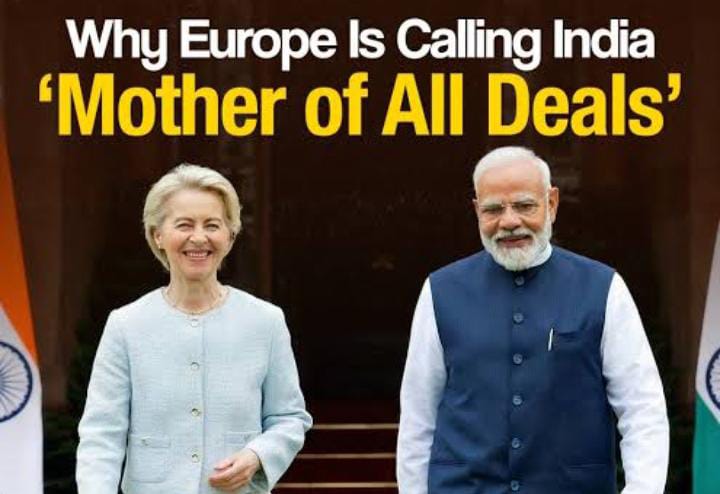
India and the European Union are on the brink of finalising one of the most ambitious trade agreements in recent history, widely described by policymakers as the “mother of all trade deals.” After nearly two decades of intermittent negotiations, the proposed India-EU Free Trade Agreement (FTA) is expected to mark a turning point in economic relations between the world’s fastest-growing major economy and one of its largest trading blocs.
A Long Road to a Landmark Agreement
Talks for an India-EU FTA began almost 18 years ago but were repeatedly stalled due to disagreements over tariffs, market access, environmental standards, and intellectual property rules. In recent years, however, geopolitical shifts, supply-chain disruptions, and rising protectionism have pushed both sides to accelerate negotiations.
The renewed urgency reflects a shared objective: reducing dependence on limited trade partners and creating a more resilient, diversified economic ecosystem.
Why the Deal Is Being Called the ‘Mother of All Deals’
The scale of the agreement is unprecedented for India. The European Union represents a market of 27 countries with high purchasing power, advanced manufacturing capabilities, and strong regulatory frameworks. For India, securing deeper access to this market could significantly boost exports, foreign investment, and technology transfer.
At the same time, the EU views India as a critical long-term partner — a large consumer market, a manufacturing hub, and a strategic counterbalance in global trade dynamics.
Key Highlights of the Proposed Deal
One of the most discussed elements of the agreement is tariff reduction, particularly in the automobile sector. India is reportedly willing to reduce import duties on European cars from levels as high as 110% to around 40% in a phased manner. This signals a notable shift from India’s traditionally protectionist auto policy.
However, sensitive sectors like electric vehicles (EVs) are expected to receive temporary protection to allow domestic manufacturers time to strengthen local capabilities.
Beyond automobiles, the agreement is likely to cover:
Improved market access for Indian textiles, leather goods, jewellery, and engineering products
Greater opportunities for European firms in services, manufacturing, and digital sectors
Stronger rules on investment protection, sustainability, and dispute resolution
Strategic and Economic Impact
If implemented successfully, the deal could significantly expand bilateral trade volumes over the next decade. For India, it opens doors to a premium export market while encouraging higher manufacturing standards and global competitiveness. For the EU, it provides access to one of the world’s fastest-growing consumer bases at a time when global trade relationships are undergoing major realignments.
The agreement also carries strategic weight. As global powers increasingly use tariffs and trade barriers as policy tools, the India-EU pact sends a message in favour of open, rules-based trade.
Challenges and Concerns
Despite its promise, the deal is not without challenges. Domestic manufacturers in India have raised concerns about increased competition, particularly in high-value segments like automobiles and machinery. Labour standards, environmental commitments, and regulatory alignment may also prove complex during implementation.
Moreover, the agreement will still require approvals from EU institutions and Indian authorities, a process that could take time and involve further negotiations.
What Lies Ahead
The anticipated announcement of the deal is only the beginning. Actual implementation will depend on how effectively both sides manage sensitive sectors, phase tariff reductions, and ensure that smaller businesses benefit alongside large corporations.
"The decisions we make today will shape the world for generations to come."