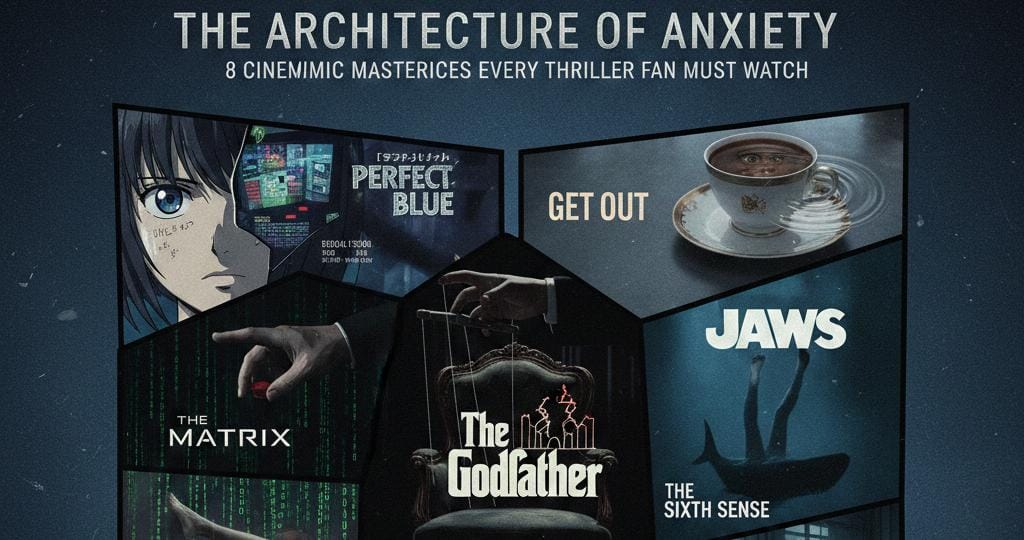
In the ever-evolving landscape of cinema, 2026 stands as a year where the boundaries of tension, psychology, and suspense are being pushed to new heights. Yet, to truly appreciate the cutting edge of modern thrillers, one must look back at the pillars that defined the genre.
The following eight films are not merely "classics"; they are blueprints of tension that every cinephile must experience. From the neon-soaked nightmares of Tokyo to the cold, silent vacuum of space, these are the 8 thriller masterpieces you must watch in 2026.
1. Perfect Blue (1997)
The Descent into Identity Crisis
Satoshi Kon’s animated masterpiece remains more relevant in 2026’s digital age than ever before. It follows Mima, a pop idol who retires to pursue acting, only to be stalked by a fan and haunted by a "ghost" of her former persona.
- Why it’s a masterpiece: It blurs the line between reality, dreams, and digital perception so seamlessly that the viewer becomes as disoriented as Mima.
- The 2026 Angle: In an era of deepfakes and curated social media personas, Perfect Blue acts as a cautionary tale about the commodification of the self and the fragility of the human psyche when the world refuses to let you change.
2. The Matrix (1999)
The Architectural Thriller of the Mind
While often categorized as pure sci-fi, The Matrix is, at its core, a high-stakes psychological thriller. Thomas Anderson’s discovery that his world is a simulation is the ultimate "paranoia" trope taken to a global scale.
- Why it’s a masterpiece: It combines philosophical inquiry with "Bullet Time" suspense. The tension isn't just in the gunfights; it’s in the terrifying realization that everything you touch and see is a lie controlled by an invisible enemy.
- The 2026 Angle: As we navigate increasingly sophisticated AI and VR, the film’s "Prison for your Mind" allegory feels less like fiction and more like a social commentary on our own digital dependencies.
3. Get Out (2017)
The Monster is Society
Jordan Peele redefined the genre by introducing the "Social Thriller." When Chris, a young Black man, visits his white girlfriend’s family estate, the "awkward" tension slowly curdles into a sinister survival horror.
- Why it’s a masterpiece: It weaponizes microaggressions and "polite" society to build a sense of dread. The "Sunken Place" is one of the most haunting visual metaphors for the loss of agency in modern cinema.
- The 2026 Angle: It remains the gold standard for films that use the thriller framework to dissect race, privilege, and the predatory nature of "performative" allyship.
4. The Godfather (1972)
The Slow-Burn Transformation
Often cited as the greatest film of all time, The Godfather is a masterclass in slow-burn suspense. It isn't just a "gangster movie"; it’s a thriller about the corruption of a soul.
- Why it’s a masterpiece: The tension is found in the whispers, the closed doors, and the unspoken threats. The "baptism" sequence remains the most effective thriller climax in history, juxtaposing holy ritual with cold-blooded execution.
- The 2026 Angle: Its exploration of power dynamics and the moral cost of "protecting the family" resonates in a modern world where corporate and political dynasties continue to shape our reality.
5. Jaws (1975)
The Power of the Unseen
Steven Spielberg’s Jaws created the "Summer Blockbuster," but it did so by mastering the Hitchcockian principle: what you don't see is scarier than what you do.
- Why it’s a masterpiece: Due to technical issues with the mechanical shark, Spielberg kept the predator hidden for most of the film. This forced the audience to rely on John Williams’ iconic two-note score and their own imagination to fill the murky depths.
- The 2026 Angle: In a CGI-saturated 2026, Jaws serves as a reminder that tension is built through pacing, character vulnerability, and the primal fear of what lurks just beneath the surface.
6. The Sixth Sense (1999)
The Anatomy of the Twist
M. Night Shyamalan’s career-defining work is a quiet, somber thriller about a child who "sees dead people" and the psychologist trying to help him.
- Why it’s a masterpiece: While famous for its ending, the film’s true strength is its atmosphere of grief and isolation. It builds tension through small, chilling details—a drop in temperature, a misplaced piece of jewelry, or a breath of cold air.
- The 2026 Angle: It proves that a great thriller doesn't need jump scares. It needs a human heart and a narrative structure so tight that a second viewing reveals a completely different movie hidden in plain sight.
7. Alien (1979)
Claustrophobia in the Infinite
"In space, no one can hear you scream." Ridley Scott’s Alien took the "haunted house" trope and put it on a commercial tugboat in deep space.
- Why it’s a masterpiece: It is a "blue-collar" thriller. The characters are space-truckers, not soldiers. The H.R. Giger-designed Xenomorph is a bio-mechanical nightmare, but the real tension comes from the claustrophobic corridors and the betrayal by "Mother" (the ship’s AI).
- The 2026 Angle: As we look toward actual Mars missions and corporate space travel, the fear of being "disposable" to a corporation in the face of an unknown threat is more chilling than ever.
8. The Dark Knight (2008)
The Unstoppable Force vs. The Immovable Object
Christopher Nolan’s The Dark Knight transcended the superhero genre to become a gritty, sprawling urban thriller. It is essentially a Michael Mann-style crime epic (Heat) with a man in a mask.
- Why it’s a masterpiece: The Joker is the ultimate thriller antagonist—he has no motive, no "plan" other than chaos. The tension never lets up, moving from high-stakes bank heists to agonizing moral dilemmas that force the hero to choose between two impossible outcomes.
- The 2026 Angle: It remains the definitive cinematic study of how a civilized society responds to terrorism and the breakdown of order, asking the haunting question: How much of your own morality are you willing to sacrifice to stop a monster?