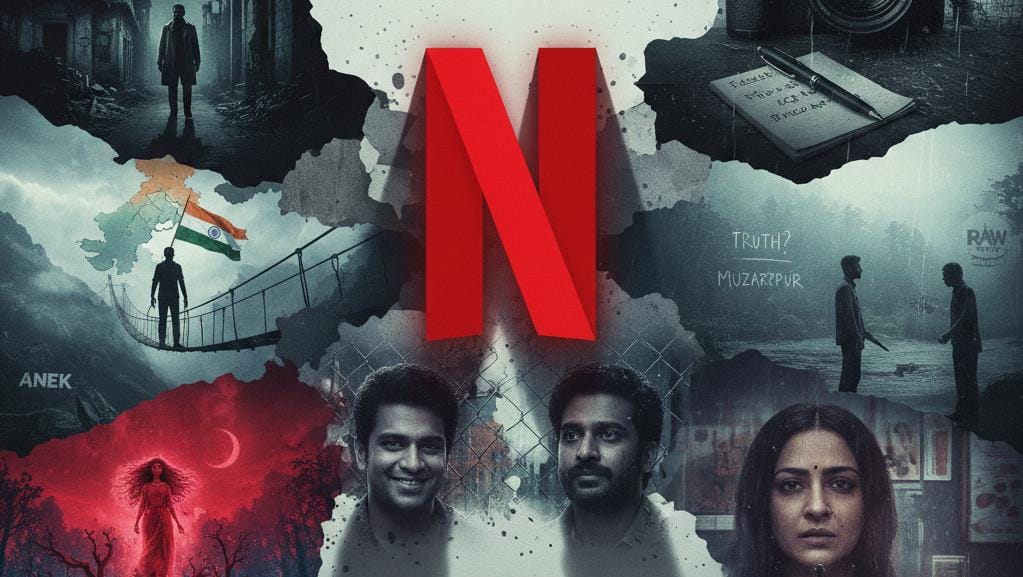
In the last five years, the "Netflix Original" banner has transitioned from a niche experimental label to the primary engine of high-concept Indian storytelling. While theatrical releases often buckle under the pressure of "mass appeal" and box-office formulas, Netflix has provided a sanctuary for filmmakers like Vishal Bhardwaj, Anvita Dutt, and Sujoy Ghosh to explore the darker, more intricate corners of the human condition.
This article examines seven films that represent the pinnacle of this shift—moving away from the song-and-dance tradition and toward a gritty, atmospheric, and socially conscious "New Wave."
1. Raat Akeli Hai
The Gothic Whodunnit: Unmasking the Rot of Feudal Patriarchy
A subversion of the "angry young man" trope within a crumbling haveli.
Directed by Honey Trehan, Raat Akeli Hai is much more than a murder mystery; it is a surgical dissection of the feudal rot that persists in small-town India. The film follows Inspector Jatil Yadav (Nawazuddin Siddiqui) as he investigates the murder of a powerful patriarch on his wedding night.
What makes this a "must-watch" is the atmospheric world-building. The cinematography uses shadows and narrow corridors to mirror the claustrophobia of the family's secrets. Siddiqui’s performance is a masterclass in subtlety—he plays a man struggling with his own internalised prejudices while trying to be a righteous officer. The film challenges the viewer to look beyond the "who" of the murder and focus on the "why"—a motive rooted in decades of systemic female suppression.
2. Bulbbul (2020)
Feminist Folklore: The Red Hue of Justice and Horror
Transforming the "Chudail" myth into a powerful allegory for female agency.
Produced by Anushka Sharma and directed by Anvita Dutt, Bulbbul is visually the most stunning film on this list. Set in 19th-century Bengal, it uses the "Chudail" (witch) folklore not to terrify the audience, but to empower the protagonist.
The film uses a distinct color palette—shifting from the warm, nostalgic yellows of childhood to a blood-red moonlit forest in the present. This isn't just a stylistic choice; it represents the transition from innocence to trauma and, eventually, to terrifying power. Tripti Dimri’s portrayal of Bulbbul is haunting, capturing the transition from a "caged bird" bride to a silent protector. It is a professional triumph in production design and a searing critique of how society labels "rebellious" women as monsters.
3. Bhakshak (2024)
The Conscience of the Fourth Estate: A Gritty Pursuit of Truth
A sobering look at the Muzaffarpur shelter home case and the power of local journalism.
In Bhakshak, director Pulkit tackles one of the most harrowing subjects in recent memory: the systemic abuse of minors in state-run shelters. Bhumi Pednekar plays Vaishali Singh, a small-town journalist who refuses to look away.
The film's strength lies in its refusal to sensationalize. It avoids the "heroic" tropes of Bollywood journalism, instead focusing on the tedious, dangerous, and often discouraging process of uncovering the truth in a landscape of political corruption. It asks a haunting question: When those meant to protect become the predators (Bhakshak), who is left to stand guard? It is a professional necessity for anyone interested in the intersection of media and social justice.
4. Khufiya (2023)
The Poetic Spy: Intelligence through the Lens of Human Frailty
Vishal Bhardwaj’s lyrical take on the cold, lonely world of surveillance.
Vishal Bhardwaj is known for his Shakespearean adaptations, and he brings that same sense of tragic grandeur to the world of RAW (Research and Analysis Wing) in Khufiya. Based on the novel Escape to Nowhere, the film stars Tabu as an operative hunting a mole within her own organization.
Unlike the high-octane action of the Tiger or Pathaan franchises, Khufiya is slow-burning and intimate. It focuses on the domestic lives of spies—the laundry, the meals, and the broken relationships. The inclusion of a queer narrative involving Tabu’s character adds a layer of vulnerability rarely seen in the genre. It is a masterfully directed piece that treats espionage as a tragedy rather than a triumph.
5. Anek (2022)
The Geopolitics of Identity: Questioning the Definition of "Indian"
Anubhav Sinha’s complex exploration of North-East India’s struggle for recognition.
Anek is perhaps the most intellectually demanding film on this list. Directed by Anubhav Sinha, it stars Ayushmann Khurrana as an undercover agent in Northeast India. The film does not offer easy answers; it intentionally muddies the waters between "patriot" and "separatist."
Through the character of Aido (Andrea Kevichusa), a boxer who wants to represent India despite being marginalized by it, the film explores the nuances of national identity. It critiques the "mainland" gaze and the bureaucratic machinery that treats certain regions as mere chess pieces. For professional viewers, Anek serves as a vital case study in using commercial cinema to address uncomfortable geopolitical realities.
6. Jaane Jaan (2023)
The Mathematics of a Crime: A Duel of Wits in the Mist
Sujoy Ghosh adapts 'The Devotion of Suspect X' with a stellar ensemble.
Set in the misty hills of Kalimpong, Jaane Jaan is a clinical and captivating adaptation of Keigo Higashino's famous novel. It features Kareena Kapoor Khan in a career-best performance, but the film is truly stolen by Jaideep Ahlawat, who plays a socially awkward math teacher capable of genius-level deception.
The film’s brilliance lies in its pacing. It tells the audience who the killer is within the first twenty minutes, yet keeps the tension sky-high by making the investigation a battle of intellect between the teacher and a sharp cop (Vijay Varma). It is a textbook example of how to adapt international literature while grounding it perfectly in local Indian textures.
7. Sector 36 (2024)
The Banality of Evil: A Chilling Descent into the Nithari Murders
A harrowing fictionalization of one of India's darkest criminal chapters.
Sector 36 is not for the faint of heart. Inspired by the Nithari serial killings, the film pits a corrupt, indifferent police officer (Deepak Dobriyal) against a terrifyingly polite psychopath (Vikrant Massey).
The film serves as a brutal critique of class divide; the reason the crimes go unnoticed for so long is that the victims are the children of migrant laborers—the "invisible" people. Vikrant Massey’s performance is transformative, shedding his "boy-next-door" image to play a man devoid of a soul. It is a stark, professional reminder of the failures of law enforcement when blinded by class prejudice.
The Path Forward for Netflix India
These seven films represent more than just entertainment; they are a testament to the maturing of Indian audiences and the creative freedom offered by streaming platforms. From the feminist horror of Bulbbul to the geopolitical grit of Anek, Netflix has successfully curated a "Digital Noir" aesthetic that is uniquely Indian yet globally relevant.
As we move further into 2026, the success of these titles suggests that the future of Indian cinema lies in "Spectacle with Substance"—where high production values meet uncompromising, truthful storytelling.