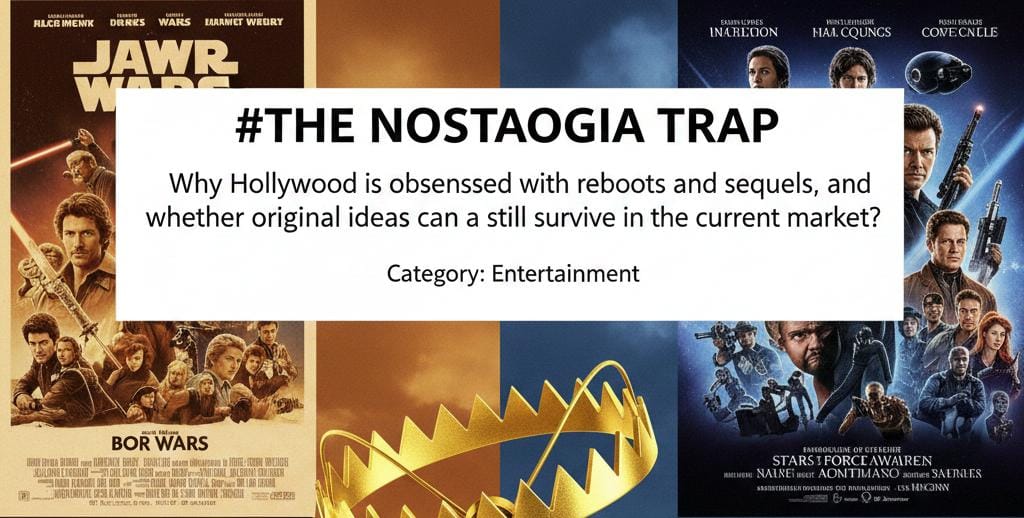
Hollywood has always been a business built on dreams, but increasingly, those dreams are recycled. Walk into any multiplex or scroll through any streaming service, and you’re likely to be bombarded with familiar faces and stories: a beloved franchise gets a new installment, a classic film is "reimagined," or a once-popular TV show is resurrected for a new generation. From Top Gun: Maverick breaking box office records decades after its predecessor to the endless conveyor belt of superhero sequels and cinematic universes, it’s clear that Hollywood is caught in what can only be described as "the nostalgia trap."
This phenomenon isn't new, but its intensity and pervasiveness in the 21st century raise critical questions about the health of original storytelling and the future of creative risk-taking in the entertainment industry. Why has the allure of the past become so dominant, and what does it mean for the survival of fresh, original ideas?
The Siren Song of Familiarity: Why Hollywood Loves Reboots and Sequels
The reasons behind Hollywood's obsession with established intellectual property (IP) are multifaceted, blending economic imperatives with evolving audience behaviors.
1. Reduced Risk and Guaranteed Audiences:
In an increasingly fragmented media landscape, where attention spans are short and content choices are infinite, launching an original film or series is a colossal gamble. Marketing an unknown story to an indifferent audience requires massive investment and yields uncertain returns. Reboots and sequels, on the other hand, come with a built-in audience. Fans of the original material are pre-disposed to watch, creating a foundational viewership that significantly de-risks the project. This is especially true for global markets, where established brands like Marvel or Star Wars have universal recognition. A familiar title means less explanation, fewer marketing hurdles, and a higher probability of opening weekend success.
2. Franchise Building and Cinematic Universes:
The modern entertainment industry is dominated by the concept of "cinematic universes" and interconnected franchises. Disney, with its Marvel and Star Wars empires, has perfected this model. Each new film or series isn't just a standalone product; it's a piece of a larger puzzle, designed to keep audiences invested for years and across multiple platforms. Reboots and sequels serve as essential building blocks for these sprawling narratives, continually expanding the universe and creating new revenue streams through merchandise, theme park attractions, and spin-offs. Original ideas rarely possess this inherent capacity for multi-platform expansion.
3. Technological Advancements and "Updating" Classics:
Sometimes, reboots are justified by advancements in filmmaking technology. A beloved story that might have been limited by the special effects of its era can now be brought to life with stunning realism. Think of the seamless CGI in The Lion King (2019) or the enhanced action sequences in modern superhero films. While these remakes often face criticism for lacking the charm of the originals, they appeal to a new generation unfamiliar with the source material and offer a visually "upgraded" experience.
4. The Power of Nostalgia Itself:
Perhaps the most potent driver is nostalgia itself. For audiences, revisiting beloved stories is a comforting experience. It taps into a yearning for simpler times, for the magic of childhood, or for cultural touchstones that shaped their youth. When a film like Top Gun: Maverick not only delivered exhilarating action but also evoked the spirit of the original with reverence, it resonated deeply with audiences who grew up with the first film, offering a powerful emotional connection that original stories struggle to replicate instantly. This emotional connection transcends simple entertainment; it's a shared cultural memory.
The Cost of Comfort: The Erosion of Originality
While the business case for reboots and sequels is clear, the pervasive reliance on them comes at a significant creative cost.
1. Risk Aversion Stifles Innovation:
When studios continually prioritize established IP, they become increasingly risk-averse towards original concepts. Developing a fresh script, nurturing new talent, and marketing an unknown story requires significant upfront investment and faith. In an environment where guaranteed returns on familiar IP loom large, original ideas are often seen as too speculative, too niche, or simply not worth the financial exposure. This creates a vicious cycle: fewer original ideas get greenlit, leading to fewer new voices and perspectives entering the mainstream.
2. "IP Mining" Over Storytelling:
The focus often shifts from telling a compelling story to simply "mining" existing IP for its commercial potential. This can result in sequels that feel forced, reboots that miss the essence of the original, or cinematic universes that prioritize intricate lore over genuine character development. The question becomes less about "what story can we tell?" and more about "how can we keep this franchise going?" This approach often sacrifices artistic integrity for market longevity.
3. "Soft Reboots" and Contradictory Canon:
To appeal to both old and new fans, many reboots employ a "soft reboot" strategy—acknowledging the original while attempting to forge a new path. This can lead to convoluted narratives, contradictory canon, and a general sense of creative indecision, satisfying neither group fully. The pressure to appease everyone often results in a product that feels diluted and lacks a strong, singular vision.
4. A Creative Brain Drain:
If studios are less willing to invest in original concepts, where do aspiring screenwriters, directors, and artists with groundbreaking ideas go? They might turn to independent cinema, television, or even other industries, leading to a "brain drain" from mainstream Hollywood. This ultimately impoverishes the mainstream with a dearth of fresh perspectives and narratives that reflect contemporary experiences.
Can Original Ideas Still Survive?
Despite the overwhelming tide of reboots and sequels, original ideas are far from extinct, though their survival strategies have had to evolve.
1. The Television Renaissance and Streaming Platforms:
Ironically, the same streaming services that often rely on existing IP (like Disney+ with its Marvel and Star Wars shows) have also become a fertile ground for original storytelling. The longer narrative formats of television allow for deeper character exploration and complex plots that might be too risky for a two-hour theatrical film. Platforms like Netflix, HBO, Apple TV+, and Amazon Prime Video have funded critically acclaimed and commercially successful original series, proving that audiences are hungry for novelty when it's well-executed. Shows like Squid Game, Ted Lasso, and Severance captivated global audiences without relying on pre-existing IP.
2. A24 and the Indie Success Story:
Independent studios, exemplified by A24, have carved out a significant niche by championing distinctive, director-driven original films. While their budgets are smaller, their focus on artistic merit and unique voices has garnered critical acclaim and cult followings, sometimes even breaking into mainstream success (e.g., Everything Everywhere All at Once, Hereditary). These studios demonstrate that a market exists for challenging, unconventional narratives.
3. The Power of "Event" Cinema (Beyond IP):
Occasionally, an original film manages to break through by becoming an "event" in itself, either through critical buzz, word-of-mouth, or a compelling marketing campaign. Films like Jordan Peele's Get Out or Christopher Nolan's Inception proved that high-concept original stories, expertly crafted, can still draw massive audiences and generate significant cultural impact. Their success often lies in offering something genuinely new and thought-provoking.
4. The "Mid-Budget" Original Film's Struggle:
The true casualty in the battle for originality has been the "mid-budget" original film – the drama, comedy, or thriller that isn't a massive blockbuster but isn't a tiny indie either. These films, which used to be a staple of Hollywood, are now increasingly rare in theaters, often relegated to streaming platforms. Studios are hesitant to invest in them theatrically when a blockbuster sequel can deliver exponentially higher returns.
Hollywood's nostalgia trap is a complex symptom of an industry grappling with massive financial pressures and evolving audience habits. While reboots and sequels offer a safe harbor in turbulent waters, their dominance poses a real threat to the creative vitality of the industry. The good news is that original ideas are tenacious. They are finding new homes on streaming platforms, thriving in independent cinema, and occasionally breaking through the noise with undeniable artistic merit.
The challenge for Hollywood is to remember that while nostalgia can provide a comforting temporary escape, true innovation and lasting cultural impact come from daring to tell new stories, to discover new voices, and to embrace the unknown. The future of cinema depends not just on how well we revisit the past, but on how bravely we imagine what comes next.
"The decisions we make today will shape the world for generations to come."