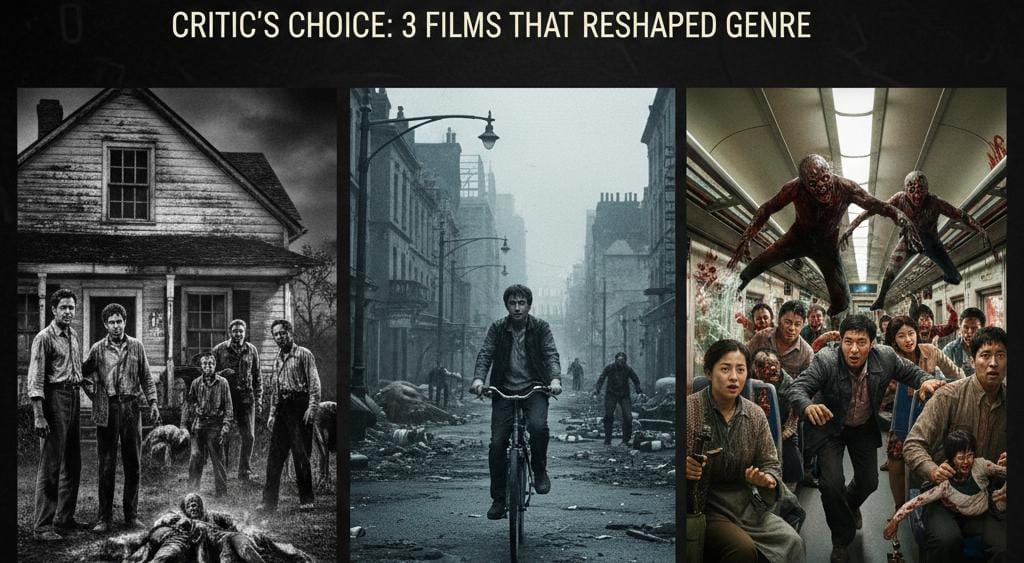
The zombie genre, often dismissed as mere schlock, has proven itself to be a surprisingly resilient and insightful lens through which to examine societal anxieties. From its humble beginnings to its modern-day resurgence, the shuffling, groaning undead have served as metaphors for everything from consumerism and disease to political instability and the breakdown of social order. While countless films have tackled the zombie apocalypse, a select few stand out for their innovative storytelling, profound themes, and lasting impact on popular culture. This article delves into three such masterpieces: George A. Romero's Night of the Living Dead, Danny Boyle's 28 Days Later, and Yeon Sang-ho's Train to Busan, exploring how each film redefined the genre and continues to resonate with audiences today.
Night of the Living Dead (1968): The Genesis of Modern Horror
More Than Just Ghouls: A Sociopolitical Mirror
George A. Romero's Night of the Living Dead didn't invent the zombie, but it certainly reinvented it. Prior to Romero, "zombies" were largely figures of Haitian folklore, often depicted as reanimated corpses under the control of a voodoo practitioner. Romero stripped away the supernatural elements, replacing them with a terrifyingly grounded, plague-like phenomenon where the dead simply rose to consume the living. This groundbreaking approach established the core tenets of the modern zombie narrative: slow, relentless hordes; brain-eating tendencies; and the emphasis on human survival and societal collapse.
The film's low budget and independent production lent it a raw, visceral quality that mainstream Hollywood often shied away from. Set in a rural farmhouse where a disparate group of survivors tries to weather the initial onslaught, Night of the Living Dead masterfully crafts an atmosphere of claustrophobic terror. The true horror, however, isn't just from the zombies outside, but from the fracturing relationships and escalating tensions within the farmhouse itself. The characters, a microcosm of 1960s American society, are plagued by distrust, sexism, and racial prejudice, ultimately leading to their tragic undoing.
Perhaps the most enduring legacy of Night of the Living Dead is its powerful sociopolitical commentary. Released during the tumultuous Civil Rights Movement and the Vietnam War, the film subtly (and sometimes not so subtly) reflects the anxieties of the era. The casting of Duane Jones, an African American actor, in the lead role of Ben, a competent and rational survivor, was a revolutionary act in itself, especially considering his ultimate demise at the hands of seemingly well-meaning white rescuers who mistake him for a zombie. This ending, jarring and nihilistic, served as a bleak commentary on racial injustice and the inherent flaws within society. The film’s relentless focus on human failings, rather than just the monstrous undead, elevated it beyond mere horror into a potent piece of social satire. It forced audiences to confront not just the fear of the unknown, but the chilling realization that humanity's greatest threat might be itself.
Romero’s film laid the groundwork for every zombie movie, TV show, and video game that followed. Its influence is immeasurable, solidifying the zombie as a potent symbol of societal decay and a mirror reflecting our deepest fears. It proved that horror could be intelligent, challenging, and profoundly unsettling, forever changing the landscape of genre cinema.
28 Days Later (2002): The Rage-Fueled Evolution
Over three decades after Night of the Living Dead, Danny Boyle's 28 Days Later burst onto the scene, revitalizing a genre that many felt had become stagnant. While not technically a zombie film—the infected are alive, albeit consumed by a terrifying rage virus—it is undeniably a direct descendant, taking the core concepts of contagion and societal collapse and injecting them with a ferocious, adrenaline-fueled energy.
The most striking innovation of 28 Days Later was its introduction of fast-moving, screaming "infected." Romero's shambling ghouls were terrifying in their relentless numbers, but Boyle's sprinters brought a new level of visceral panic and immediate threat. This shift dramatically altered the survival tactics required, emphasizing speed, agility, and quick thinking over the more static, defensive strategies of earlier films. The opening sequence, with Jim (Cillian Murphy) wandering through an eerily deserted London, remains one of the most iconic and chilling portrayals of a post-apocalyptic world.
Beyond the speed, 28 Days Later also revolutionized the aesthetic and sound design of the genre. Shot on consumer-grade digital video, the film possessed a grainy, raw realism that amplified its unsettling atmosphere. The stark, desolate landscapes of London were beautifully unsettling, a powerful visual metaphor for a world brought to its knees. Coupled with John Murphy's iconic, mournful, yet propulsive score, the film created a unique sensory experience that distinguished it from its predecessors.
The narrative, much like Romero's work, quickly shifts from battling the infected to confronting the more insidious threat of human nature. Jim, Selena (Naomie Harris), and Hannah (Megan Burns) seek refuge with a group of soldiers led by Major Henry West (Christopher Eccleston). What initially appears to be a sanctuary quickly devolves into a desperate struggle for survival against the soldiers' horrifying descent into barbarism and sexual violence. The film powerfully argues that in the absence of societal norms, the true monsters are often not the infected, but the uninfected, who succumb to their darkest impulses. This exploration of humanity's capacity for cruelty, even in the face of an existential threat, cemented 28 Days Later's place as a poignant social commentary. It asks whether survival is truly worth it if it means sacrificing one's humanity. The film's critical and commercial success reignited interest in the zombie genre, proving that there was still fertile ground for innovation and profound storytelling within its decaying confines.
Train to Busan (2016): Emotional Depth at Breakneck Speed
A Father's Redemption in a Confined Apocalypse
Hailing from South Korea, Yeon Sang-ho's Train to Busan arrived as a breath of fresh air in the zombie genre, seamlessly blending high-octane action with deeply resonant emotional storytelling. The film takes the "fast zombie" concept introduced by 28 Days Later and places it within an incredibly claustrophobic and kinetic setting: a high-speed train hurtling through a country rapidly succumbing to a zombie outbreak. This confinement amplifies the tension and fear, making every encounter with the infected a thrilling and terrifying ordeal.
What sets Train to Busan apart is its masterful character development and emotional core. At its heart, the story follows Seok-woo (Gong Yoo), a workaholic fund manager estranged from his young daughter, Su-an (Kim Su-an). As the train becomes a battleground for survival, Seok-woo is forced to confront his selfishness and learn what it truly means to be a father. The film is a powerful narrative of redemption, as Seok-woo gradually transforms from a self-absorbed individual into a selfless protector, willing to sacrifice everything for his daughter and, eventually, for others.
The supporting cast is equally compelling, featuring a pregnant couple, a high school baseball team, and a ruthless CEO, each representing different facets of human nature under duress. Their individual struggles and collective efforts to survive against overwhelming odds create a tapestry of courage, cowardice, and sacrifice. The film brilliantly uses these characters to explore themes of class struggle, collective action, and the moral choices people make when faced with life-or-death situations. The acts of solidarity, often in stark contrast to the selfish actions of a few, provide moments of heartbreaking beauty and hope amidst the relentless terror.
Train to Busan's action sequences are meticulously choreographed, offering a visceral and exhilarating experience. The confined spaces of the train carriages necessitate creative and desperate fighting, from blocking doors with luggage to strategizing movements between cars. However, these sequences never overshadow the emotional narrative. The film understands that the true impact of the horror lies not just in the jump scares or gore, but in the audience's investment in the characters' fates. The ending, in particular, is a masterclass in emotional devastation, leaving a lasting impression long after the credits roll.
Train to Busan proved that the zombie genre could still innovate, not just through new zombie mechanics, but by grounding the horror in deeply human stories. Its global success introduced a wider audience to the brilliance of Korean cinema and cemented its place as a modern classic, demonstrating that even in the most apocalyptic scenarios, the human heart can still find a way to beat.
From the social commentary of Night of the Living Dead to the visceral terror of 28 Days Later and the emotional poignancy of Train to Busan, these three films represent the pinnacle of the zombie genre. They are not merely exercises in gore and jump scares; they are profound explorations of human nature, societal collapse, and the enduring struggle for survival. Each film, in its own distinct way, pushed the boundaries of what a zombie movie could be, leaving an indelible mark on cinema and solidifying the undead's place as a potent and versatile metaphor for our deepest fears and most enduring hopes. For anyone seeking to understand the evolution and impact of the zombie genre, these three cinematic milestones are absolutely essential viewing.
"The decisions we make today will shape the world for generations to come."