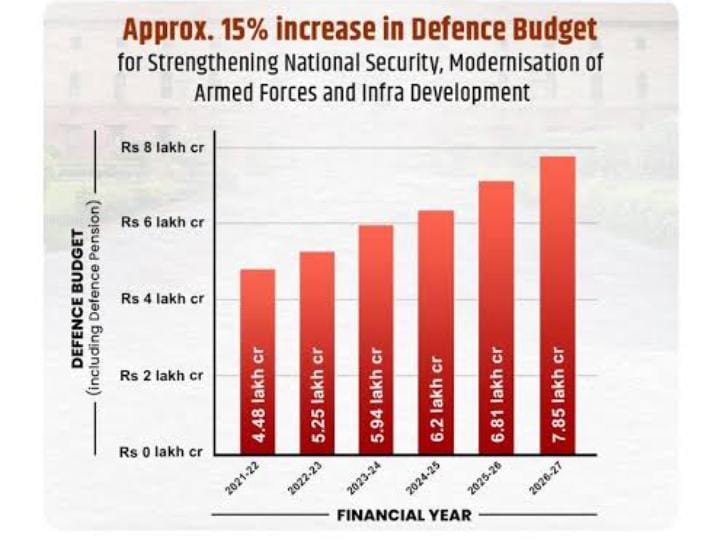
The Union Budget 2026–27 has placed national security firmly at the centre of India’s economic and strategic priorities, with the government announcing a record allocation of ₹7.85 lakh crore for the defence sector. Presented by Finance Minister Nirmala Sitharaman, the budget reflects a year-on-year increase of nearly 15 per cent, underlining the government’s commitment to strengthening India’s military capabilities amid evolving global and regional security challenges.
This enhanced allocation aims to modernise the armed forces, boost domestic defence manufacturing, and improve welfare measures for soldiers and veterans.
Defence Budget at a Glance
The defence allocation for FY 2026–27 accounts for nearly 14.6 per cent of the total Union Budget, making it one of the largest expenditure heads.
| Component | Allocation (Approx) |
| Total defence budget | ₹7.85 lakh crore |
| Capital Expenditure | ₹2.19 lakh crore |
| Revenue expenditure | ₹5.53 lakh crore |
| Defence R&D (DRDO) | ₹29,000+ crore |
| Defence Pension | ₹1.71 lakh crore |
Strong Focus on Modernisation
A key highlight of Budget 2026–27 is the sharp increase in capital expenditure, which has risen by around 24 per cent compared to the previous year. This funding will be directed towards:
Procurement of advanced fighter aircraft and helicopters
Construction of naval warships and submarines
Induction of drones, UAVs, and precision-guided weapons
Upgrading surveillance, communication, and cyber defence systems
The government believes these investments will significantly enhance the operational readiness of the Army, Navy, and Air Force.
Boost to ‘Make in India’ in Defence
The budget continues to prioritise Aatmanirbhar Bharat in the defence sector. A major share of capital procurement has been earmarked for domestic defence manufacturers, encouraging Indian companies and startups to play a larger role in weapons and equipment production.
This move is expected to reduce import dependency, strengthen India’s defence industrial base, and generate high-skilled employment across the country.
Increased Support for Defence Research
The allocation for Defence Research and Development Organisation (DRDO) has been enhanced to support innovation in critical areas such as missile systems, electronic warfare, artificial intelligence, and next-generation defence technologies. The focus on indigenous R&D is seen as a long-term investment in strategic autonomy.
Welfare of Soldiers and Veterans
The government has also ensured substantial funding for defence pensions and healthcare schemes for ex-servicemen. Enhanced allocations under pension and medical facilities aim to improve the quality of life for retired personnel and their families, acknowledging their contribution to national security.
Why Defence Budget 2026–27 Matters
Rising geopolitical uncertainties
Increasing need for technological superiority
Border security and maritime challenges
Long-term goal of defence self-reliance
Taken together, these factors make the increased defence allocation both timely and strategically significant.
"The decisions we make today will shape the world for generations to come."