Ather Energy did not only launch a cheaper scooter on Saturday. At Community Day 2026 in Bengaluru, it put a name on the problem that kills more EV purchases than range charts ever will: the apartment parking slot with no legal, safe, society-approved plug. That product is Ather Node.
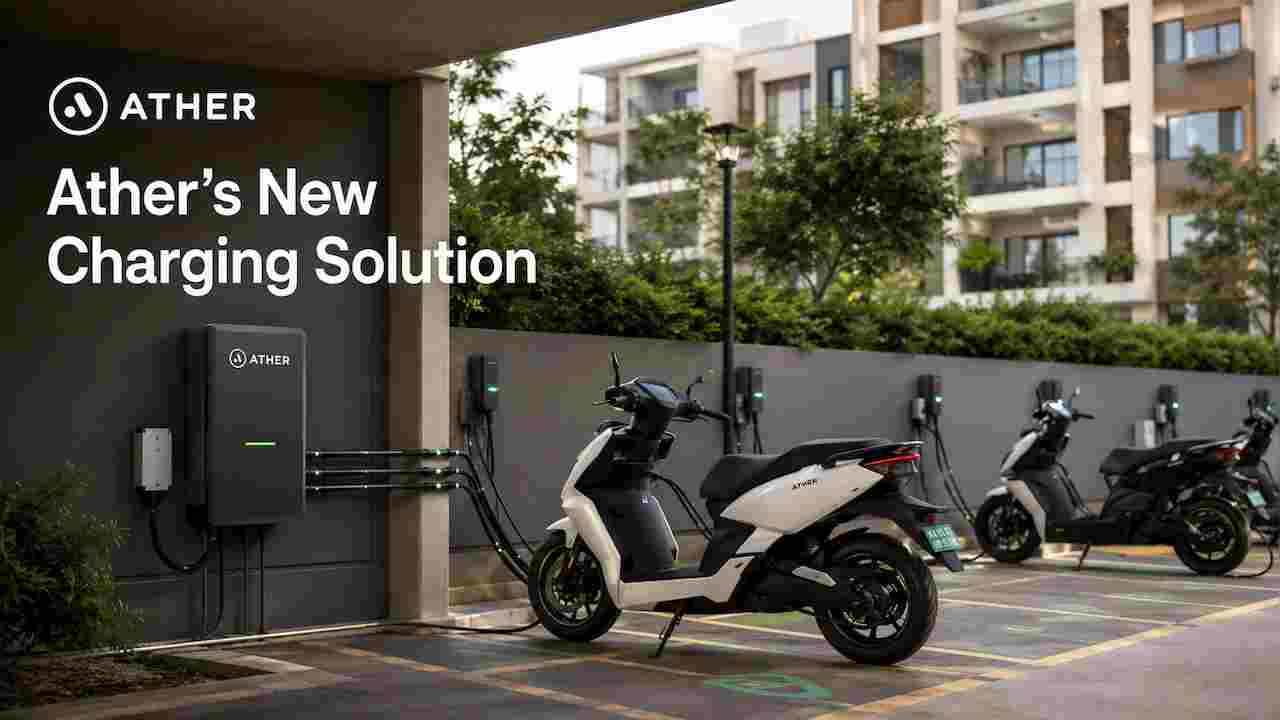
Node is a building-level charging system, not another portable brick in the under-seat storage. A rider gets a dedicated point at their own parking space. The building gets one central gateway that can run up to 1,000 of those points. The gateway watches the available electrical load, shares power across chargers, and handles billing so the association is not chasing WhatsApp receipts at midnight. Ather says the same stack can serve two-wheelers and four-wheelers in residential or commercial complexes. First live cities: six, by the end of 2026. The company has not published the list.
The sales pitch is blunt. Most housing societies refuse extra chargers because the transformer is already sweating and a load upgrade means DISCOM files, contractors, and a special general body meeting that never ends. Node is designed to sit on the load the building already has. Charge when there is headroom. Pause in the peak. Resume when the lifts and ACs stop fighting the same cable. That is load management, not magic. If it works at scale, the secretary’s favourite excuse gets thinner.
This sat next to three other announcements the same afternoon: Konarc, Ather’s first scooter under ₹1 lakh on the new EL platform; fifth-generation Bedrock batteries with a 10-year / 1,00,000 km warranty and a 70% state-of-health promise; and True Health, an in-app score for battery, brakes and resale. Node is the piece that lives in the basement, not on the showroom floor. Without it, the ₹99,999 scooter still dies in a society that will not sign the NOC.
Benefits of Ather Node
- Dedicated charging at your parking slot instead of a shared basement cable fight.
- One gateway can coordinate as many as 1,000 chargers in a single complex.
- Built for buildings with limited spare load — the common Indian apartment reality.
- Dynamic power sharing: more juice when the building is quiet, less when everyone is home.
- Peak-hour pause and resume so the society does not trip the main supply.
- No forced upgrade of transformers or incoming power, according to Ather.
- Central billing instead of informal “who used how many units” arguments.
- Works for electric two-wheelers and four-wheelers in the same campus.
- Aimed at both housing societies and commercial parking.
- Cuts the approval friction that currently sits between buying an EV and actually charging it at home.
- Supports the wider Ather ownership stack — Grid fast-charging outside, Node overnight at home.
- If billing and load data stay transparent, resale and society compliance get easier, not messier.
That last point matters. India does not have a charging problem on PowerPoint. It has a permission problem in basements. Public Grid points help a tourist. They do not replace a socket eight steps from the lift. Ather’s own Grid network already exists for roadside top-ups. Node is the attempt to make the daily charge as boring as plugging in a phone.
The system is still a promise with a city count and no public price card. Societies will ask who owns the gateway, who pays for downtime, who is liable if a point sparks, and whether a non-Ather car can use the same slot. Those answers will decide if Node is infrastructure or a keynote slide. Six cities by December is a tight clock. Miss it, and the announcement ages into another EV slogan.
Now the ugly part the launch video will not say out loud. Governments print EV targets and cut ribbons on highway chargers while apartment law, DISCOM queues and municipal wiring codes remain a maze. A buyer can get a subsidy photograph and still lose six months waiting for a society NOC. That is not a market failure. That is a state that wants the climate speech and none of the basement paperwork. Private companies will keep inventing gateways because the public system will not draw a simple rule: every new tower must leave spare load and a metered point per parking slot. Until that rule exists, Node is a workaround wearing a product name.
If Ather ships the hardware, names the six cities, and publishes tariffs that a treasurer can defend in a meeting, apartment charging stops being folklore. Until then, treat Node as the most important thing Ather said on Saturday — and the one that still has to survive a secretary, an electrician, and a transformer that was never designed for a hundred scooters coming home at 8 p.m.
Disclaimer: Product features, city rollout, warranties and pricing are as stated by the company on 29 August 2026 and can change. This is reporting, not investment advice. Ather Energy is a listed company; do your own research before any financial decision.
"The decisions we make today will shape the world for generations to come."