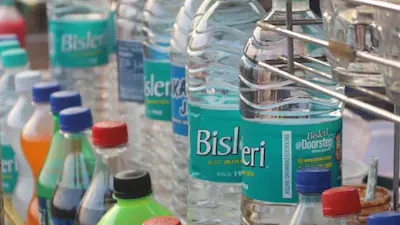
India’s most trusted bottled water brand is now in the dock. On 22-23 November 2026, the Food Safety and Standards Authority of India sanctioned prosecution against Bisleri International after declaring a sample of its packaged drinking water “unsafe.” The finding relates to a batch manufactured at the company’s Goa facility in September 2025. Nearly 14 months later, the regulator finally moved. That timeline alone should alarm every Indian who reaches for a bottle of Bisleri without a second thought.
According to Bisleri’s detailed response, FSSAI officials collected six samples from the Goa plant on 30 September 2025. Five cleared every prescribed standard. The sixth showed bromate at 12 micrograms per litre against the legal limit of 10. Bromate is a disinfection by-product that forms when ozone is used on water containing natural bromide. It is classified by the International Agency for Research on Cancer as possibly carcinogenic to humans (Group 2B), with animal studies linking prolonged exposure to kidney and thyroid tumours. India’s limit matches the WHO provisional guideline precisely because the concern is cumulative, not acute.
Bisleri appealed. The sample went to a referral laboratory. That lab reportedly found bromate within the limit but flagged polynuclear aromatic hydrocarbons (PAHs). Some PAHs are known or suspected carcinogens linked to incomplete combustion of organic material; they can enter water through environmental contamination or, in older systems, from pipe coatings. Bisleri then arranged independent testing at an FSSAI-approved laboratory that, according to the company, also cleared the bromate level. The company says it submitted those results to the Western Regional Office in February 2026 and heard nothing further. It claims it has still not received any formal notice of the prosecution sanction and understood the matter is closed. FSSAI, meanwhile, has pointed to the initial non-compliance and the later PAH detection as grounds for action under the Food Safety and Standards Act, 2006. It has also indicated wider testing across the packaged water sector.
This is the messy reality. One plant among 143. One batch among the more than 50,000 Bisleri says it produces annually. Stocks of the specific batch (reportedly GO 270 from 27 September 2025) are said to be long gone from the market. Subsequent testing of other products has reportedly shown no issues. Yet the country’s largest bottled-water name—synonymous with purity for generations—now faces legal proceedings over a 14-month-old sample whose lab results themselves conflict.
The deeper failure sits with the regulator and the system that enables such delays. A chemical of concern is detected in September 2025. An appeal is filed in November 2025. Independent results are submitted in February 2026. Public action and prosecution sanction arrive only in late November 2026. In that interval, millions of bottles moved through the market. Consumers had no information. No transparent public alert explained the risk, the limited scope, or the conflicting data. When the announcement finally came, it arrived via social media and selective statements, leaving the company scrambling to respond and the public confused.
This pattern is not unique to Bisleri. India’s packaged drinking water industry is worth roughly four billion dollars and serves a population that increasingly relies on bottles because municipal supply remains unreliable or unsafe in many places. Yet enforcement remains episodic, delayed, and opaque. Lab results that contradict each other undermine confidence in the very standards the government claims to uphold. Selective high-profile action against a market leader generates headlines while systemic questions about routine surveillance, laboratory consistency, and timely public communication go unanswered. Citizens are left to wonder whether the system prioritizes optics over protection.
Bisleri maintains that its products remain safe for consumption, that it conducts over 90 tests across a 10-step process, and that it will cooperate fully. Those claims will be tested in the legal process. What cannot be tested away is the 14-month gap between detection and decisive public action, the absence of clear real-time information for consumers, and the lingering impression that food safety enforcement in India still operates more like crisis management than continuous, transparent oversight.
When the brand that defined bottled water in India is forced to defend a single old sample while the regulator’s own timeline and laboratory consistency invite scrutiny, the real story is larger than one company. It is about a system that still struggles to deliver timely, consistent protection of something as basic as the water people pay to drink. Until that changes, every bottle carries a quiet question mark that no amount of corporate reassurance or delayed prosecution can fully erase.
Official sources of data
FSSAI public statements and social media announcements (November 2026); Bisleri International official media statements (23-24 November 2026); contemporaneous reporting from Reuters, Moneycontrol, Business Standard, Deccan Chronicle and other outlets based on company and regulator communications. Health classification references draw from WHO guidelines and IARC evaluations on bromate and PAHs.