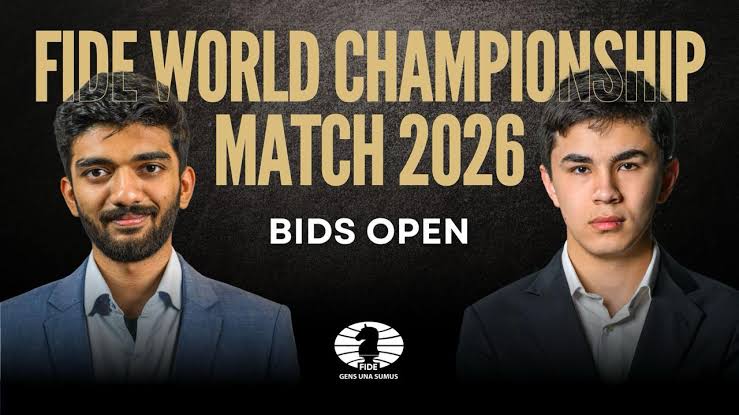
The youngest World Chess Championship match in history began the only way a true title fight should — with tension, time pressure, and zero room for comfort. On 24 November in the quiet surroundings of the Fondation Martin Bodmer near Geneva, defending champion Dommaraju Gukesh of India held challenger Javokhir Sindarov of Uzbekistan to a hard-fought draw after 38 moves. The score stands 0.5–0.5. Game 2 is scheduled for later today with Gukesh having the white pieces.
Sindarov, playing white, opened with the Ruy Lopez. Gukesh replied with the Berlin Defence, a rock-solid choice that has frustrated many an attacker. Queens left the board early. What followed was not a dull theoretical exercise but a practical battle. Sindarov, clearly well-prepared, kept the pressure high and forced Gukesh into serious time trouble. At one stage the Indian had less than ten minutes for a long stretch of moves while his opponent sat comfortably for over an hour. Yet Gukesh refused to crack. Accurate defensive moves, including a crucial king centralisation and careful handling of the same-coloured bishop ending, neutralised the pressure. The game ended by threefold repetition after a brief procedural hiccup when Sindarov incorrectly claimed the draw and the arbiter added two minutes to Gukesh’s clock.
Commentators called it a psychological win for the champion. Surviving the first examination with the black pieces against a hungry, higher-rated challenger is never easy. Gukesh later described the time pressure as “a little scary” but insisted he always felt the position remained under control. Sindarov admitted he tried to push every moment because of the clock advantage yet found no breakthrough against precise defence.
This is high-level classical chess at its purest: long thinking, zero major blunders, and a result that reflects the quality of both players. Both are just 20 years old. The match itself is historic simply for that reason. The prize fund is $2.5 million. The first to 7.5 points from a maximum of 14 classical games takes the title. Tiebreaks, if needed, are scheduled for 12 December.
Yet while the world focuses on the board in Geneva, the deeper story sits far from Switzerland. India now produces world champions with alarming regularity. Gukesh is the latest proof. Viswanathan Anand before him. A generation of young grandmasters following. This success does not happen because of the system. It happens in spite of it.
Indian sports administration continues to treat chess as a convenient afterthought once the medals arrive. Funding remains patchy and reactive. Training infrastructure outside a few elite centres is still inadequate. School and college systems actively discourage deep focus on a “non-glamorous” sport. Most young players still rely on private academies, family sacrifice, and personal coaches rather than any coherent national pathway. When a player reaches the top, the state suddenly appears for photographs and speeches. The years of quiet struggle that made the champion possible are conveniently forgotten.
The same pattern repeats across Olympic sports, athletics, and almost every discipline that does not generate the kind of money cricket does. Cricket itself survives on commercial muscle, not administrative excellence. Chess, by contrast, survives on individual brilliance and a thin layer of private support. That a 20-year-old from Chennai can sit across the board as world champion is a triumph of personal will, family support, and a handful of dedicated coaches. It is not a triumph of policy.
Game 2 later today will show whether Gukesh can begin to seize the initiative with the white pieces. The match is young. Thirteen games remain. The quality so far suggests both players are ready for a long, draining fight. But while the two young men play for the highest title in chess, the larger question for India remains unanswered: how many more Gukeshes are we prepared to lose simply because the system that should nurture them continues to look the other way?
Official Sources
FIDE official broadcasts and statements; post-game press conferences of Dommaraju Gukesh and Javokhir Sindarov; reporting from FIDE-accredited media and major Indian sports desks covering the match in Geneva.