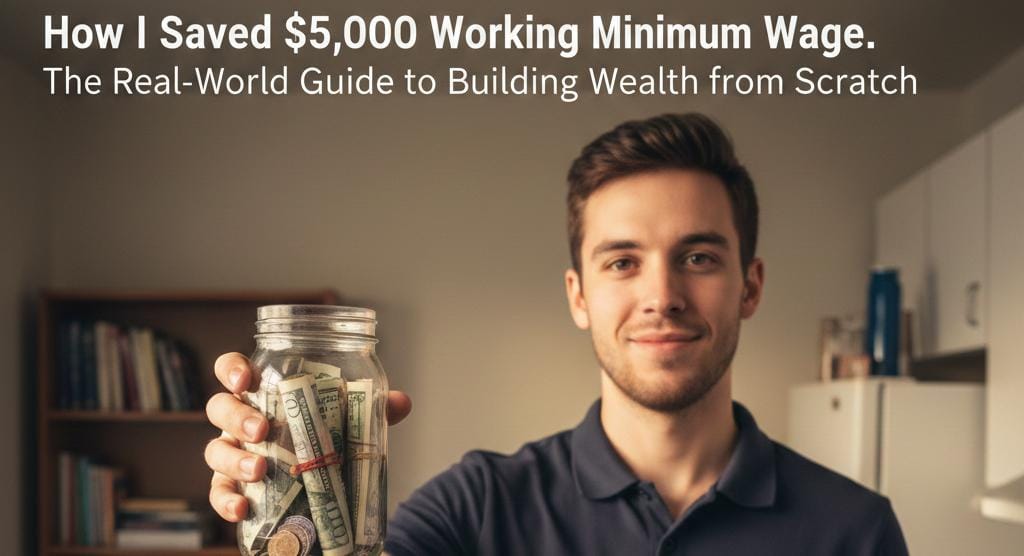
Introduction: The "Minimum Wage Myth" and My Journey
When I started my first job, fresh out of high school, earning minimum wage, I heard it all. "You'll never get ahead." "Saving is impossible on that kind of money." "Just focus on paying the bills." For a while, I believed it. My paychecks felt like they evaporated as soon as they hit my account. Rent, groceries, transportation, and a few meager attempts at a social life ate up every dollar.
But deep down, I knew there had to be a different way. I wasn't aiming for early retirement or a yacht, but I desperately wanted a financial safety net – enough to cover an unexpected expense, or even just to have options beyond living paycheck to paycheck. My initial goal was a modest $1,000, then $2,000, until I eventually hit $5,000 in savings, all while earning an hourly wage that barely kept pace with inflation.
This isn't a story about winning the lottery or inheriting money. It's a practical, no-fluff guide for anyone who feels stuck, overwhelmed, or convinced that saving money on a low income is an impossible dream. It’s about the small, consistent habits and mindset shifts that allowed me to build a significant cushion from the ground up.
Step 1: Confronting Reality – The Brutal Budget Audit
The first and most crucial step was to stop pretending. I had to know exactly where every single dollar was going. This wasn't about guilt-tripping myself; it was about gaining control.
The Spreadsheet of Shame (and Enlightenment)
I created a simple spreadsheet. On one side, I listed my exact net income per paycheck. On the other, I meticulously tracked every expense for a full month. And I mean every expense:
- Fixed Costs: Rent, utilities, phone bill, internet (these were non-negotiable, but I still looked for cheaper alternatives where possible).
- Variable Necessities: Groceries, transportation (gas/bus pass), basic toiletries.
- "Leakage" Costs: This was the eye-opener. Daily coffee runs, impulsive fast food, streaming subscriptions I barely used, that extra snack from the convenience store. These small, seemingly insignificant purchases added up to a shocking amount.
- My Revelation: I discovered I was bleeding money through dozens of tiny, almost unconscious decisions. That $4 coffee every workday? That's $80 a month, or nearly $1,000 a year! The three streaming services I rarely watched? Another $30-$40 a month. These weren't "bad" things, but they were definitely hindering my progress.
- Actionable Advice: Don't just estimate. Use bank statements, credit card statements, and even a note on your phone to track everything for 30 days. Most banks now offer spending insights in their apps – use them! The truth might sting, but it's the only way to move forward.
Step 2: The "Pay Yourself First" Philosophy (Even If It’s Just $5)
This was the biggest game-changer. Before I paid a single bill or bought a single snack, a portion of my paycheck went directly into savings.
Automate Small, Consistent Deposits
Initially, I could only afford to save $10 from each bi-weekly paycheck. It felt pathetic. $20 a month? That would take forever to hit $5,000! But I stuck with it. I set up an automatic transfer for the day after my paycheck landed. This removed the decision-making and the temptation to spend it.
- Why Automation Works: If the money never hits your checking account, you don't miss it. It becomes a non-negotiable "bill" you pay yourself. It also leverages the power of consistency. Small, regular deposits accumulate far faster than sporadic, larger ones.
- My Revelation: Even $5 or $10 per paycheck adds up. If you save $10 bi-weekly, that's $260 a year. Not huge, but it builds momentum and reinforces the habit. As my income occasionally increased (a few extra hours, a small raise), I immediately increased my automatic transfer.
- Actionable Advice: Set up an automatic transfer from your checking to a separate savings account for the day after your payday. Start with whatever you can genuinely afford – $5, $10, $20. Make it non-negotiable. Treat it like a bill you absolutely must pay.
Step 3: Ruthless Optimization – Cutting Costs Without Sacrificing Sanity
Once I knew where my money was going and had my automated savings in place, I focused on reducing expenses in meaningful ways. This wasn't about deprivation, but about smart choices.
Food: The Biggest Budget Buster
This was my largest variable expense. Eating out, even fast food, was a huge drain.
- Meal Prep Like a Pro: Sundays became my cooking day. I'd make a big batch of something versatile (rice and beans, chicken and veggies, pasta salad) that could be portioned for lunches and dinners for several days.
- Grocery Store Savvy: I learned to shop the sales, buy generic brands, and never shop hungry. Planning meals before I went to the store prevented impulse buys. I also reduced meat consumption, which is often the most expensive item.
- Water is Free: Carried a reusable water bottle everywhere instead of buying bottled drinks.
Transportation: Walking, Biking, and Public Transit
My job was within walking distance, which saved a lot on gas. For longer distances, I relied on public transport. If I absolutely needed a ride, I'd carpool with a friend or use a ride-share service only after considering the cost.
Entertainment: Free & Frugal Fun
This was a tough one, as I didn't want to become a hermit.
- Leverage the Library: Books, movies, music, and even passes to local museums were all free.
- Outdoor Activities: Hiking, biking, picnics, exploring parks – these were great, free ways to socialize and stay active.
- "Potluck" Socializing: Instead of expensive dinners out, my friends and I started doing potlucks or cooking together, which was more fun and much cheaper.
- One Streaming Service: I cut down to just one streaming service and rotated it every few months to catch up on shows.
Clothing & Miscellaneous: Needs vs. Wants
- Second-Hand First: Thrift stores became my go-to for clothes, books, and even some household items.
- The "30-Day Rule": For any non-essential purchase over a certain amount, I'd wait 30 days. More often than not, the desire would pass, saving me money.
- My Revelation: Many "necessities" were actually habits or conveniences I could live without or replace with cheaper alternatives. Cutting back didn't mean suffering; it meant being more intentional and creative.
- Actionable Advice: Go through your variable expenses and identify the top 2-3 areas where you spend the most. Brainstorm 2-3 specific, actionable ways to reduce spending in each of those areas this week. Start with food – it's often the easiest win.
Step 4: Finding Extra Income – The Side Hustle Mentality
While my main income was minimum wage, I learned that a little extra on the side could significantly accelerate my savings. This wasn't about getting a second full-time job but about leveraging small opportunities.
Micro-Gigs and Odd Jobs
- Babysitting/Pet Sitting: Friends and family often needed help, and I offered my services for a fair hourly rate.
- Selling Unused Items: My closet and garage became sources of cash. Old clothes, electronics, books – anything I hadn't used in a year went up for sale online or at a garage sale.
- Online Surveys/Task Sites: While they don't pay much, a few dollars here and there added up, especially during downtime.
- Freelance Skills: I offered to help with basic tasks like data entry or social media management for small local businesses, charging a modest hourly rate. Even just 5 extra hours a week at minimum wage was an additional $35-$40 that went straight to savings.
The "Found Money" Jar
Any unexpected money – a small gift, a rebate, a few dollars found on the street, or even loose change from my couch – went straight into a "found money" jar. When it accumulated to $20, it went into savings. It’s a small psychological trick that reinforces positive saving habits.
My Revelation: Every little bit truly helps. An extra $50 here, $100 there, made a huge difference in hitting my savings goals faster. It also provided a sense of empowerment – I wasn't just cutting back; I was generating more.
Actionable Advice: Look around you. What do you have that you can sell? What small services could you offer to friends, family, or neighbors for a modest fee? Even an hour or two of extra work a week can make a noticeable impact on your savings rate.
Step 5: The Mindset Shift – Patience, Persistence, and Celebrating Small Wins
Saving money, especially on a low income, is a marathon, not a sprint. There will be setbacks. There will be times you feel discouraged. This is where mindset becomes critical.
Embrace Delayed Gratification
I learned to differentiate between immediate wants and long-term goals. That new gadget or fancy meal might feel good for an hour, but the feeling of watching my savings account grow was far more satisfying and lasting.
Focus on Progress, Not Perfection
There were weeks I saved less than I planned, or even had an unexpected expense that dipped into my emergency fund (which meant rebuilding). Instead of beating myself up, I acknowledged it, adjusted, and got back on track. One bad week doesn't derail the entire journey.
Celebrate Milestones
Hitting $100 saved, then $500, then $1,000 – these were huge wins. I didn't spend money to celebrate, but I allowed myself a small, free indulgence (a long walk, a movie from the library, an extra hour of reading) and acknowledged my hard work. These small celebrations kept me motivated.
Educate Yourself Continuously
I started reading books, blogs, and listening to podcasts about personal finance. The more I learned, the more confident I became in my decisions and the more strategies I discovered. Knowledge is power, especially when you're starting with limited resources.
- My Revelation: Saving isn't just about the money; it's about building discipline, resilience, and a profound sense of self-reliance. The $5,000 wasn't just a number; it represented freedom and possibility.
- Actionable Advice: Find an accountability partner or join an online community for support. Read one personal finance article or listen to one podcast episode a week. Remind yourself why you're saving and visualize the positive impact it will have on your life.
$5,000 Saved, and a Future Unlocked
Reaching that $5,000 mark felt monumental. It wasn't just cash in a bank account; it was tangible proof that financial security isn't exclusive to those with high incomes. It showed me that with intentional effort, consistent habits, and a refusal to believe the limitations others set, anyone can build a foundation for a more secure future.
My journey didn't end at $5,000. That initial success gave me the confidence and skills to continue saving, invest wisely, and eventually pursue higher-paying opportunities. But it all started with those first few dollars, saved diligently, one paycheck at a time, from a minimum wage job.
If I can do it, you can too. Start small, stay consistent, and believe in the power of your own financial agency. The path might be slow, but the destination of financial empowerment is absolutely worth every step.
"The decisions we make today will shape the world for generations to come."