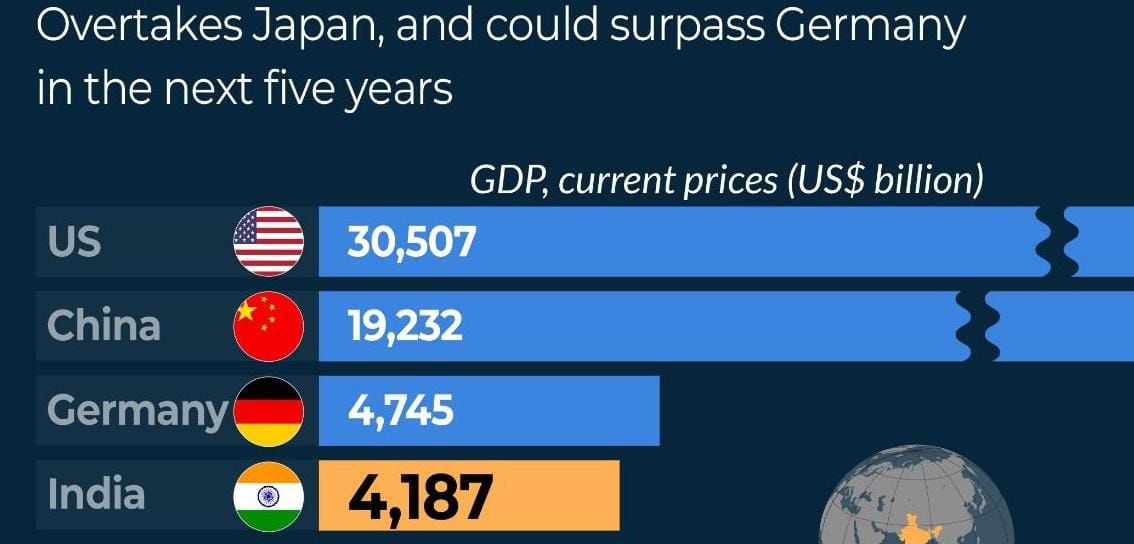
As 2026 dawns, the global economic map has been permanently redrawn. In a landmark shift for the "Asian Century," India has officially overtaken Japan to become the world’s fourth-largest economy. With a nominal GDP reaching $4.18 trillion, India now trails only the United States, China, and Germany. This is not merely a statistical milestone; it is a testament to a decade of "Big Bang" reforms, a resilient domestic market, and a strategic pivot in global supply chains.
The journey from the world’s tenth-largest economy in 2014 to the fourth in 2026 represents one of the most rapid ascents in modern history. While the global economy has faced headwinds—ranging from trade wars to energy transitions—India has maintained a "Goldilocks" momentum: high growth paired with controlled inflation.
The Pillars of the $4 Trillion Milestone
India’s rise to the fourth spot is built on four distinct pillars that converged in 2025 to push the nation past Japan.
1. The "Big Bang" Reform Era
The year 2025 was described by many economists as a "policy reset." The government implemented a series of long-stalled structural changes:
- Labor Code Rollout: Consolidating 29 complex statutes into four streamlined codes.
- GST Rationalization: Simplifying the tax structure into fewer slabs, which boosted compliance and reduced logistics costs.
- FDI Liberalization: Allowing 100% foreign ownership in sectors like insurance and private participation in nuclear energy.
2. The "China Plus One" Strategy
Geopolitics has acted as a tailwind. As global corporations sought to diversify their manufacturing bases away from China, India’s Production Linked Incentive (PLI) schemes became a magnet. The electronics sector, led by iPhone manufacturing, moved from simple assembly to high-value component production.
3. The Digital Public Infrastructure (DPI)
The "India Stack"—comprising UPI, Aadhaar, and digital lockers—has digitized the informal economy at a scale unseen elsewhere. In December 2025 alone, UPI processed over 21 billion transactions, facilitating a velocity of money that fuels consumption even in the most remote villages.
4. Robust Domestic Consumption
Unlike export-dependent economies, India’s growth is anchored by its 1.4 billion people. A young demographic, rising middle-class incomes, and a significant reduction in the poverty rate have created a self-sustaining cycle of demand.
India’s ascent is particularly impressive because it is the only economy in the Top 5 growing at a rate exceeding 7%. At this trajectory, economists predict India will surpass Germany by late 2027 or early 2028, securing the third spot on the global podium.
Sectoral Drivers: What’s Moving the Needle?
The transition to the fourth-largest economy has been led by a diversification of the "India Story."
The Services Revolution 2.0
While IT services remain a bedrock, the rise of Global Capability Centers (GCCs) has transformed India into the world’s back office for high-end R&D. Engineering, legal, and accounting services are now exported at a record scale, with India's share of global services exports rising to 4.5%.
Manufacturing and Semiconductors
The "Make in India" initiative has finally found its footing in high-tech manufacturing. With the first Indian-made chips rolling out of domestic fabrication units in 2026, the country is reducing its import dependence on critical minerals and technology.
The Green Transition
India has emerged as a leader in the renewable energy space. Massive investments in green hydrogen and solar parks have not only helped meet climate goals but have also created a new industrial core centered on battery manufacturing and electric vehicle (EV) ecosystems.
The Challenges: The "Road to $7 Trillion"
While the fourth-place ranking is a cause for celebration, the path to becoming a $7 trillion economy by 2030 is fraught with structural hurdles.
1. The Per Capita Reality
While the aggregate GDP is massive, India’s per capita income remains low compared to its peers. The challenge for 2026 and beyond is "inclusive growth"—ensuring that the wealth generated in tech hubs like Bengaluru and Mumbai trickles down to the rural heartlands.
2. Skill Gaps and Unemployment
Despite being a young nation, a "skills mismatch" persists. The workforce needs rapid upskilling to meet the demands of an AI-driven and automated manufacturing environment.
3. Land and Agricultural Reforms
To truly rival China’s manufacturing scale, India needs easier land acquisition laws. Furthermore, the agricultural sector, which employs nearly half the population, requires modernization to improve productivity and farmer incomes.
A New Era of Global Leadership
India’s rise to the world’s fourth-largest economy is a "coming of age" moment. It signals to the world that India is no longer just a "promising" market but a dominant global engine. The "India Story" has shifted from one of potential to one of performance.
As the nation looks toward the $5 trillion mark and the third-place ranking, the focus must remain on the ease of living for its citizens. By balancing macro-growth with micro-reforms, India is not just climbing a leaderboard; it is defining the economic architecture of the 21st century.