The New Pillars of Indian Growth
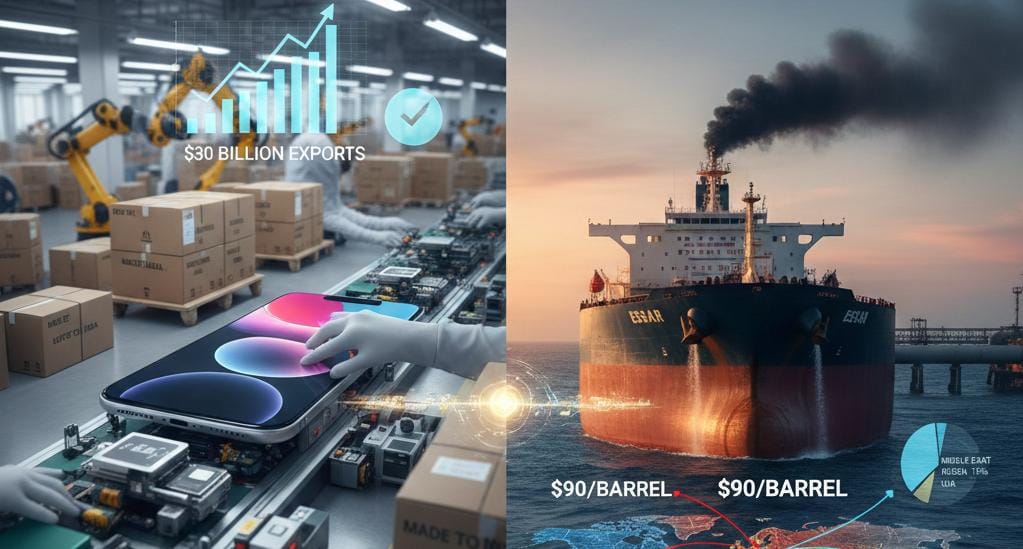
As we enter 2026, the narrative of the Indian economy is being rewritten by two distinct yet interconnected forces: the meteoric rise of high-tech manufacturing and a masterclass in energy diplomacy. On one hand, India has successfully pivoted from being a net importer of electronics to a global smartphone export powerhouse, with shipments hitting a historic $30 billion in 2025. On the other, the nation is navigating a "crude lifeline" transition, balancing discounted Russian oil against increasing pressure from Western trade partners and a volatile Middle East.
These shifts represent more than just trade statistics; they signal India’s evolution into a "multi-aligned" economic power that leverages its domestic market to build global supply chains while securing its energy future through strategic diversification.
I. The Smartphone Revolution: From "Make in India" to "Export from India"
The most visible success story of India’s industrial policy is the smartphone sector. Driven by the Production-Linked Incentive (PLI) scheme, India has leapfrogged its own targets to become the world’s second-largest mobile phone manufacturer.
The $30 Billion Milestone
In the 12-month period ending December 2025, India’s smartphone exports surged by 47% compared to 2024. This growth is anchored by a significant shift in the global supply chain, often referred to as the "China Plus One" strategy.
- The Apple Factor: Apple’s iPhone exports from India crossed the ₹2 lakh crore ($24 billion+) mark in 2025, representing roughly 75% of the country’s total smartphone exports.
- Market Dominance in the US: In a historic shift in Q2 2025, India overtook China to become the top smartphone exporter to the United States. Between April and October 2025, shipments to the US tripled to $10.78 billion.
- Infrastructure & Jobs: The ecosystem has expanded from just 2 manufacturing units in 2014 to over 300 today, creating an estimated 25 lakh jobs over the last decade.
Why the Surge is Sustainable
Unlike previous export booms, this growth is rooted in value addition. Companies like Foxconn and the Tata Group are not just assembling; they are deepening the component ecosystem. However, challenges remain as the PLI scheme for smartphones approaches its scheduled conclusion in March 2026, prompting calls for a "PLI 2.0" to sustain momentum.
II. Crude Lifelines: Navigating a Geopolitical Tightrope
While electronics drive the export engine, crude oil remains the fuel that powers India’s domestic growth. With over 85% dependence on oil imports, India’s energy strategy in 2025-26 has become a sophisticated exercise in risk management.
The Russian Pivot and Rebalancing
Since 2022, discounted Russian crude has been a critical "economic shield," saving the Indian exchequer an estimated $3-4 billion annually. However, as of early 2026, the mix is changing:
- Compliance and Diversification: In late 2025, India reduced its Russian imports by nearly 38% (from peak levels) to mitigate the risk of secondary sanctions and high tariffs from the US.
- The Rise of US Sourcing: In a move to balance trade ties, India’s imports of US crude reached record highs of over 575,000 barrels per day in late 2025.
The "Crude Basket" in 2026:
Middle East: ~40% (Renewed focus on Saudi Arabia and Iraq)
- Russia: ~15-20% (Down from 35-40%)
- USA & Americas: Increasing share (Brazil, Guyana, and US variants like WTI Midland)
- Strategic Petroleum Reserves (SPR): The National Shield
To combat global supply shocks, the Indian government has fast-tracked the expansion of its Strategic Petroleum Reserves. Currently holding a capacity of 5.3 million tonnes, plans are underway to double this capacity through new underground salt cavern storage sites. This "insurance policy" ensures that India can withstand 60-90 days of supply disruption, a vital necessity in an era of unpredictable maritime conflicts.
III. The FDI Landscape: Confidence Amid Volatility
Foreign Direct Investment (FDI) serves as the bridge between India’s manufacturing ambitions and its energy needs. Despite global monetary tightening, India’s gross FDI inflows remained resilient, increasing by 15.4% to approximately $58.3 billion in the first half of FY26.
India's FDI and smartphone exports strong; crude lifelines surging amid global shifts.