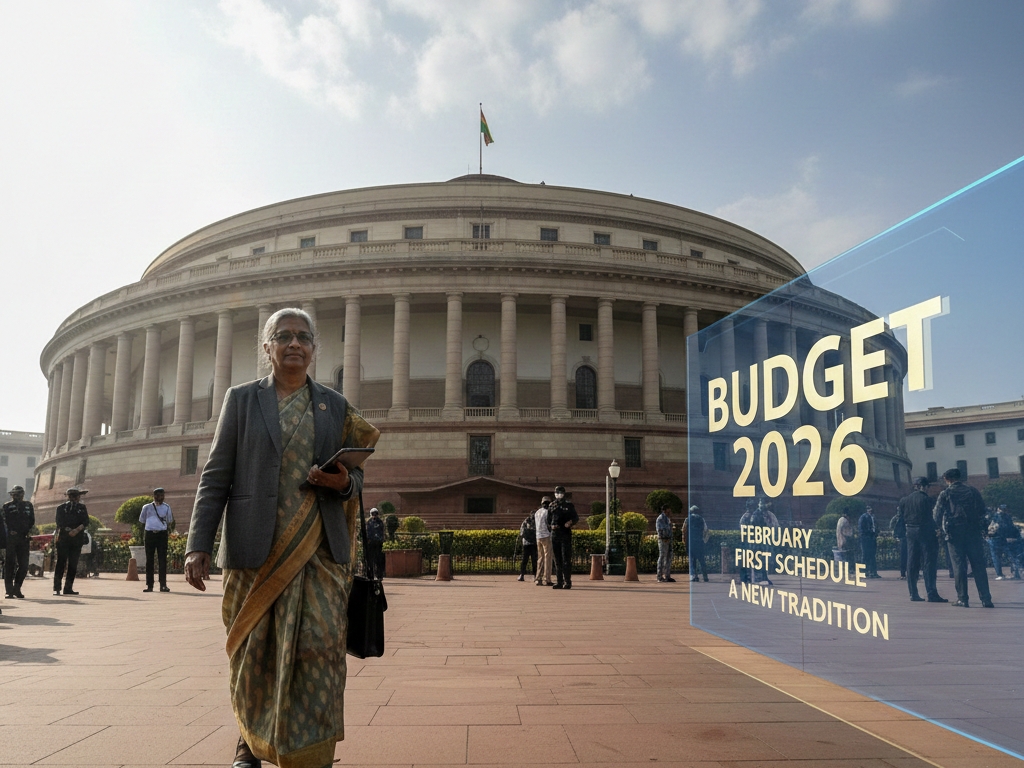
India is set for a rare weekend sitting of Parliament as Finance Minister Nirmala Sitharaman presents the Union Budget 2026‑27 on Sunday, February 1, 2026, at 11 a.m., continuing the convention of a February 1 Budget date even though it falls on a holiday. This Budget will be the 88th since Independence and comes against the backdrop of robust economic growth, with advance estimates pegging real GDP expansion at about 7.4 percent for FY 2025‑26.
The Cabinet Committee on Parliamentary Affairs, chaired by Defence Minister Rajnath Singh, has cleared the broad calendar, with the Budget Session expected to begin around January 28, followed by the tabling of the Economic Survey the next day. After the President’s address and the motion of thanks, the Union Budget and Finance Bill will be taken up, with the first phase of the session likely to run for about three weeks before a recess for detailed scrutiny of demands for grants.
For Sitharaman, the Sunday presentation marks a historic milestone: this will be her ninth consecutive Union Budget, making her the first Indian finance minister to present nine budgets in a row and placing her alongside the country’s most prolific budget-makers. She now stands just one budget short of former Prime Minister Morarji Desai’s all‑time record of 10 Union Budgets, while matching the career tally of P. Chidambaram and surpassing Pranab Mukherjee’s eight.
Although a Sunday Budget is unusual, it is not without precedent in India’s parliamentary history. On February 27, 1999, then finance minister Yashwant Sinha presented the Union Budget on a Sunday and simultaneously broke with the British‑era practice of a 5 p.m. start by shifting the speech to 11 a.m.—a timing that has since become the norm and is being retained for the 2026 exercise.
The decision to stick with February 1 reflects a broader reform launched in 2017, when the government moved the Budget date forward from the traditional February 28 or March 1 slot to give Parliament more time to debate and pass key provisions before the new financial year starts on April 1. Despite February 1, 2026, coinciding with a Sunday and Guru Ravidas Jayanti in some states, convention and continuity are being prioritised, with exchanges and government machinery preparing for special arrangements, including the possibility of a dedicated Sunday trading session to absorb budget‑day announcements.