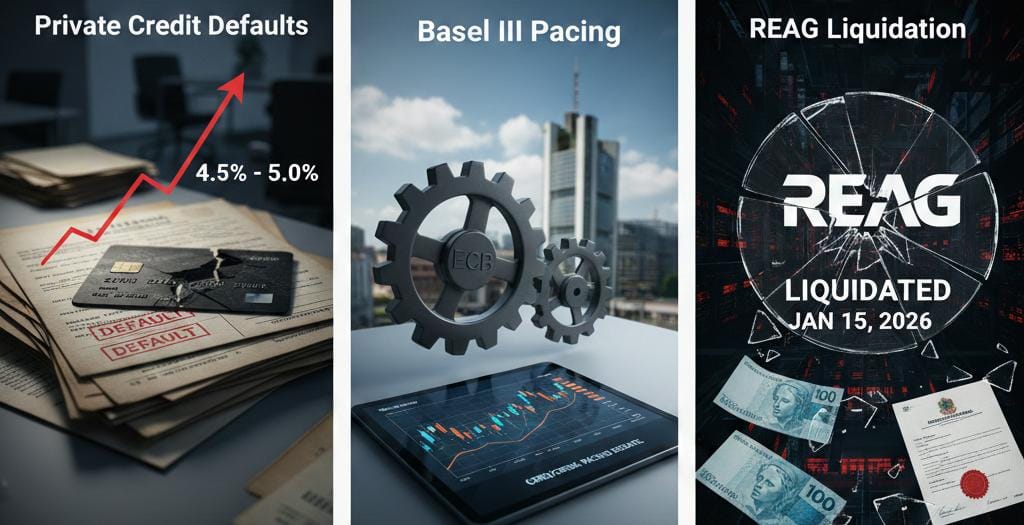
The global financial landscape in early 2026 is undergoing a period of intense recalibration. While the broader economy has shown resilience, the "shadow banking" sector is beginning to show cracks as private credit defaults climb. Simultaneously, European regulators are debating the speed of the final "Basel III Endgame" implementation, and in South America, a major regulatory intervention has seen the liquidation of one of Brazil’s notable brokerages.
The Rising Tide of Private Credit Defaults
For nearly a decade, private credit was the darling of the investment world, offering higher yields than traditional bonds in a low-interest-rate environment. However, as we move into 2026, the honeymoon period has ended.
A Shift in the Credit Cycle
Data from early January 2026 suggests that default rates in private credit funds are moving toward 4.5% to 5.0%, up from historical averages of less than 2%. The primary drivers are:
- Sustained High Interest Rates: Although central banks have stabilized rates, they remain significantly higher than the 2010–2021 average, placing immense pressure on floating-rate borrowers.
- Earnings Compression: Many mid-market companies that took on private debt are seeing their margins squeezed by labor costs and persistent energy prices.
- Maturity Walls: A significant portion of debt issued in 2021 is coming due, and refinancing options are both scarcer and more expensive.
Investors are now shifting their focus from "yield at any cost" to capital preservation. We are seeing a "flight to quality," where top-tier fund managers with robust restructuring teams are outperforming smaller, newer entrants who lack the experience to manage distressed assets.
ECB and the Basel III "Pacing" Debate
In Frankfurt, the European Central Bank (ECB) is currently engaged in high-stakes discussions regarding the implementation of the final Basel III standards, often referred to as CRR3/CRD6 in the European context.
The Regulatory Dilemma
The central debate revolves around pacing. While the goal of Basel III is to ensure banks hold enough capital to survive a crisis, there are concerns that moving too quickly could choke off lending to the real economy—particularly to Small and Medium Enterprises (SMEs) which are already struggling.
ECB officials, including those involved in the 2025 Supervisory Review and Evaluation Process (SREP), have indicated that while capital requirements for 2026 will remain "broadly stable" at around 11.2% CET1, the qualitative requirements for risk management are being tightened. The message is clear: the rules aren't necessarily getting harder immediately, but they are getting smarter and more focused on geopolitical and IT risks.
Brazil’s Financial Shock: The REAG Liquidation
In a move that sent ripples through Latin American markets, the Central Bank of Brazil (BCB) ordered the extrajudicial liquidation of brokerage REAG (formerly known as CBSF) on January 15, 2026.
The Collapse of a Challenger
REAG was once a fast-growing player in the alternative investment space, managing approximately R$ 50 billion in assets at its peak. However, its downfall was precipitated by:
- Serious Rule Violations: Governor Gabriel Galípolo signed the liquidation decree following evidence of "serious violations of the rules governing the national financial system."
- The "Banco Master" Connection: The liquidation is a direct fallout from the collapse of mid-sized lender Banco Master. Federal police and the central bank identified fraudulent fund transfers linked to REAG.
- Operation Carbono Oculto: This massive investigation uncovered a R$ 50 billion money-laundering network. REAG’s founder, João Carlos Mansur, became a primary target of the probe, leading to a loss of market confidence and a fire sale of assets throughout late 2025.
- Regulatory Note: While REAG represents less than 0.001% of Brazil's total financial system assets, its liquidation serves as a stern warning to the "fintech" and "alternative asset" sectors in Brazil that aggressive growth cannot come at the expense of compliance.
Synthesis: What This Means for Global Markets
These three developments—rising private credit defaults, Basel III pacing, and the REAG liquidation—are interconnected threads of a single narrative: The return of risk discipline.
- For Investors: The era of "easy money" and opaque private structures is being replaced by a demand for transparency. The REAG scandal highlights the dangers of complex, inter-connected financial entities.
- For Banks: The ECB's measured approach to Basel III suggests that regulators are wary of causing a "credit crunch," but will demand much better internal governance.
- For Borrowers: Credit is becoming a "seller's market." Only the most resilient companies with clear cash-flow paths will find favorable terms in the private or public debt markets.
As we progress through 2026, the focus will remain on whether these "pockets" of distress remain isolated or if they signal a broader systemic tightening.