The Indian primary market, which reached a fever pitch in late 2025, began 2026 with one of its most anticipated debuts: the initial public offering (IPO) of Bharat Coking Coal Limited (BCCL). As a critical subsidiary of the Maharatna giant Coal India Limited (CIL), BCCL was poised to be a bellwether for Public Sector Undertaking (PSU) valuations. However, the excitement was met with a sudden administrative pivot.
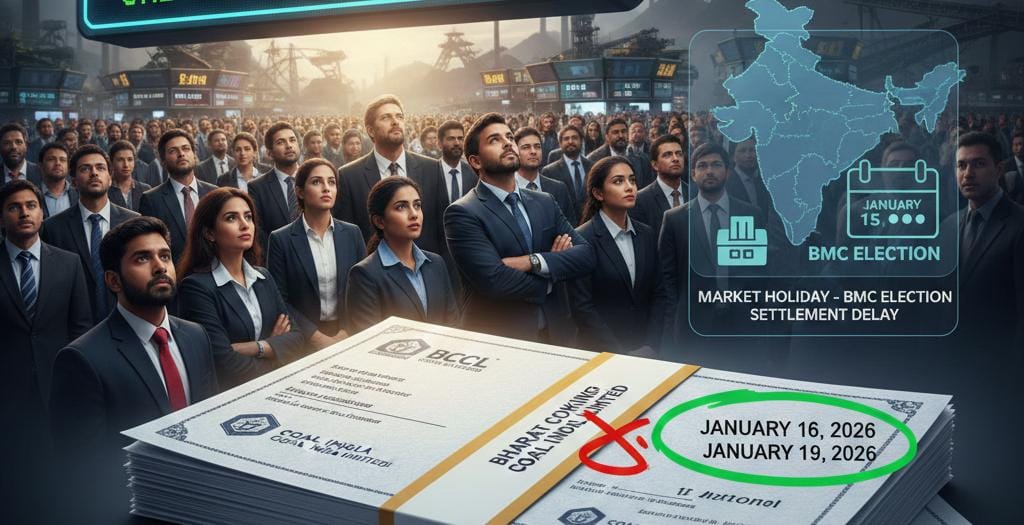
Originally scheduled to debut on the bourses on January 16, 2026, the listing has been officially rescheduled to January 19, 2026. While a three-day delay might seem minor in the grand timeline of a multi-billion-dollar enterprise, it serves as a fascinating case study on the intersection of democratic processes, regulatory compliance, and market logistics.
1. The Immediate Catalyst: The Maharashtra Civic Polls
The primary driver for the immediate delay is rooted in regional governance rather than corporate failure. The Brihanmumbai Municipal Corporation (BMC) elections, scheduled for mid-January, necessitated a market closure on Thursday, January 15, 2026.
Because the Indian stock exchanges (BSE and NSE) operate within Mumbai, significant local events—especially those requiring a large-scale security presence and public holidays—directly impact the settlement cycle.
- Settlement Gridlock: With the market closed on the 15th, the critical T+2 settlement process for share credits and refund processing was interrupted.
- Political Overlap: Authorities often avoid high-stakes listings on days coinciding with major election results (slated for January 16) to prevent excessive volatility or "noise" that could distract from the fundamental price discovery of a new stock.
2. The Structural "Hidden" Delays: Governance and Compliance
While the election was the final hurdle, the BCCL listing process had already faced headwinds in the months leading up to the IPO. In late 2025, reports surfaced regarding vacancies in the Board of Directors.
SEBI mandates a specific ratio of independent directors to ensure corporate governance transparency. For a subsidiary like BCCL transitioning into a public-listed entity, these "procedural" delays were significant. Filling six independent director positions was not merely a box-ticking exercise but a prerequisite for filing the final Red Herring Prospectus (RHP). These earlier governance bottlenecks arguably compressed the timeline, making the final listing date more susceptible to external disruptions like the civic polls.
3. Investor Enthusiasm: A Record-Breaking Response
Despite the scheduling shifts, the appetite for BCCL shares remains unprecedented. The IPO, a 100% Offer for Sale (OFS) by Coal India, sought to raise approximately ₹1,071 crore. The results were nothing short of spectacular:
- Overall Subscription: The issue was subscribed a staggering 146.8 times.
- QIB Participation: Institutional investors led the charge, with the segment oversubscribed by over 310 times.
- Retail Sentiment: Even with the low price band of ₹21–₹23, retail investors flocked to the issue, subscribing nearly 49 times their allotted quota.
The sheer volume of applications—estimated at over 90 lakh—created its own logistical challenge. Managing the allotment for such a massive pool of investors requires precise coordination between the registrar (KFin Technologies) and the clearing houses, a task made more complex by the mid-week bank holiday.
4. The Valuation Perspective: Is the Wait Worth It?
The delay has not dampened the Grey Market Premium (GMP). As of mid-January 2026, the GMP continues to hover around ₹13–₹14, suggesting a listing price of approximately ₹36–₹37. This represents a potential 60% gain for allottees.
BCCL holds a unique "monopoly-like" position in India's energy landscape:
- Coking Coal Scarcity: It is the largest domestic producer of coking coal, which is essential for the steel industry. Currently, India imports the vast majority of its coking coal; BCCL is the primary vehicle for the government's "Atmanirbhar" (self-reliant) mission in this sector.
- Resource Base: With reserves exceeding 7.9 billion tonnes, the company offers long-term visibility that few private players can match.
- Financial Health: For FY25, the company reported revenues of ₹13,083 crore. While profit margins saw a slight dip due to rising operational costs, the company remains debt-free and cash-generative.
5. Strategic Implications for Coal India and the Government
For the parent company, Coal India, the BCCL listing is more than just a fund-raising exercise. It is a strategic "value unlocking" move. By listing its subsidiaries, CIL can:
- Establish Market Valuation: Having a market-determined price for BCCL allows CIL to better value its own consolidated balance sheet.
- Improve Transparency: Listed entities are subject to higher disclosure norms, which can drive operational efficiencies in what was previously a strictly "internal" subsidiary operation.
- Divestment Goals: The listing helps the Government of India meet its divestment targets without losing majority control over vital energy assets.
A Minor Pause in a Major Debut
The delay of the BCCL listing from January 16 to January 19 is ultimately a logistical adjustment rather than a fundamental red flag. In the high-stakes world of Indian IPOs, where retail participation is reaching historic levels, ensuring a "clean" listing day free from administrative or political distractions is in the best interest of the shareholders.
For the millions of investors who bid for a piece of India’s coking coal giant, the extra 72 hours of waiting is a small price to pay for what is expected to be a blockbuster debut. As the market reopens on Monday, January 19, all eyes will be on the ticker to see if the "King of Coking Coal" can live up to the massive hype.