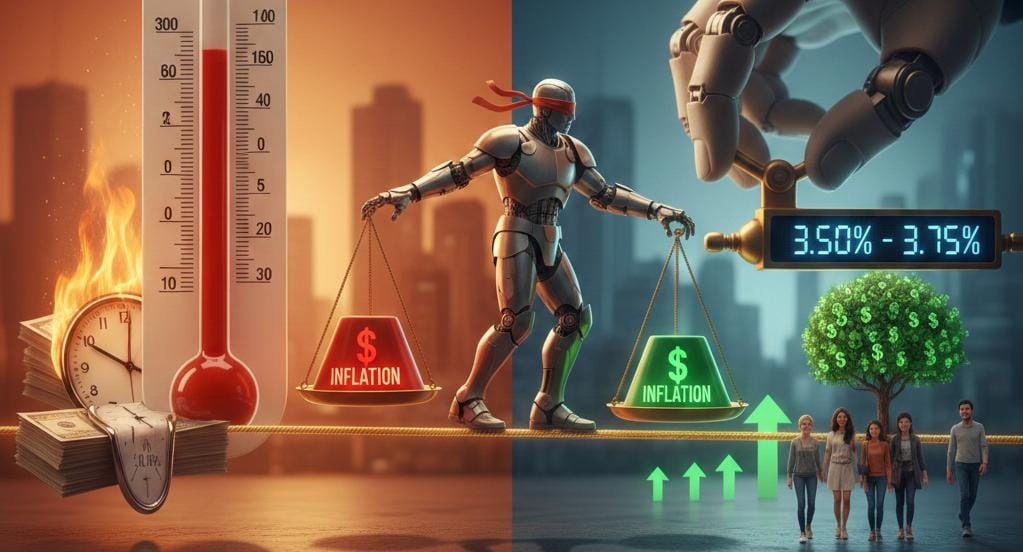
The Federal Reserve’s recent decision to lower the federal funds rate to a target range of 3.50%–3.75% marks a definitive, albeit controversial, shift in American economic strategy. For the past two years, the narrative was dominated by "higher for longer," a mantra designed to crush the post-pandemic inflationary surge. Now, as the central bank initiates a descent from the peak, it finds itself navigating a narrow corridor between two looming threats: a cooling labor market and an inflation rate that refuses to retreat to the 2% target.
This policy move was not a unanimous victory. It was a closely contested decision that reflects a deep philosophical divide within the Federal Open Market Committee (FOMC). With inflation currently hovering near 3%, the Fed is testing a bold hypothesis: that the economy can handle a moderate loosening of credit without reigniting the inflationary fires.
The Anatomy of "Sticky" Inflation
To understand why this rate cut was so contentious, one must look at the nature of current price pressures. While "headline inflation"—the total inflation including food and energy—has dropped significantly from its 2022 peaks, "core inflation" remains stubborn.
The term "sticky inflation" refers primarily to the service sector and housing. Unlike manufactured goods, which benefit from resolved supply chains and global competition, services (such as healthcare, education, and insurance) are driven by domestic wages and long-term contracts. When inflation becomes embedded in the service sector, it becomes harder to dislodge. By cutting rates while inflation sits at 3%, critics argue the Fed risks signaling that it has abandoned its 2% mandate, potentially de-anchoring inflation expectations and leading to a permanent higher-cost environment.
The Rationale for the Cut: Protecting the "Real" Economy
If inflation is still 100 basis points above the target, why cut at all? The answer lies in the Fed’s dual mandate: to promote maximum employment alongside stable prices.
As interest rates remained at restrictive levels, cracks began to appear in the broader economy:
- The Labor Market: Recent data shows a slowdown in monthly job creation and a gradual rise in the unemployment rate. While not yet in "recession territory," the momentum is downward.
- Manufacturing Contraction: Higher borrowing costs have stifled capital expenditure. Businesses are hesitant to invest in new machinery or facilities when the cost of debt is high.
- The Yield Curve: Persistent inversion of the yield curve has long signaled that markets expect a slowdown. By lowering the short-term policy rate, the Fed is attempting to "un-invert" the curve and normalize the lending environment.
The Fed’s logic is preemptive. Monetary policy operates with "long and variable lags," meaning a rate cut today won’t fully impact the economy for several months. If the Fed waits until the labor market is in a freefall to cut rates, it will likely be too late to prevent a hard landing.
The Mechanics of the 3.50%–3.75% Range
The federal funds rate is the interest rate at which commercial banks borrow and lend their excess reserves to each other overnight. It is the "north star" for all other interest rates in the global economy.
When the Fed lowers this range to 3.50%–3.75%, a series of domestic and global shifts occur:
- Lower Consumer Borrowing Costs: Mortgage rates, auto loans, and credit card APRs typically track the federal funds rate. This cut provides immediate relief to households, potentially boosting discretionary spending.
- Corporate Refinancing: Many companies that took out "cheap debt" in 2020 and 2021 are facing "maturity walls"—dates when they must refinance at current rates. A lower rate environment reduces the risk of a wave of corporate defaults.
- Dollar Valuation: Lower interest rates tend to weaken the U.S. dollar relative to other currencies. While this makes American exports more competitive abroad, it can also make imports more expensive, ironically adding to the "sticky" inflation the Fed is trying to monitor.
The Dissenting View: The Risk of a Second Wave
The "closely contested" nature of this decision suggests that several FOMC members are haunted by the ghosts of the 1970s. During that era, the Fed—led by Arthur Burns—cut rates prematurely as soon as inflation showed signs of dipping. The result was a "double-top" in inflation that eventually required the shock therapy of Paul Volcker’s 20% interest rates to cure.
The dissenters argue that by easing now, the Fed is providing "dry tinder" for a second wave of inflation. If consumer demand surges because of cheaper credit while the labor market remains relatively tight, companies will continue to pass on higher wage costs to consumers. In this view, the 3.50%–3.75% range is not "neutral" but "stimulative," which may be inappropriate for an economy where prices are still rising at 3% annually.
The Path Forward: Data Dependency
The Fed has been clear that this cut does not necessarily signal the start of a rapid "race to the bottom." Instead, the policy is now in a state of "Data Dependency."
The 3.50%–3.75% range is likely a "wait-and-see" station. The committee will be looking for two specific indicators before the next move:
- Supercore Inflation: Inflation minus food, energy, and housing. If this number begins to trend toward 2%, further cuts are likely.
- The Sahm Rule: A recession indicator related to the unemployment rate. If unemployment continues its upward drift, the Fed may be forced to prioritize the "employment" side of its mandate even more aggressively.
A New Economic Chapter
The transition to a 3.50%–3.75% target range represents the Fed’s attempt to orchestrate a "soft landing"—a scenario where inflation returns to target without a significant spike in unemployment. It is an exercise in precision engineering conducted with blunt instruments.
For businesses and investors, the era of "free money" is not returning, but the era of "crushing' rates" appears to be sunsetting. The challenge remains the "sticky" 3%. If the Fed can maintain this balance, they will have achieved one of the most difficult feats in central banking history. If they fail, they may find themselves forced into a painful U-turn later this year.
The stakes could not be higher. As the global economy watches, the Federal Reserve is betting that 3.50% is the "Goldilocks" zone—just right for growth, but just cool enough to keep the inflationary embers from becoming a blaze.
"The decisions we make today will shape the world for generations to come."