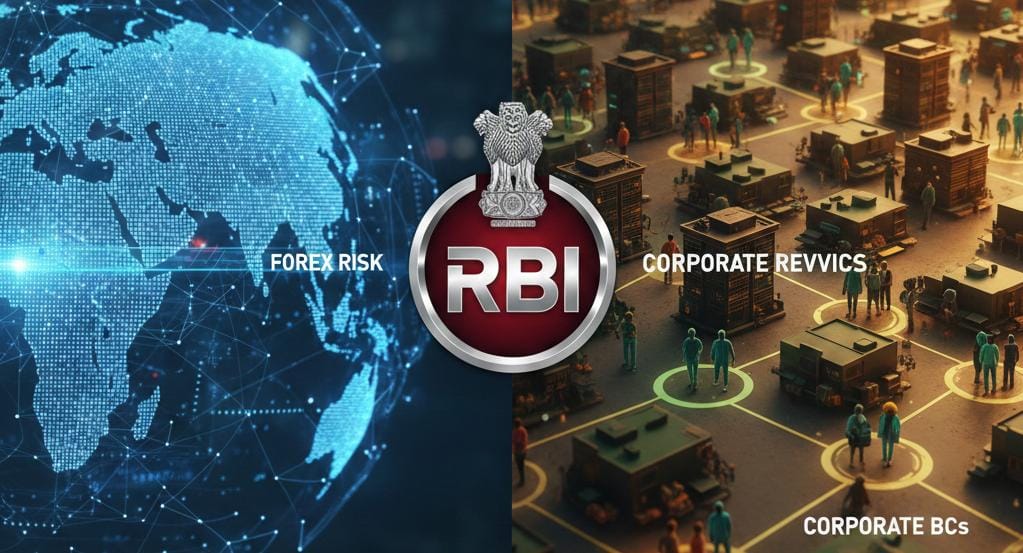
In a significant move to bolster the resilience of India’s financial architecture, the Reserve Bank of India (RBI) has simultaneously turned its gaze toward two critical yet disparate areas of the banking ecosystem: the Foreign Exchange (Forex) risk capital norms and the regulatory framework for Corporate Business Correspondents (BCs).
As of January 2026, the central bank’s latest proposals indicate a shift from periodic compliance to continuous, real-time oversight. For banks, this means a rigorous daily recalibration of capital for forex exposure. For the corporate BC landscape, it signals the potential end of the "regulatory arbitrage" era, as the RBI explores a formal licensing regime to ensure accountability in the last-mile delivery of financial services.
Part I: The Forex Risk Overhaul – From Periodic to Perpetual
Historically, banks managed their foreign exchange risk capital on a monthly or quarterly reporting basis. However, in an era of hyper-volatile global markets and lightning-fast capital flows, the RBI has recognized that "matched" assets and liabilities are no longer a sufficient shield against currency fluctuations.
The Move to "Continuous Compliance"
The core of the RBI’s new proposal is the mandate for banks to maintain capital for foreign exchange risk on an ongoing, end-of-day basis.
Daily Recalculation: Banks must now compute their Net Open Position (NOP) and allocate capital charges at the close of every business day.
Dual-Level Monitoring: The norms apply at both the standalone level (individual bank) and the consolidated level (banking group), ensuring that risks hidden in subsidiaries do not threaten the parent entity.
Why Now? The Rationale of Stability
The RBI’s logic is rooted in a fundamental prudential truth: exchange rate movements can erode a bank’s Capital Adequacy Ratio (CAR) even if its foreign currency assets and liabilities are perfectly matched. If the Indian Rupee (INR) depreciates significantly, the value of foreign currency assets in INR terms increases, causing the total risk-weighted assets to swell and the CAR to drop. By requiring daily capital buffers, the RBI is ensuring that banks are not caught off-guard by "Black Swan" currency events.
Strategic Exclusions: A Balanced Approach
While the screw is tightening, the RBI has provided sensible exclusions to prevent "capital trapping":
Structural Investments: Banks may exclude long-term investments in foreign branches or subsidiaries, provided they are held for at least six months and used as a hedge against capital ratio volatility.
Matured/NPA Assets: Securities that have matured but remain unpaid, or those classified as non-performing assets, are exempt from forex risk charges (though they remain subject to credit risk charges).
Capital Deductions: Any position already deducted from regulatory capital is excluded to avoid double-counting.
Part II: The Corporate BC Shake-up – Bridging the Accountability Gap
While the forex changes focus on the "Global" face of Indian banking, the proposed rules for Corporate Business Correspondents (BCs) address its "Grassroots" face.
For years, Corporate BCs—large entities that act as intermediaries to provide banking services in unbanked areas—have operated under a relatively loose contractual framework with banks. The RBI is now contemplating a transition to a licensing regime for these entities.
Addressing the "Shadow Banking" Risk
The RBI's scrutiny of Corporate BCs stems from several emerging concerns:
Regulatory Arbitrage: Many large BCs perform functions nearly identical to banks or NBFCs but without the same level of capital requirements or governance standards.
Customer Protection: In recent years, there has been a rise in complaints regarding unauthorized charges, data privacy breaches, and mis-selling at BC points.
Operational Resilience: As BCs handle a massive volume of Direct Benefit Transfers (DBT) and micro-deposits, their systemic importance has grown. A failure of a major corporate BC could disconnect millions from the banking system overnight.
What the New Rules Could Look Like
While the final circular is awaited, industry insiders expect the RBI to focus on:
Minimum Net Worth: Raising the bar for entry to ensure only "serious players" with deep pockets can operate at scale.
Governance Standards: Mandating board-approved policies and independent audits for BCs, similar to the requirements for NBFCs.
Restricting Intermediary Layers: Limiting the number of sub-agents a corporate BC can hire to ensure clear lines of accountability.
Part III: The Intersection of Forex and BC Regulation
At first glance, forex risk and rural BCs seem miles apart. However, they are two sides of the same coin: Risk Containment.
The RBI is currently engaged in a broader project of "Segregating Core and Non-Core Activities." The updated Financial Services Directions 2025 already prohibit banks from using group entities to bypass regulatory limits. By tightening forex norms, the RBI ensures that the wholesale side of the balance sheet is secure. By regulating BCs, it ensures the retail distribution network is stable.
Together, these moves create a "Safe Corridor" for Indian banks to grow. The message is clear: Whether you are trading derivatives in Mumbai or collecting deposits in a village in Bihar, the capital backing that transaction must be real, documented, and sufficient.
Strategic Implications for Banks and Corporates
For the banking sector, 2026 will be a year of technological and operational realignment.
1. The SupTech Imperative
The requirement for daily forex capital calculation makes manual spreadsheets obsolete. Banks will need to invest in SupTech (Supervisory Technology) and AI-driven risk engines to provide real-time dashboards of their NOP.
2. Consolidation in the BC Space
Smaller corporate BCs may find the new licensing and capital norms too high to climb. This is likely to lead to a wave of M&A activity in the fintech and BC sector, as larger, well-capitalized firms swallow smaller players to gain scale.
3. Enhanced Transparency
Both sets of rules point toward a future where "hidden risks" are no longer tolerated. Banks will have to be more transparent in their ICAAP (Internal Capital Adequacy Assessment Process) reports, and BCs will have to embrace a culture of compliance over "growth at any cost."
A Resilient Path Forward
The RBI’s double-pronged approach—scrutinizing the global risks of forex and the local risks of corporate BCs—represents a mature evolution of Indian financial regulation. By shifting to continuous monitoring and formal licensing, the central bank is not just reacting to past crises but pre-emptively fortifying the system against future ones.
While these rules may initially increase the "cost of doing business," the long-term dividend is a financial system that is more stable, more predictable, and significantly more trusted by both global investors and domestic savers.
"The decisions we make today will shape the world for generations to come."