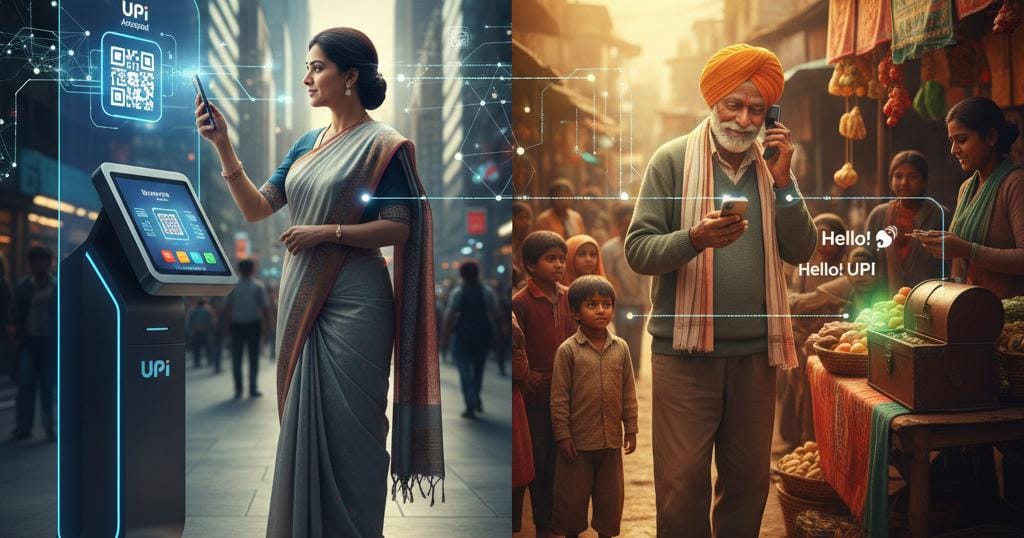
The story of India’s digital transformation is often told through the lens of a QR code. From the roadside tea stall to high-end luxury boutiques, the Unified Payments Interface (UPI) has become the ubiquitous heartbeat of Indian commerce. However, for the Reserve Bank of India (RBI), the current success is merely a foundation. As of early 2026, the RBI has officially set its sights on a monumental milestone: one billion active UPI users.
Reaching this target requires more than just scaling existing apps; it demands a fundamental overhaul of India’s digital payment architecture. With the current user base standing at approximately 400 million, the journey to a billion represents a 150% growth mandate. To achieve this, the central bank is moving beyond the "low-hanging fruit" of urban smartphone users and is actively testing new, resilient infrastructure designed to penetrate the deepest corners of the rural economy and the most sophisticated layers of global finance.
The Current Landscape: A Giant Still Growing
India already accounts for nearly 50% of global real-time retail payment transactions. In the fiscal year 2024-25, the total value of digital transactions reached a staggering ₹22,831 crore, growing at a compound annual growth rate (CAGR) of 41% since 2017. Despite these world-leading numbers, RBI Deputy Governor T. Rabi Sankar recently noted that the digital transaction volume per capita in India still trails behind some advanced and peer economies, such as Kenya.
The vision of 1 billion users is not just about vanity metrics; it is an economic imperative. RBI estimates suggest that a 10% increase in digital payments can lead to a 0.3% addition to the national GDP. By doubling the user base, the RBI aims to formalize the shadow economy, provide credit access to the unbanked, and solidify India's position as the global leader in "Digital Public Infrastructure" (DPI).
Engineering Resilience: Testing the New Infrastructure
To support a billion users, the underlying "pipes" of the payment system must be indestructible. The RBI is currently overseeing the testing and implementation of several critical infrastructure upgrades:
1. The Lightweight Payment and Settlement System (LPSS)
One of the most strategic developments is the conceptualization of a "Lightweight" payment rail. Traditional UPI and NEFT systems rely on complex, heavy-duty infrastructure that can be vulnerable during natural disasters or kinetic warfare. The LPSS is designed to be a "bunker" system—independent of regular networks, requiring minimal hardware, and capable of operating during extreme emergencies to ensure that the country’s liquidity never freezes.
2. Offline and Voice-Enabled Payments
The next 600 million users will not all have high-speed 5G or even smartphones. The RBI is intensifying tests on:
- UPI 123PAY: Targeted at the 400 million feature phone users in India.
- Hello! UPI: An AI-voice-enabled payment feature that allows users to make transactions through conversational commands in regional languages, breaking the literacy barrier.
- UPI Lite X: A refined version of on-device wallets that allows for "near-offline" transactions, solving the problem of payment failures in areas with patchy internet connectivity.
- Security: The "Mule Hunter" and Two-Factor Mandates
A billion users represent a billion potential targets for cybercriminals. The RBI has recognized that trust is the only currency that matters in digital payments. Consequently, new security directions have been issued, set to be fully enforceable by April 1, 2026.
The "Mule Hunter" Initiative: An AI-driven tool developed to identify and freeze "mule accounts"—bank accounts used by fraudsters to launder stolen money.
Mandatory Two-Factor Authentication (2FA): Moving away from simple SMS-based OTPs, which are prone to SIM-swapping and phishing, the RBI is pushing for dynamic, hardware-based, or biometric authentication for all digital transactions.
Risk-Based Authentication: Banks are now testing systems that analyze transaction "velocity" and geographical metadata to flag suspicious activity before the money leaves the sender's account.
The Global Horizon: UPI Without Borders
The quest for a billion users isn't confined to Indian geography. The RBI is aggressively linking UPI with international payment systems. We have already seen live linkages with Singapore’s PayNow, and projects are nearing completion with the UAE, Nepal, and several Eurozone partners.
By making UPI a "global" standard, the RBI is essentially creating a parallel to the SWIFT network for retail payments. This allows Indian travelers to pay via QR codes in Paris or Dubai and enables seamless, low-cost remittances for the Indian diaspora, further swelling the active user count.
Challenges: The Last Mile Problem
Despite the optimism, the road to a billion is fraught with hurdles:
- Digital Literacy: Training the elderly and rural populations to use "Hello! UPI" without falling prey to social engineering scams.
- Infrastructure Costs: Banks and payment service providers (PSPs) face high compliance and technology costs. The debate over the Merchant Discount Rate (MDR)—the fee charged to merchants—remains a sensitive topic as the government seeks to keep UPI free for users while ensuring the system remains commercially viable for banks.
- Data Privacy: With the implementation of the Digital Personal Data Protection Act, 2023, the RBI must ensure that the massive trail of transaction data is not misused by third-party apps.
The Future is Frictionless
The RBI’s goal of a billion UPI users is a declaration of India’s digital sovereignty. By building a system that works on a $20 feature phone just as well as it does on a $1,000 flagship smartphone—and ensuring it stays online even during a national crisis—the central bank is redefining what it means to be a "financially included" citizen.
As testing of the new "lightweight" rails and AI-voice interfaces concludes throughout 2025 and 2026, the QR code will cease to be a "tech feature" and become a fundamental right for every Indian.