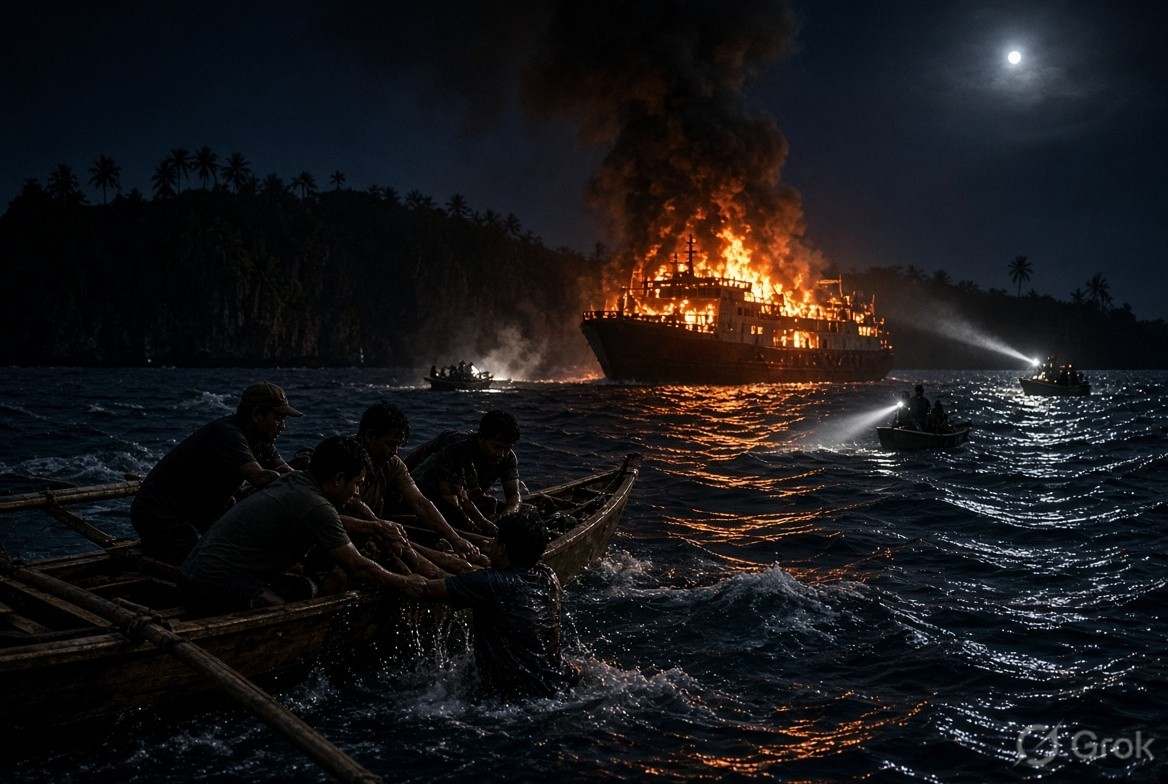
A night crossing to a postcard island ended as a floating pyre. On Wednesday evening, 9 September 2026, fire tore through the passenger ferry MV June Aster as it neared Coron in Palawan, a place sold to the world for limestone cliffs, wreck dives and clear water. By Thursday morning the Philippine Coast Guard was still counting the living against a manifest of 134 people — 117 passengers and 17 crew — and the arithmetic was brutal: at least five dead, about 42 to 43 pulled from the sea, and roughly 86 to 87 still missing. Officials said the numbers could move. That is the language of an unfinished disaster, not a closed file.
The blaze was reported around 6:45 p.m. local time, close to shore — about 1.2 nautical miles off Barangay Marcilla, or a few nautical miles off Turda, depending on the first distress fix. The ship had left Baseco in Manila, bound for Coron, and was due around 6 p.m. It never made the pier. Coast Guard video showed the hull wrapped in flame. Bodies went into bags on the beach. Volunteer fishermen worked beside official boats. Survivors among those first pulled out included 38 passengers and four crew, according to Commodore Noemi Cayabyab. Rescuers had not yet been able to take full statements. The cause was listed as under investigation. That phrase arrives after every Philippine sea tragedy. It rarely arrives with a system that has already been fixed.
Thursday’s search got larger because the sea refused to hold still. Strong currents and heavy weather shoved the burning vessel from the first distress point to nearly 7.7 nautical miles off Turda. Smoke and heat kept teams off the deck. Officials warned of explosion risk. Multiple vessels went out. Drift-modelling was used to guess where people might have been carried. Time, Cayabyab said, was of the essence. Families already knew that. They were waiting for names, not slogans. No confirmed word had emerged on foreign nationals aboard. The dead had not been publicly identified.
This is not a rare accident in a hard ocean. It is a pattern in an archipelago of more than 7,000 islands where ferries are cheap lifelines and regulation is too often a paper ritual. Overloading, ageing hulls, thin inspections and monsoon weather have written the same story for decades. Tourism brochures sell Coron as paradise. Working Filipinos still ride night boats because flying is a luxury and the state has never built a maritime safety culture equal to the risk. Atienza Interisland Shipping Line operated the June Aster. The Coast Guard can throw boats at a burning wreck. It cannot invent, overnight, the inspections and enforcement that should have made a torch at the edge of a holiday town unthinkable.
By late morning Thursday the fire was still being fought. The missing list was still a moving number. Rescue is the duty of the hour. Accountability is the duty after the hour. If this ends only with prayers, a probe that fades, and another vessel allowed to sail under the same slack rules, the next flame will not be a surprise. It will be a sequel.
"The decisions we make today will shape the world for generations to come."