The Fragile Bridge of Bilateral Commerce
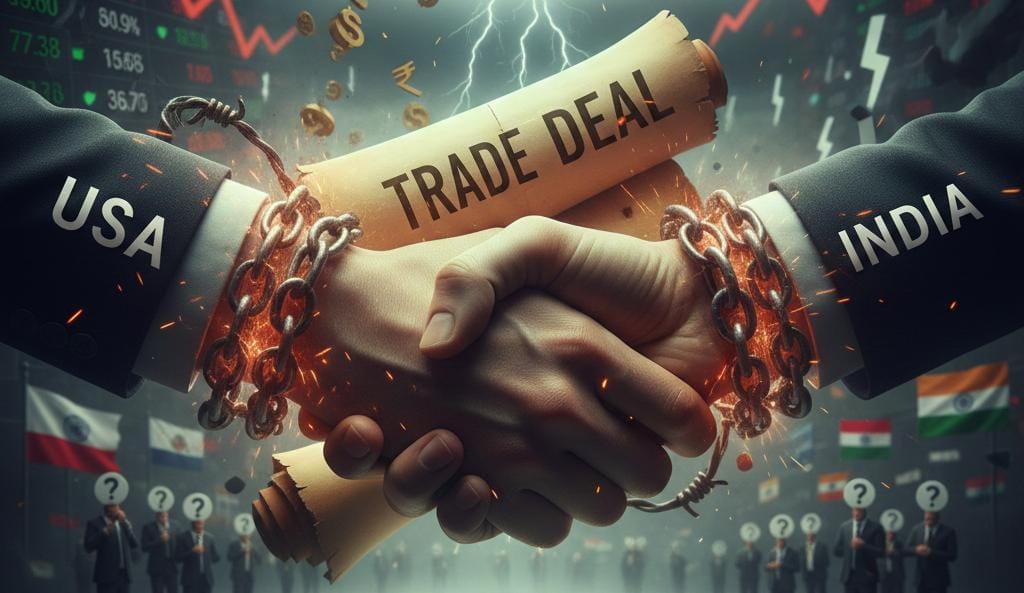
As we enter the first quarter of 2026, the economic narrative for emerging markets (EMs) is no longer solely about post-pandemic recovery or domestic reform. Instead, it is increasingly dominated by the high-stakes "brinkmanship" between the world’s largest and fifth-largest economies. The much-anticipated India-US trade deal, which has been in a state of "near-finalization" for over a year, remains the single most significant variable for investors looking at South Asia.
The stakes could not be higher. With the US recently imposing tariffs as high as 50% on specific Indian exports—citing India’s continued energy ties with Russia and trade imbalances—the "special relationship" between Prime Minister Modi and the Trump administration is being tested by the cold reality of protectionist math. For the global investor, this isn't just a bilateral spat; it is a systemic risk affecting currency stability and the movement of multi-billion dollar Foreign Institutional Investor (FII) flows.
The Tariff Wall: A 50% Hurdle for Indian Exports
The defining disruption of late 2025 was the US decision to categorize India among its "most tariffed" trading partners. In August 2025, the US increased tariffs on Indian goods to a staggering 50%, effectively creating a price wall for labor-intensive sectors such as textiles, footwear, and gems.
The "Russian Factor" in Trade Math
A primary catalyst for this aggressive stance has been India’s purchase of Russian crude oil. Despite US pressure, India has maintained that its energy security is non-negotiable. However, the cost of this autonomy has been high:
- The Penalty Tariff: The US administration implemented a "25% penalty surcharge" on Indian imports specifically linked to the Russian oil trade.
- The Pakistani Pivot: In a move that sent shockwaves through New Delhi, Washington recently signed a trade deal with Pakistan, signaling that it is willing to use its economic leverage to realign South Asian geopolitics.
Currency in the Crosshairs: The Rupee’s Test of Resilience
The most immediate casualty of this trade tension has been the Indian Rupee (INR). While India’s internal macro fundamentals remain robust—with GDP growth projected at 7.3% for FY26—the currency has struggled to find a floor against a volatile US Dollar.
Breaching the 91-Mark
In December 2025, the Rupee breached the psychological barrier of 91 per USD, reaching an all-time low. Analysts point to a "negative feedback loop":
- Tariff Fear: Uncertainty over the trade deal leads to speculative selling of the Rupee.
- FII Exodus: As the currency weakens, foreign investors pull out of Indian equities to avoid exchange-rate losses.
- Liquidity Crunch: The exit of dollars further weakens the Rupee, forcing the Reserve Bank of India (RBI) to intervene and deplete its foreign exchange reserves, which saw a drop of over $10 billion in the last quarter of 2025.
Experts warn that without a "breakthrough" deal by March 2026, the Rupee could test the 92–93 levels, making imports of critical technology and components significantly more expensive.
FII Flows: From "India Optimism" to "Strategic Caution"
Foreign Institutional Investors (FIIs) have traditionally viewed India as a "safe harbor" within emerging markets. However, the persistent "tariff stalemate" has cooled this enthusiasm.
The Great Rebalancing of 2025-26
The numbers tell a sobering story. In 2025, FIIs offloaded Indian equities worth over ₹1.66 lakh crore. This selling streak has continued into the first week of 2026, with over ₹7,000 crore sold in just two trading sessions.
Valuation vs. Risk: Investors are increasingly weighing India’s high P/E (Price-to-Earnings) ratios against the rising trade risks. Why pay a premium for Indian stocks if the underlying companies face a 50% tariff in their largest export market?
The "AI Diversion": Much of the capital leaving India is flowing toward "AI-winner" markets like Taiwan and South Korea, where trade relations with the US are perceived to be more stable.
"India's long-term story is intact, but FIIs are 'slaves to earnings.' If tariffs squeeze the margins of India’s IT and manufacturing giants, the 'India Premium' will continue to erode until a trade deal provides clarity." — V.K. Vijayakumar, Chief Investment Strategist.
The Road Ahead: Strategic Recalibration
India is not standing still while the US deal remains in limbo. The Ministry of Commerce has shifted to a strategy of "strategic integration" elsewhere to cushion the blow:
The UK & EU Pivot: India signed the Comprehensive Economic and Trade Agreement (CETA) with the UK in July 2025, with implementation expected mid-2026.
Oman & New Zealand: New deals with Oman and New Zealand have been fast-tracked to provide duty-free access for Indian MSMEs, offering a "buffer" against US market volatility.
Energy Transparency: In a significant move last week, Indian oil refiners were asked to provide weekly data on Russian oil imports. This is a clear olive branch to Washington, intended to provide "verified figures" that could pave the way for a tariff rollback during the next round of negotiations.
A Year of "Data-Driven" Diplomacy
The financial fate of 2026 hinges on whether the India-US relationship can return to "bonhomie" or if it will remain stuck in "brinkmanship." For the Indian Rupee to stabilize and for FIIs to return in earnest, the "tariff stalemate" must be resolved.
Investors should watch the March 2026 deadline closely. If a deal—even a "mini-deal" focusing on agriculture and electronics—is reached, it could trigger a massive rerating of Indian equities. Until then, the theme remains "cautious optimism" amidst a landscape of protectionist hurdles.