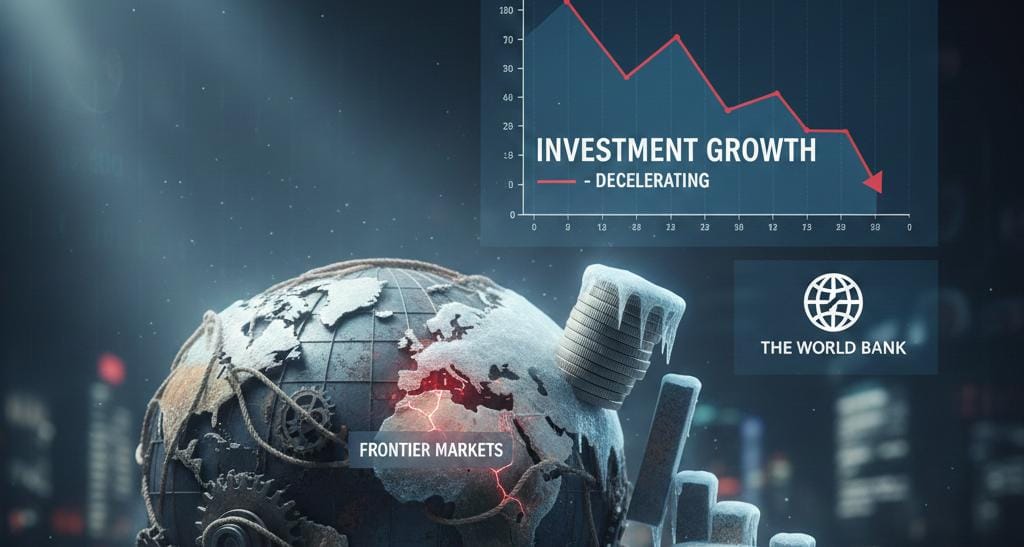
The global economic landscape is currently navigating a period of profound transition. For decades, the narrative of global growth was tethered to the rise of "Frontier Markets" (FMs)—those nations that occupy the space between the least developed countries and the more established "Emerging Markets" (EMs). However, a recent and sobering analysis by the World Bank has highlighted a concerning trend: a significant deceleration in investment growth across these frontier economies.
This slowdown is not merely a statistical hiccup; it represents a fundamental shift in capital distribution that threatens to widen the gap between the developed and developing worlds. As the World Bank notes, if investment continues to stagnate, the path to poverty reduction, infrastructure development, and climate resilience in these regions could be set back by a decade or more.
Defining the Frontier: The High-Stakes Arena
Frontier markets—encompassing regions across Sub-Saharan Africa, parts of Southeast Asia, and Central Asia—have traditionally been the "high-beta" bets of the global economy. They offer the potential for rapid returns driven by youthful demographics, untapped natural resources, and the early stages of industrialization.
However, they are also uniquely sensitive to global headwinds. Unlike the "BRICS" or other established emerging markets, frontier economies often lack the deep domestic capital markets or diversified industrial bases required to weather external shocks. When the World Bank reports a slowdown in investment growth, it is signaling that the risk-reward calculus for international investors has tilted dangerously toward the former.
The Triple Threat: Why Investment is Stalling
The World Bank identifies three primary "choke points" that are currently stifling the flow of capital into these regions:
1. The Burden of Debt and Fiscal Fragility
Many frontier markets are currently grappling with high levels of sovereign debt. As global interest rates rose to combat inflation in major economies, the cost of servicing this debt skyrocketed. For a frontier nation, high debt-to-GDP ratios act as a massive deterrent to Foreign Direct Investment (FDI). Investors fear that any capital they inject will be swallowed by debt repayment or devalued by the currency volatility that often accompanies fiscal distress.
2. The "Flight to Quality" Phenomenon
In times of geopolitical uncertainty—such as the ongoing conflicts in Europe and the Middle East—global capital tends to retreat to "safe havens." This "flight to quality" draws liquidity away from perceived high-risk areas like frontier markets and back into U.S. Treasuries or European bonds. The World Bank notes that the premium investors demand to hold frontier market debt has reached levels not seen since the height of the pandemic, effectively pricing many of these nations out of international markets.
3. Structural and Institutional Bottlenecks
Investment requires more than just capital; it requires a conducive environment. The World Bank’s findings point toward a stagnation in structural reforms. Issues such as inadequate power grids, bureaucratic red tape, and inconsistent legal frameworks continue to plague frontier economies. Without the promise of efficient infrastructure, even the most attractive natural resource deposits struggle to draw long-term commitment from multinational corporations.
The Human Cost: Development at a Standstill
The implications of slower investment growth extend far beyond the balance sheets of investment banks. There is a direct correlation between investment levels and a nation’s ability to achieve the United Nations Sustainable Development Goals (SDGs).
Infrastructure Deficits: Frontier markets need an estimated $2.5 trillion annually to meet infrastructure needs. A slowdown in investment means that critical projects—clean water systems, fiber-optic networks, and transportation hubs—remain on the drawing board.
Climate Vulnerability: Ironically, many frontier markets are the most vulnerable to climate change but have the least capital to adapt. The World Bank emphasizes that without a surge in "green investment," these nations will remain trapped in a cycle of climate-induced economic shocks.
The Demographic Dividend at Risk: With millions of young people entering the workforce in frontier regions every year, a lack of investment leads to high youth unemployment, which can, in turn, trigger social unrest and migration.
Strategic Pivots: How Frontier Markets Can Rebound
The World Bank’s report is not just a warning; it is a call to action. For investment growth to resume, a multi-pronged approach involving local governments and international financial institutions is required.
Strengthening Domestic Resource Mobilization
Frontier markets must decrease their reliance on fickle foreign capital. This involves widening the tax base and fostering domestic pension funds and insurance markets that can provide stable, long-term funding for local projects.
Transparency and Governance Reforms
Investors are more likely to tolerate economic risk if the legal risk is low. Implementing transparent bidding processes for infrastructure and strengthening the rule of law are "low-cost, high-impact" reforms that can improve a nation’s creditworthiness.
The Role of Multilateral Development Banks (MDBs)
The World Bank itself, alongside the IMF and regional banks, must play a more aggressive role in "de-risking" investments. This can be achieved through:
- Partial Credit Guarantees: Where the MDB covers a portion of the risk, making the project palatable for private investors.
- Blended Finance: Combining concessional public funds with private capital to lower the overall cost of a project.
The Outlook: A Fragmented Recovery?
Looking ahead, the World Bank suggests that the recovery in investment growth will likely be fragmented. Countries that proactively address their debt burdens and invest in digital transformation will separate themselves from the pack. We are moving away from a world where "Frontier" was a monolithic category; instead, we will see a "K-shaped" recovery where a few high-performing frontier nations thrive while others fall further behind.
The "Investment Chill" noted by the World Bank serves as a reminder that global prosperity is deeply interconnected. If the frontier is left behind, the global economy loses one of its most potent engines for future demand and innovation.
The deceleration of investment in frontier markets is a wake-up call for the international community. While the challenges—debt, geopolitical shifts, and infrastructure gaps—are daunting, the potential of these markets remains undiminished. Reversing this trend requires more than just "waiting for the cycle to turn." It requires a concerted effort to rebuild trust, reform institutions, and reimagine the way we finance development in the 21st century.
As the World Bank continues to monitor these trends, the message is clear: the cost of inaction is a future of stagnant growth and widening inequality. The time to reinvest in the frontier is now.
"The decisions we make today will shape the world for generations to come."