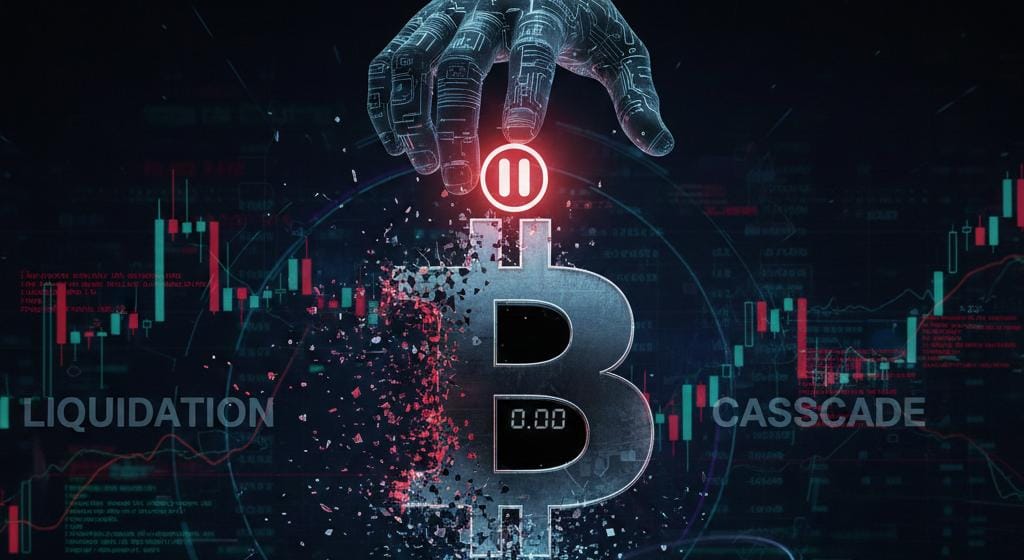
The cryptocurrency markets are no stranger to volatility, but the events of January 19, 2026, on the Paradex exchange redefined the concept of a "flash crash." In a digital blink of an eye, the world’s premier cryptocurrency, Bitcoin, appeared to lose 100% of its value on the platform, crashing to a literal price of $0.
While the broader global market remained stable with Bitcoin trading near $92,000, the internal ecosystem of Paradex—a prominent decentralized perpetuals exchange built on the Starknet Layer-2 network—collapsed into chaos. The culprit was not a sudden loss of investor confidence or a massive sell-off, but a technical "glitch" during a routine database migration that fueled a nightmare scenario: mass automated liquidations.
Anatomy of the Glitch: From Maintenance to Meltdown
The crisis began during what was intended to be a standard performance upgrade. According to official reports from the Paradex team, engineers were conducting a database migration to optimize the platform’s high-frequency trading capabilities. However, a flaw in the migration script corrupted the internal price feed.
In the highly automated world of decentralized finance (DeFi), smart contracts act as judge, jury, and executioner. When the corrupted database began reporting Bitcoin’s price as $0, the exchange's liquidation engine—designed to protect the protocol from bad debt—immediately identified every single "long" position on the platform as being underwater.
The Liquidation Cascade
Within seconds, the protocol initiated a "Liquidation Cascade." This is an automated process where:
The system detects that a trader's collateral is no longer sufficient to back their leveraged position.
The system forcibly closes the position by selling the collateral.
Because the price was $0, the "math" dictated that 100% of the collateral was lost.
Thousands of traders watched in horror as their dashboards flashed red, wiping out portfolios that, minutes earlier, had been worth millions. For many, it initially looked like a UI (User Interface) bug, but the reality was far grimmer: the smart contracts were executing real-time trades based on "phantom" data.
The Unprecedented Response: A "Centralized" Rollback
In the ethos of blockchain, "immutability" is a sacred pillar—the idea that once a transaction is written to the ledger, it cannot be changed. However, when faced with a catastrophic systemic failure that was clearly the result of an internal error, Paradex made the controversial decision to execute a blockchain rollback.
The exchange halted all operations for approximately eight hours, during which they coordinated a reversal of the Starknet-based "appchain" to Block 1,604,710—the last known healthy state before the maintenance began.
Impact of the Rollback
Transaction Reversal: All trades, liquidations, and funding rate adjustments that occurred during the glitch were effectively deleted.
Order Cancellations: To prevent a second wave of chaos upon restart, Paradex force-cancelled all open orders, with the exception of Take-Profit (TP) and Stop-Loss (SL) orders.
Account Restoration: User balances were restored to their pre-glitch status, essentially "time-traveling" the exchange back to a point before the crash.
While the rollback successfully saved users from permanent financial ruin, it sparked a fierce debate in the DeFi community. Critics argued that the ability to "rewind" a blockchain at will proves that many decentralized exchanges are decentralized in name only.
The Human and Market Toll
Despite the restoration of funds, the psychological damage was significant. Traders who were attempting to hedge other positions or who missed out on genuine market movements during the eight-hour outage expressed deep frustration.
Furthermore, the incident had a "contagion" effect on the Starknet ecosystem. The network's native token, STRK, saw a sharp 5% decline shortly after the news broke, as investors questioned the stability of the infrastructure supporting major dApps (decentralized applications) like Paradex.
Comparison to Past Events
The Paradex event echoes other "flash crashes" in crypto history, such as the 2021 incident where Bitcoin briefly hit $8,000 on Binance.US due to a bug in a trading algorithm. However, the Paradex crash is unique because the price hit absolute zero, and the remedy required a full ledger reversal rather than just an insurance fund payout.
Lessons for the Future of DeFi
The "Zero-Dollar Anomaly" serves as a stark reminder of the risks inherent in automated financial systems. As DeFi platforms strive to match the speed and complexity of traditional Wall Street exchanges, they become increasingly vulnerable to "black swan" technical failures.
Moving forward, the industry is calling for several critical reforms:
Multi-Oracle Redundancy: Platforms should never rely on a single internal database for pricing. Using multiple decentralized oracles (like Chainlink or Pyth) can provide a "sanity check" to prevent a $0 price feed from being accepted.
Circuit Breakers: Just as the NYSE halts trading during extreme volatility, DeFi protocols need "pause buttons" that trigger automatically if the price moves by an impossible percentage (e.g., 99%) in a single block.
Formal Verification: Routine updates and migration scripts must undergo rigorous formal verification—a mathematical process that proves the code will behave as intended under all circumstances.
Trust vs. Technology
Paradex has since resumed normal operations, and the team has assured the public that user funds are safe. However, the incident has left a lasting scar on the platform’s reputation. For a derivatives exchange handling over $37 billion in monthly volume, the margin for error is non-existent.
In the world of "Code is Law," a single misplaced line of code can override the financial reality of thousands. As we move deeper into 2026, the Paradex glitch will likely be cited as a landmark case study in the ongoing struggle to balance the efficiency of automation with the necessity of human-led safeguards.
"The decisions we make today will shape the world for generations to come."