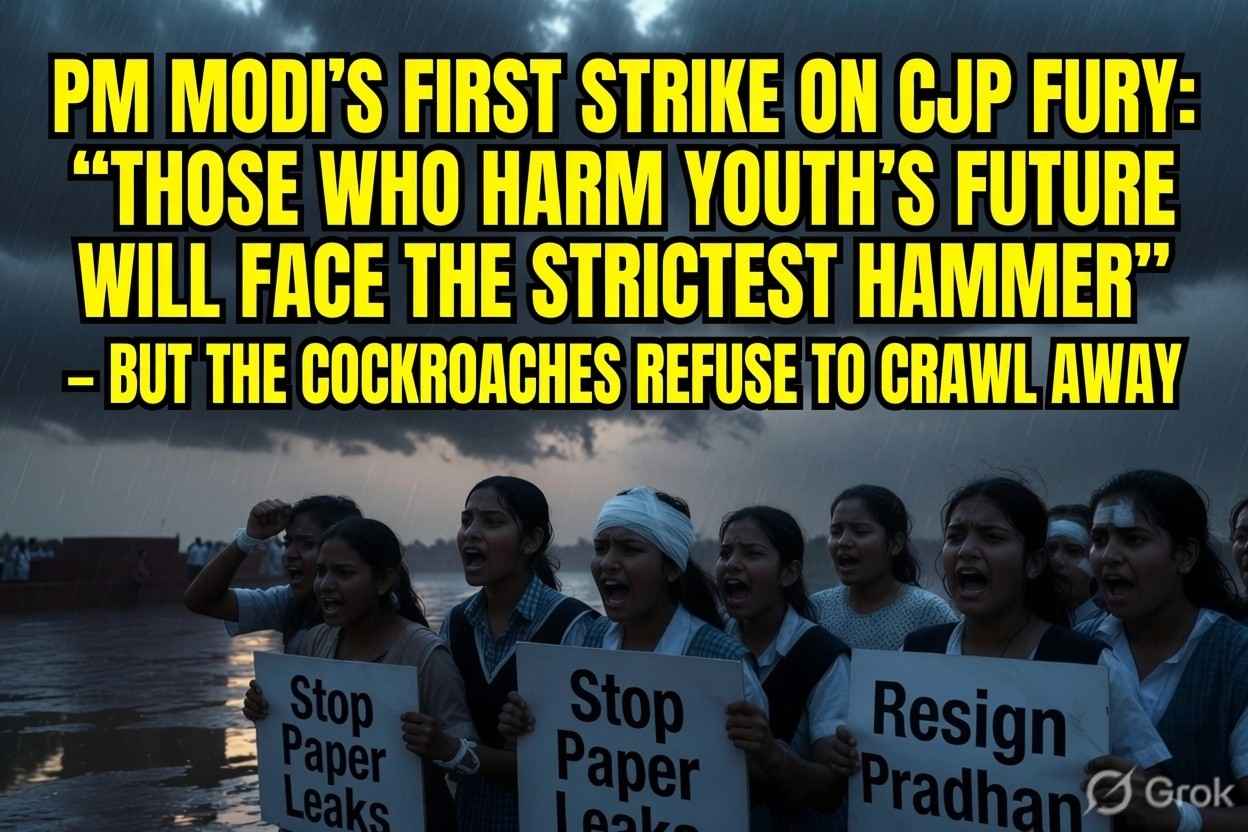
The national capital is once again the stage for a raw, unfiltered confrontation between India’s restless youth and a power structure that treats legitimate anger as a law-and-order problem. As of 23 July 2026, the Cockroach Janta Party-led agitation at Jantar Mantar continues with undiminished intensity after the violent “Sansad Chalo” attempt on 20 July. Fresh clashes erupted late on 22 July into the early hours of 23 July near Tolstoy Marg and the Connaught Place area. Stones and bottles flew. An Assistant Commissioner of Police sustained a forehead injury and was rushed to RML Hospital. Police claim protesters turned aggressive. Protesters and independent accounts describe selective targeting, heavy barricading that boxed students in, and the familiar pattern of state force meeting demands for accountability.
This is not a sudden outburst. The sit-in has stretched for weeks. Thousands of students, many still carrying the scars of repeated examination scandals, have occupied the designated protest space. Their core demand remains simple and non-negotiable: the resignation of Union Education Minister Dharmendra Pradhan, whom they hold responsible for a system that repeatedly fails to conduct fair, transparent national exams. Paper leaks, technical glitches, and the erosion of trust in institutions like NEET have become symbols of a deeper rot. Young people who spent years preparing for a single shot at medical or engineering seats now watch their futures decided by leaked question papers and political convenience.
The 20 July march toward Parliament was the flashpoint. Delhi Police had already erected multi-layered barricades, some reaching ten feet. Crowds that gathered from early morning were met with lathi charges and tear gas. Dozens of protesters, including women and older supporters, were injured. Around seventy were detained. Police later reported 118 of their own personnel hurt and accused the crowd of violence and damage to property. Stages and tents at the main site were dismantled. The next day the protesters returned, rebuilt what they could, and declared the agitation would continue until their demands were met. Solidarity gatherings appeared in other cities. Opposition leaders, including Rahul Gandhi, attempted to amplify the issue and faced detentions of their own near the Prime Minister’s residence.
Activist Sonam Wangchuk, on an indefinite hunger strike that has now crossed twenty-five days, has become the moral centre of the movement. From Medanta Hospital in Gurugram, after being shifted under High Court directions from Safdarjung, he released a video message. He has lost around eleven kilograms and significant muscle mass. He offered to end the fast if the government gave a clear assurance that no force would be used against the students and that FIRs or criminal cases would not be weaponised to harass them. Multiple MPs from different parties have appealed to him. As of the latest available updates, the required firm guarantee has not materialised in a form that satisfies him, and the fast continues. His presence has kept the human cost of the protest visible.
The Delhi High Court has taken note. A bench issued notices to the Centre and Delhi Police over allegations of excessive force on 20 July, ordered the preservation of all CCTV footage and related records, and sought formal responses. This is a rare institutional pushback, but it does not change the ground reality: the streets remain the only place where the youth feel heard.
What this protest reveals is more damaging than any single clash. An entire generation has watched the examination system become a lottery of leaks and influence. Instead of systemic reform—independent oversight, transparent processes, genuine accountability—the response has been containment, force, and the usual political deflection. Talks have been floated. Statements about punishing those responsible for leaks have been issued. Yet the minister remains in office. The pattern is familiar: when the powerful fail, the powerless are managed.
The monsoon session of Parliament continues under heavy security. Farmers have simultaneously mobilised at the borders against the proposed India-US trade deal, adding another layer of pressure on the capital. But the CJP agitation is the one that has cut deepest into the youth demographic. These are not career activists. Many are first-time protesters who have discovered that the system does not bend for them unless they force it into the open.
The government can continue to frame this as a law-and-order challenge. It can keep counting injured policemen and registering cases. That approach only confirms the protesters’ central charge: the state prioritises control over correction. Every lathi charge, every overnight clash, every day that passes without the resignation of the minister responsible deepens the conviction that the education system is not broken by accident—it is protected by design.
The students at Jantar Mantar are still there. The hunger striker is still fasting. The questions about how a country of this size repeatedly fails its own children in the most basic test of fairness remain unanswered. Until those answers come in the form of real accountability rather than more barricades, the streets of Delhi will keep carrying the cost.
"The decisions we make today will shape the world for generations to come."