India’s ambition to become a global science and technology powerhouse is entering an important phase. The country has expanded its capabilities in areas ranging from space and biotechnology to artificial intelligence, quantum technology and advanced materials. At the same time, a major gap remains between India’s scientific potential and the resources devoted to research.
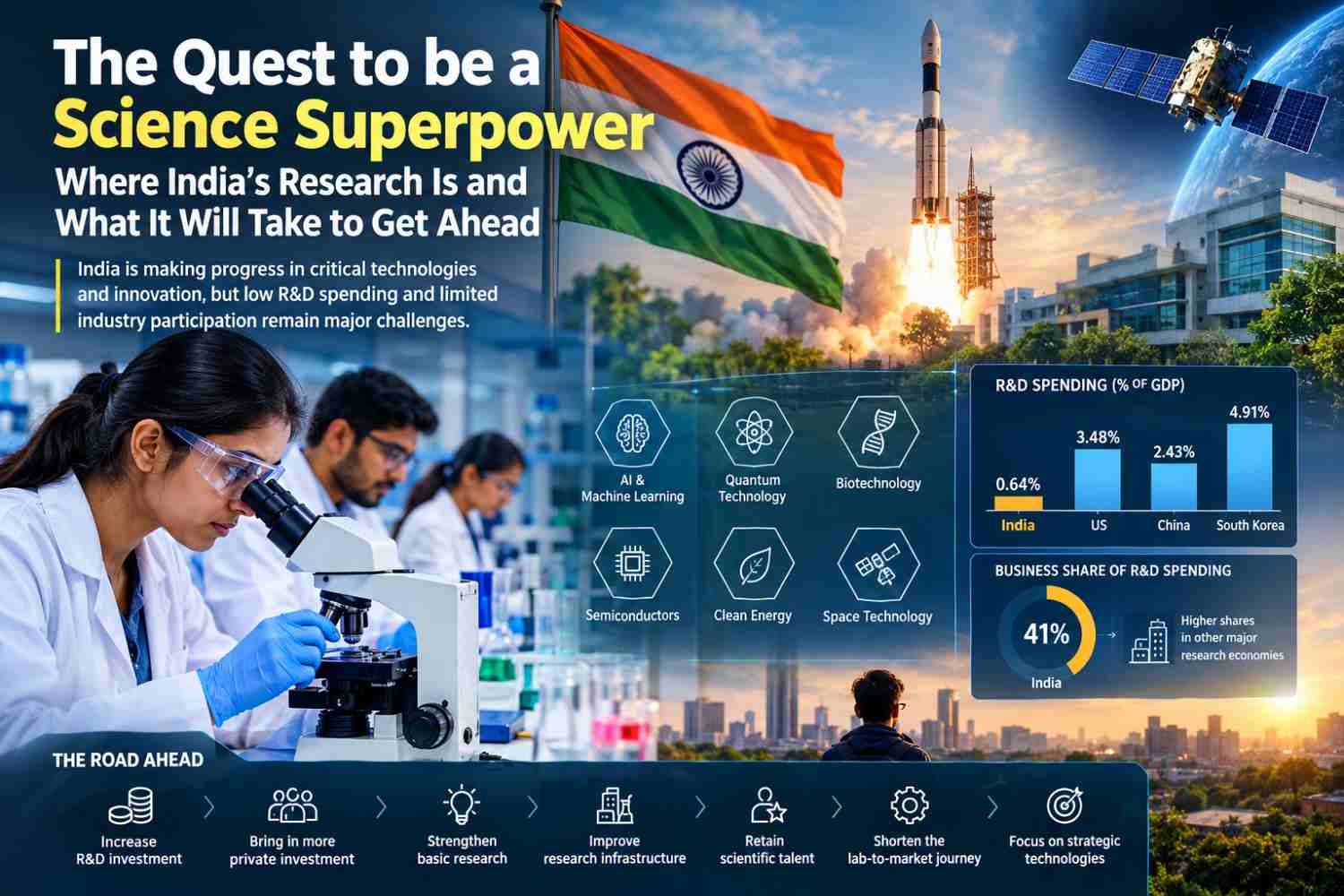
The Economic Survey 2025-26 puts India’s Gross Expenditure on Research and Development (GERD) at around 0.64% of GDP, considerably below the levels reported for the United States, China and South Korea. The survey also notes that businesses account for only about 41% of India’s total R&D spending, compared with much higher shares in several major research economies.
India’s research strength is growing
India has developed substantial research capacity across both traditional and emerging fields. According to the Economic Survey, India ranks among the leading countries in research output for several critical technologies, including AI and machine learning, advanced communications, quantum technologies, biotechnology, advanced materials and energy technologies.
The government has also highlighted India's growing innovation ecosystem. The Department of Science and Technology reported that India ranked 39th in the Global Innovation Index in 2024, while the country ranked sixth globally in intellectual-property filings according to the WIPO data cited by the department.
These developments suggest that India's challenge is no longer simply building scientific talent. The bigger question is how effectively that talent can be supported, connected with industry and converted into technologies that reach the market.
The funding gap remains a central issue
India's R&D spending has increased significantly in absolute terms. DST data shows that GERD more than doubled from about ₹60,197 crore in 2010-11 to ₹1.27 lakh crore in 2020-21. However, R&D expenditure as a share of GDP remained around 0.64% in 2020-21.
The comparison with other major research economies highlights the scale of the challenge. The Economic Survey 2025-26 reports R&D intensity of 3.48% of GDP for the US, 2.43% for China and 4.91% for South Korea, against India's 0.64%.
For India to compete in expensive, long-term fields such as semiconductors, advanced computing, quantum technology, new materials and biotechnology, sustained funding will be crucial.
Getting universities and industry closer
Another major challenge is the connection between research institutions and businesses.
India's private sector contributes a smaller proportion of national R&D spending than businesses in several leading innovation economies. Government experts have repeatedly pointed to stronger industry-academia collaboration, technology roadmaps, corporate research laboratories and public-private partnerships as ways to improve the research-to-market pipeline.
This matters because scientific discoveries do not automatically become products. Researchers need access to advanced laboratories, industrial datasets, manufacturing capabilities, testing facilities and capital to move an idea from a laboratory prototype to commercial deployment.
A new push for research funding
India has introduced several initiatives aimed at strengthening this ecosystem.
The Anusandhan National Research Foundation (ANRF) was established under the 2023 legislation to strengthen research and innovation across universities and institutions. The government has also announced a ₹1 lakh crore Research, Development and Innovation Scheme, intended to support high-risk and high-impact research and increase private-sector participation.
Other programmes are targeting specific strategic areas. India's National Quantum Mission, for example, has an approved outlay of about ₹6,003.65 crore over eight years, with the objective of developing research and industrial capabilities in quantum technologies.
What India needs to do next
Becoming a science superpower will require more than producing more research papers or filing more patents. India will need a research ecosystem that can consistently turn scientific knowledge into technologies, companies and solutions.
Key priorities include:
1.Increase R&D investment: Raising research expenditure as a share of GDP would give scientists and institutions greater capacity for long-term projects.
2.Bring in more private investment: Greater industry participation can connect scientific research with real-world technological needs.
3.Strengthen basic research: Breakthrough technologies often depend on years of fundamental research without immediate commercial returns.
4.Improve research infrastructure: Universities need access to advanced laboratories, equipment and computing resources.
5.Retain scientific talent: Competitive research careers, funding and institutional independence can help attract and retain researchers.
6.Shorten the lab-to-market journey: Better technology-transfer offices, incubators and public-private partnerships can help turn discoveries into products.
7.Focus on strategic technologies: AI, quantum computing, semiconductors, biotechnology, advanced materials, clean energy and space technology are likely to remain important areas of global competition.
The road ahead
India already possesses many of the ingredients required for a stronger scientific ecosystem: a large pool of engineers and scientists, major research institutions, a growing startup sector and expanding capabilities in strategic technologies.
The harder task is scaling these strengths.
The country's future position in global science will depend not only on how much research India produces, but also on how much it invests, how quickly discoveries move from laboratories to industry, and whether researchers have the freedom and infrastructure to pursue ambitious ideas.
India's quest to become a science superpower, therefore, is less about one breakthrough and more about building a research ecosystem capable of producing breakthroughs repeatedly and at scale.
"The decisions we make today will shape the world for generations to come."