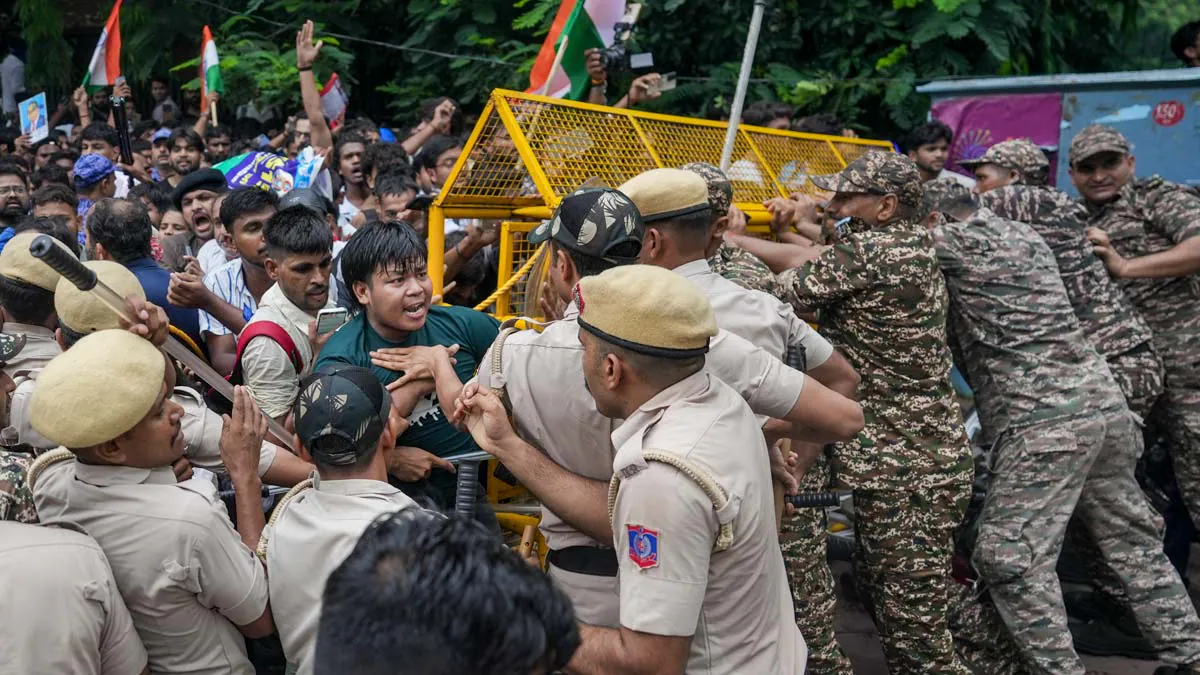
The images from Jantar Mantar on 20 July 2026 will not fade easily. Young faces bloodied, heads bandaged, bodies dragged across asphalt, women pulled by the hair, a stage reduced to rubble, electricity cut, and the air thick with tear gas. Around 100 protesters — mostly students and youth who had come to demand justice over repeated examination paper leaks — were treated at Ram Manohar Lohia Hospital. Several suffered serious head injuries. At least four landed in the ICU. One remained critical. This is what “maintaining law and order” looked like under the current central government.
The Cockroach Janta Party’s long-running sit-in had a simple, uncomfortable demand: Union Education Minister Dharmendra Pradhan must resign. The reason is not mysterious. India’s competitive examination system has become a national scandal of leaks, cancellations, re-tests, delayed results and shattered futures. Students have died by suicide. Families have spent life savings only to watch the process collapse. When thousands of young people gathered at the designated protest site and attempted to march toward Parliament on the opening day of the monsoon session, the response was not dialogue or accountability. It was prohibitory orders, multi-layered barricades, Rapid Action Force, tear gas and a full-scale baton charge.
Delhi Police claims the protesters turned violent, pelted stones, damaged vehicles and injured more than 118 personnel, including senior officers. Four FIRs have been registered. Over 70 people were detained. Videos of stone-throwing and damaged police property exist. These facts cannot be wished away. Violence against security forces is indefensible. Yet the scale and nature of the force used against students raise far deeper questions that the government has so far refused to answer.
Why were plainclothes personnel allegedly mixing with the crowd before the charge? Why do circulating videos appear to show officers striking people already on the ground? Why the allegations of lathis fitted with nails or spikes? Why was electricity cut and the entire protest infrastructure dismantled in the middle of the night? Why did the Resident Doctors’ Association of AIIMS feel compelled to write to the President of India demanding an independent, time-bound inquiry into excessive force? These are not questions the government has answered. Instead, the official line remains that injuries among protesters occurred mainly from stampedes and falls — a claim that sits uneasily beside the medical evidence and eyewitness accounts.
The deeper failure is political. For weeks the Centre has treated the education crisis as a law-and-order problem rather than a governance collapse. Meetings with Health Minister J.P. Nadda have been held. Memorandums have been submitted. Yet the minister at the centre of the storm remains firmly in his chair. No independent high-level inquiry into the paper-leak ecosystem has been announced with real teeth. No systemic reforms with timelines and accountability mechanisms have been put on the table. The message is clear: the system can fail students repeatedly, but the system will not be allowed to fail its political protectors.
When young people who have lost faith in the examination process are met with batons instead of answers, the government is not restoring order. It is manufacturing alienation. Calling this a dictatorship may be an overstatement in a country that still holds elections and has an opposition and courts. But the willingness to treat student dissent as a security threat while refusing meaningful accountability for the very crisis that produced the dissent reveals a governing culture that prioritises control over legitimacy.
Police are not supposed to “support” any side in a democratic protest. Their duty is to facilitate peaceful assembly and use minimum necessary force when public order is genuinely threatened. What unfolded at Jantar Mantar went beyond that. The optics of heavily armed forces clearing a youth protest site while the education minister continues undisturbed send a chilling signal: the state will protect its own more fiercely than it will protect the future of its students.
The protesters returned the very next night, rebuilding under phone torchlight. That quiet defiance is more dangerous to any government than broken barricades. It says the bat.
"The decisions we make today will shape the world for generations to come."