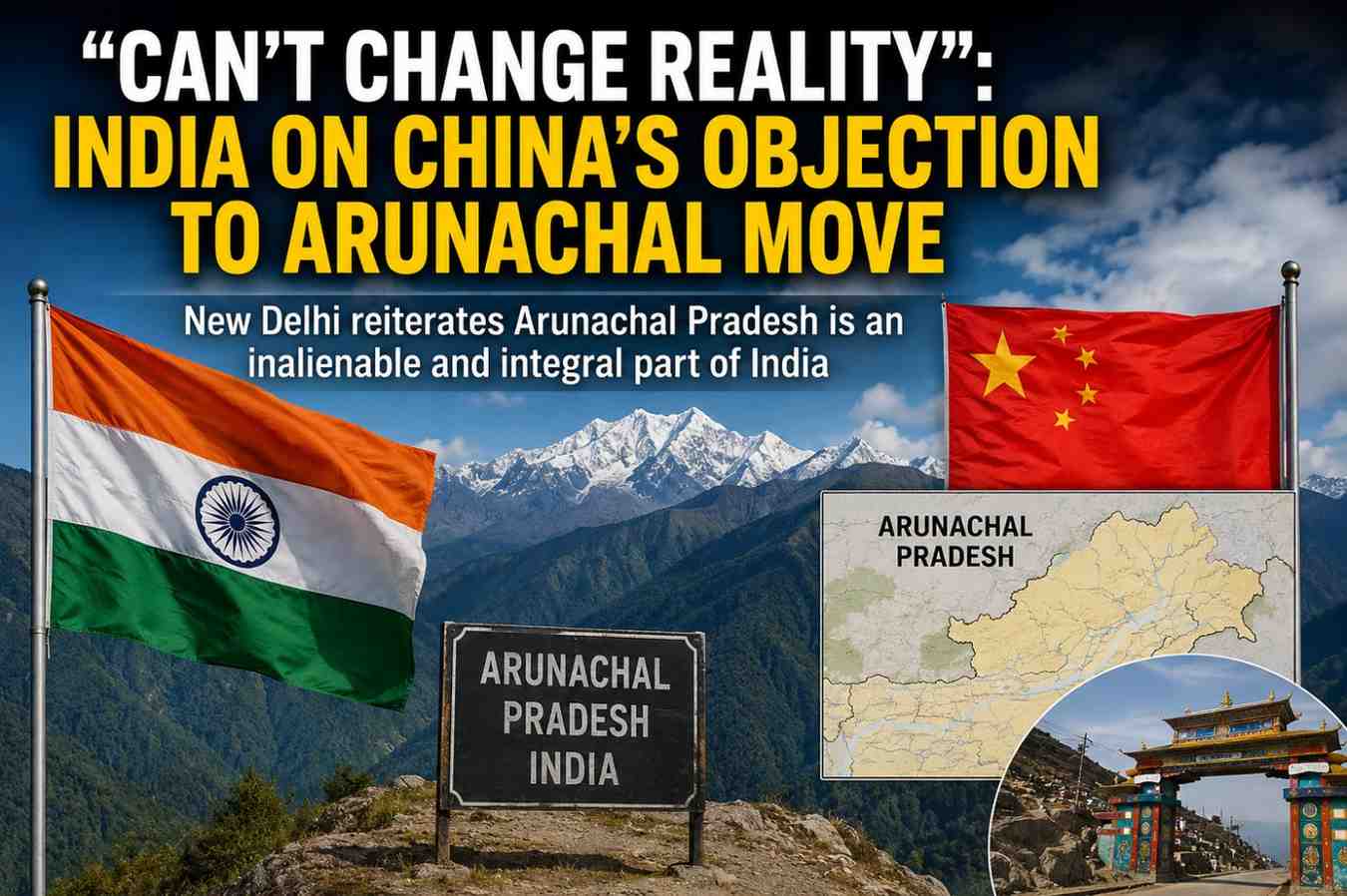
India on Tuesday firmly rejected China’s objection to New Delhi’s decision to formally identify 27 places and geographical features in Arunachal Pradesh using their standard names on official Indian maps.
Responding to Beijing’s criticism, Ministry of External Affairs spokesperson Randhir Jaiswal reiterated India’s longstanding position that Arunachal Pradesh is an integral and inalienable part of the country. He said that this reality cannot be changed by attempts to alter names or challenge India’s territorial position.
India’s latest move involves formally recording the names of 27 locations on Survey of India maps. According to the government, the exercise is intended to facilitate accurate recognition of the locations and improve public awareness about them.
China, however, strongly objected to the move. Chinese Foreign Ministry spokesperson Guo Jiakun described India’s action as “illegal, null and void” and said Beijing does not recognise what it calls “Arunachal Pradesh”, referring to the region as “Zangnan” or “Southern Tibet.”
New Delhi has repeatedly rejected China’s attempts to assign Chinese names to places in Arunachal Pradesh, arguing that such naming exercises cannot alter territorial realities. The latest exchange comes amid the broader and longstanding India-China boundary dispute.
Among the 27 locations identified by India are Long Ju, an area associated with an early India-China border flashpoint in 1959, as well as several strategically significant high-altitude passes, including Dzo La, Riza La, Pukur La and Thag La. The list also includes Jairampur in Changlang district and Maja village in Upper Subansiri district.
The latest diplomatic exchange highlights the continuing sensitivity surrounding Arunachal Pradesh and the wider India-China border issue. While Beijing continues to assert territorial claims over the region, New Delhi maintains that Arunachal Pradesh is an inseparable part of India and that unilateral attempts to rename locations cannot change that position.
"The decisions we make today will shape the world for generations to come."