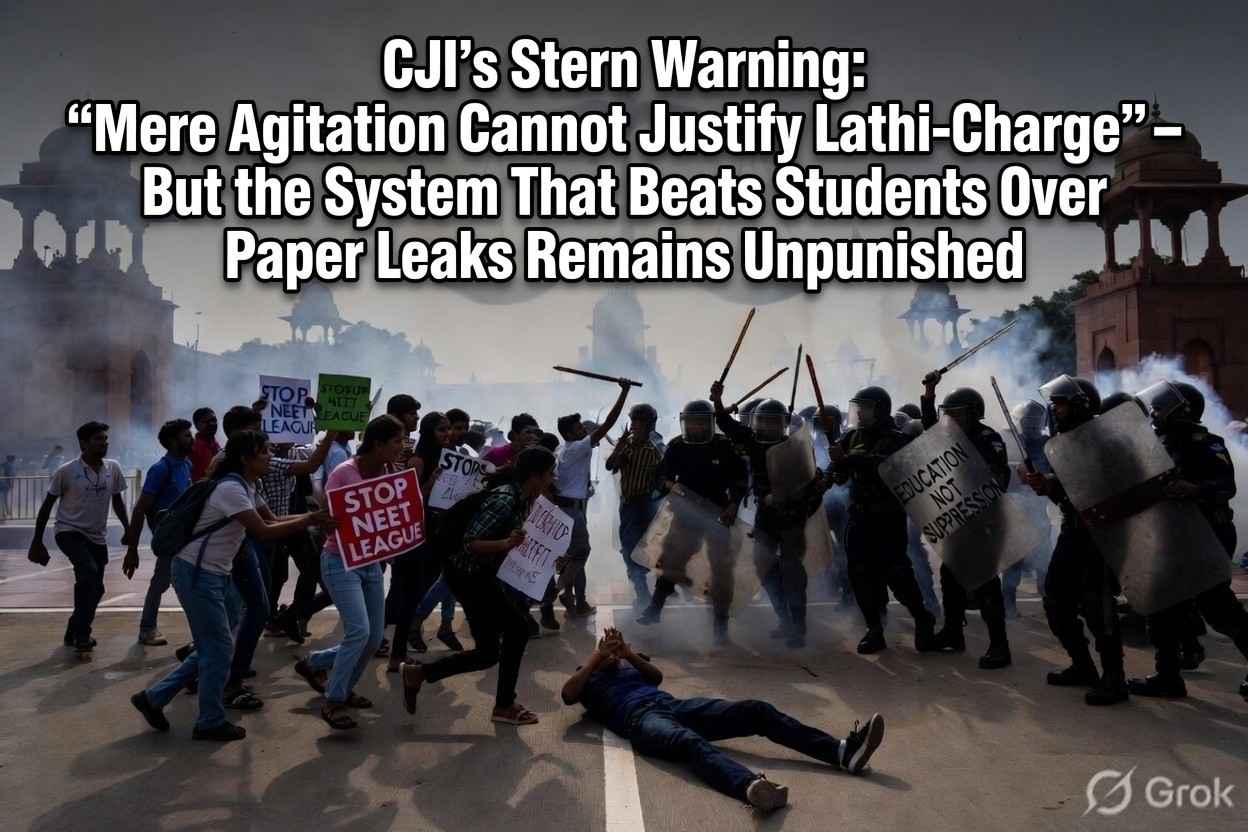
Chief Justice of India Surya Kant spoke with clarity on Monday. Hearing petitions against the police action at Jantar Mantar, he stated that the right to peaceful and lawful protest is constitutionally protected and that mere agitation cannot justify a lathi-charge. The observation came from a bench also comprising Justices Joymalya Bagchi and V. Mohana while examining claims of excessive force during the July 20 student protests.
The words are important. They reaffirm what the Constitution has always said and what successive governments have routinely forgotten when the streets fill with the young and the angry. Yet the larger picture remains grim. The same state machinery that could not prevent repeated examination paper leaks is quick to deploy batons, tear gas and, according to some accounts, even more severe force when those affected by the leaks demand answers.
The protests at Jantar Mantar grew out of deep frustration over irregularities in the NEET-UG and related examinations. Students who spent years preparing watched their futures collapse amid allegations of leaks, technical failures and administrative rot. The movement, organised under the satirical banner of the Cockroach Janta Party, began as an expression of that rage. On July 20 the protesters attempted a march towards Parliament. Clashes followed. Petitioners before the Supreme Court allege heavy deployment, barricades, baton charges, tear gas, mass detentions, injuries to dozens of demonstrators and instances of gender-based misconduct. Police personnel also suffered injuries. The court has now listed the matters for further hearing and has indicated the need for a uniform national protocol that balances the right to protest with the state’s duty to maintain order and protect its own forces.
This is the classic pattern of a system that has lost the ability to govern fairly and therefore resorts to force. Paper leaks are not acts of nature. They are products of institutional failure, weak oversight and, in many cases, outright corruption that has been allowed to fester for years. When the Education Ministry and examination authorities fail, the consequences fall on millions of young people. When those young people gather to protest, the police are ordered to restore “order.” The Centre and state governments then claim the protests turned violent, as if the violence exists in a vacuum and is never connected to the original betrayal.
CJI Surya Kant correctly noted that the right to peaceful protest cannot be denied and that excess force must be independently examined. He also spoke of the need for discipline within the democratic process and for proper space for legitimate agitation across the country. These are sound judicial observations. They do not, however, erase the record of how the executive has handled dissent in recent years. Prohibitory orders are routinely imposed. Plainclothes personnel appear in crowd-control situations. Section after section of the new criminal codes is stretched to treat peaceful assembly as a threat. The long-pending directions of the Supreme Court in the Prakash Singh case on police reforms remain largely unimplemented. Political control over the police continues. The result is predictable: when the system is challenged on its most basic failures, the baton becomes the first response.
The students at Jantar Mantar were not demanding the impossible. They wanted accountability for examination frauds that destroy merit and futures, the resignation of those responsible, and structural reforms so that the next generation does not face the same collapse of trust. The government’s answer, delivered through the Delhi Police on July 20, was force. That choice reveals more about the character of the present system than any official statement about “law and order.”
A nation that cannot conduct fair examinations for its own children and then beats those children when they protest is not a strong nation. It is a brittle one. The judiciary has once again been forced to remind the executive of first principles. The real test is whether the government will treat this observation as a binding constraint on future police action or merely as another temporary judicial observation to be managed and forgotten. History suggests the latter is more likely. Until the culture of impunity for administrative failure and for the use of force against the young is broken, statements about constitutional rights will remain necessary but insufficient. The system continues to break the very people it claims to serve.
"The decisions we make today will shape the world for generations to come."