Indian Stock Market Ends in the Red
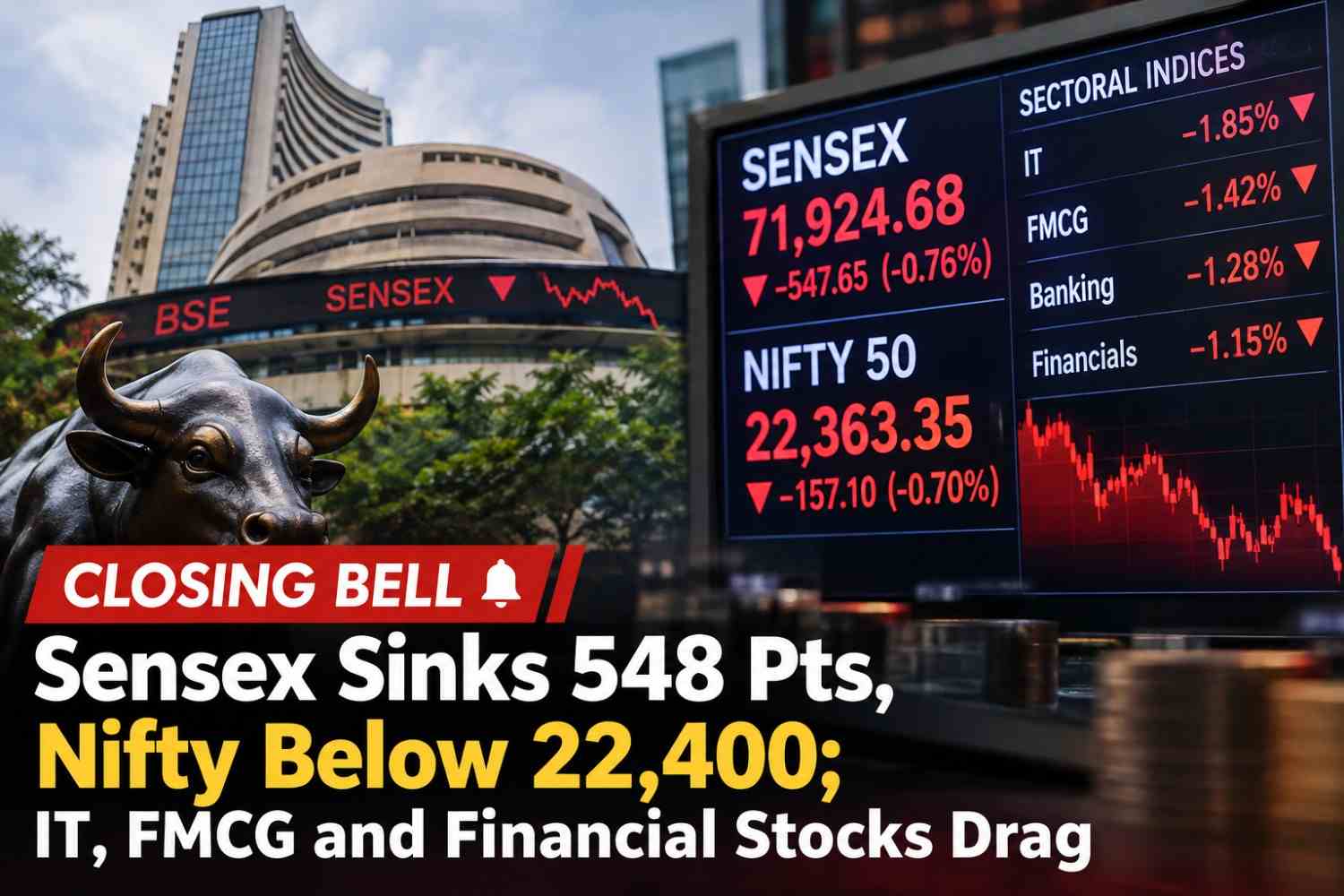
Indian equity markets closed lower on Monday, October 12, after losing their early-session gains. The BSE Sensex declined 547.65 points, or 0.76%, to settle at 71,924.68, while the NSE Nifty 50 dropped 157.10 points, or 0.70%, to close at 22,363.35. Both benchmark indices faced selling pressure as investors remained cautious amid global uncertainties and concerns over inflation.
The decline reflected weakening market sentiment, with selling across several major sectors weighing on the benchmark indices. IT, fast-moving consumer goods (FMCG) and banking-related stocks were among the key areas of weakness.
IT and FMCG Stocks Lead the Decline
Information technology and FMCG stocks faced considerable selling pressure during Monday's session. Tech Mahindra shares fell approximately 2.85%, while ITC declined around 3.05%. Larsen & Toubro and Max Healthcare also recorded notable losses.
Weakness in heavyweight stocks contributed to the broader market decline, offsetting gains in selected companies. The sell-off highlighted continued investor caution toward major equities amid uncertain domestic and international economic conditions.
Rising Crude Oil Prices and Global Concerns
Elevated crude oil prices remained a major concern for investors. Higher oil prices can increase India's import bill, put pressure on the rupee and raise costs for businesses across several industries.
Meanwhile, rising bond yields, geopolitical tensions in the Middle East and continued foreign portfolio investor (FPI) outflows added to market uncertainty. Investors also remained cautious ahead of important domestic inflation data and developments surrounding monetary policy.
Although the Reserve Bank of India introduced measures aimed at supporting the rupee and curbing dollar demand, these steps were not enough to prevent the benchmark indices from ending the session lower.
Broader Markets Show Resilience
Despite the decline in the benchmark indices, the broader market demonstrated relative strength. The Nifty Midcap 100 edged up 0.08%, while the Nifty Smallcap 100 gained approximately 1.42%.
This divergence indicated that buying interest persisted in selected mid-cap and small-cap stocks even as major index constituents faced selling pressure. However, investors continued to monitor global market movements, crude oil prices and foreign fund flows for further direction.
What Should Investors Watch Next?
Market participants are expected to keep a close watch on inflation data, crude oil price movements, foreign investor activity and upcoming corporate earnings announcements.
Continued volatility could influence trading in the near term, particularly if global economic concerns intensify. Investors may also assess whether corporate earnings can support stock valuations amid elevated borrowing costs and persistent uncertainty.
Conclusion: The Indian stock market ended Monday's session on a weak note, with the Sensex losing nearly 548 points and the Nifty slipping below 22,400. Selling in IT, FMCG and financial stocks, combined with elevated oil prices and global uncertainties, kept investor sentiment under pressure.
"The decisions we make today will shape the world for generations to come."