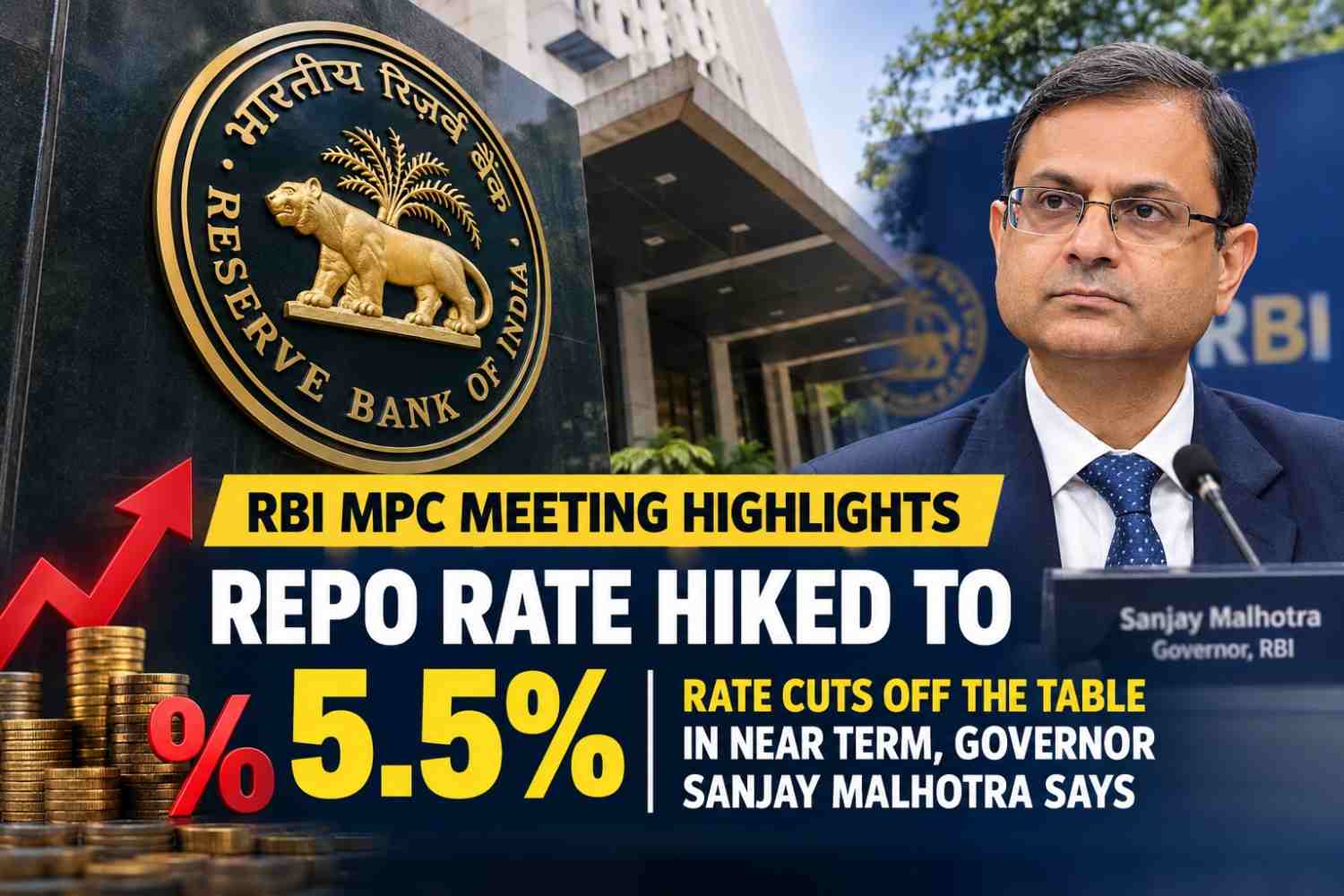
The Reserve Bank of India (RBI) has delivered a significant shift in monetary policy, raising the benchmark repo rate by 25 basis points to 5.5% in its latest Monetary Policy Committee (MPC) meeting. The move marks the first repo-rate hike in nearly four years as the central bank responds to renewed inflationary pressures and strong economic growth.
RBI Signals Tighter Monetary Policy
The six-member MPC unanimously backed the 25-basis-point increase. Along with the rate hike, the RBI changed its policy stance from “neutral” to “calibrated tightening”, signalling that controlling inflation has become a stronger priority.
Governor Sanjay Malhotra indicated that monetary policy decisions going forward will depend on incoming inflation and growth data. With inflation expected to remain elevated, the possibility of near-term rate cuts has effectively moved off the table.
Inflation and Oil Prices Drive RBI Decision
A major concern for the central bank is the sharp rise in global oil prices. Higher crude prices can increase India's import bill and put pressure on domestic inflation, while also weighing on the rupee.
The RBI expects headline CPI inflation to average around 5.8% over the next three quarters, according to Malhotra. Core inflation is projected at around 4.4%.
Weak monsoon conditions and global geopolitical tensions have added further uncertainty to the inflation outlook.
Growth Remains Strong
Despite inflation concerns, India's economic growth outlook remains relatively strong. The RBI has projected GDP growth at 7.1%, giving policymakers greater room to focus on price stability without an immediate need to support demand through lower interest rates.
What the Rate Hike Means for Borrowers
The repo rate is the rate at which the RBI lends money to commercial banks. When the repo rate rises, borrowing costs for banks can increase, potentially leading to higher interest rates on home loans, personal loans and other floating-rate loans.
Existing borrowers with loans linked to external benchmarks may see their EMIs rise or their loan tenure increase, depending on how banks transmit the policy change.
Rupee and Liquidity Also in Focus
The RBI is also dealing with pressure on the Indian rupee, which recently moved close to its record low against the US dollar. Governor Malhotra said the central bank would work to ensure that the currency market remains stable and orderly.
Meanwhile, banking-system liquidity has remained significantly in surplus. Malhotra said a large portion of this excess liquidity is expected to be absorbed naturally within the current financial year through currency movements, reserve requirements and RBI operations.
What Happens Next?
The latest MPC decision signals a clear change from the easing cycle seen earlier. With inflation risks rising and economic growth remaining firm, rate cuts are unlikely to be the RBI's immediate focus. Future decisions will depend heavily on oil prices, inflation data, the rupee, global interest rates and domestic growth.
For borrowers and investors, the key takeaway is that India's interest-rate environment may remain tighter in the near term, while the RBI keeps a close watch on inflation and financial-market stability.
"The decisions we make today will shape the world for generations to come."