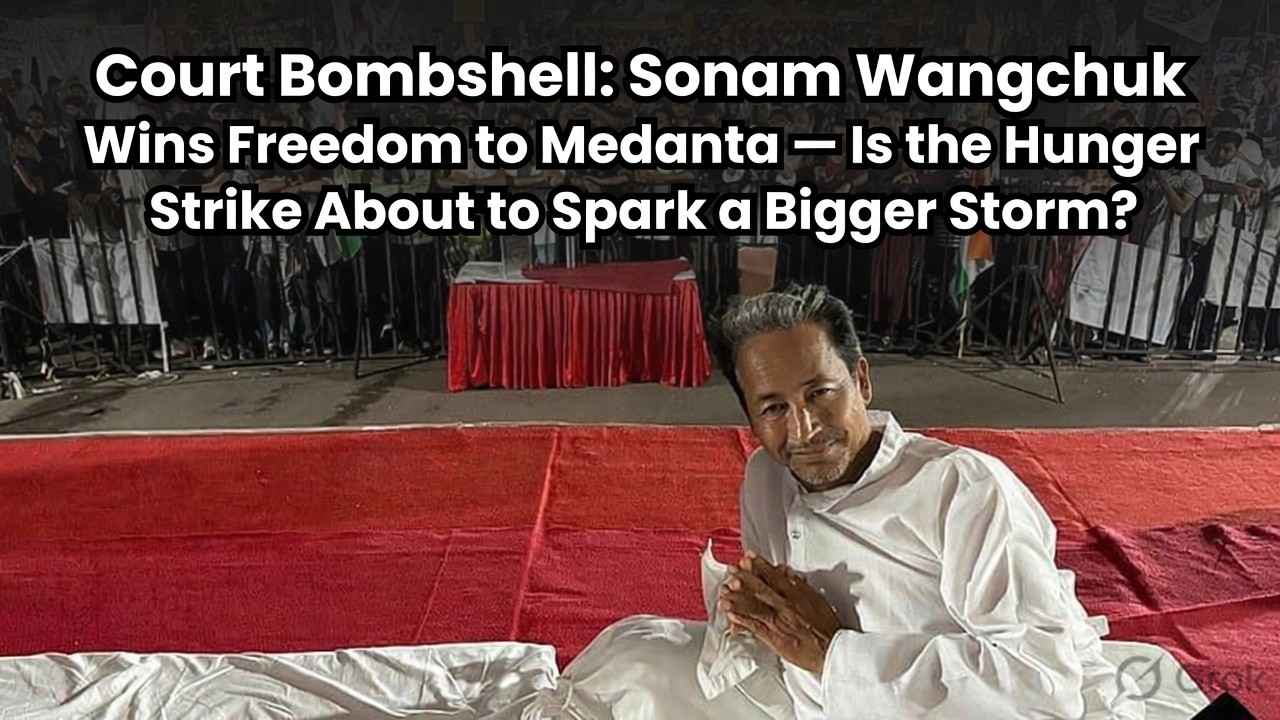
In a swift and telling intervention that cuts to the heart of personal liberty versus state responsibility, the Delhi High Court on Tuesday cleared the path for climate activist and education reformer Sonam Wangchuk to leave Safdarjung Hospital for Medanta Hospital in Gurugram. The Division Bench of Chief Justice Devendra Kumar Upadhyaya and Justice Tejas Karia, after grilling doctors from multiple institutions and poring over conflicting medical reports, ruled that the 59-year-old hunger striker must be shifted to the facility of his choice. A panel of doctors formed by Medanta’s director will now take charge, with all Safdarjung records transferred immediately.
The decision lands like a carefully measured counter-punch in the escalating standoff surrounding the Cockroach Janata Party’s youth-led agitation. Wangchuk had joined the indefinite fast at Jantar Mantar on June 28 in solidarity with students demanding Education Minister Dharmendra Pradhan’s resignation over the NEET-UG 2026 paper leak and a wave of related suicides. By July 18, after more than three weeks without food, Delhi Police moveded him from the protest site under an earlier High Court directive mandating daily health monitoring and medical intervention if needed. He was admitted to the government-run Safdarjung Hospital against his family’s wishes.
His wife, Gitanjali Angmo, immediately challenged the move. She alleged a lack of transparency, contradictory lab reports, restricted access amounting to “illegal detention,” and a complete erosion of trust. A single judge had earlier refused interim relief, holding that the original hospitalisation was not arbitrary and was aimed at protecting life. Angmo appealed. On Tuesday, the higher bench heard Senior Advocate Akhil Sibal for the family, Solicitor General Tushar Mehta and Additional Solicitor General Chetan Sharma for the Centre, and doctors from Safdarjung, AIIMS, and the original monitoring team.
Medical evidence painted a nuanced picture. Vitals remained largely stable. Wangchuk was conscious and refusing intravenous fluids or glucose, accepting only oral potassium supplements and rehydration. Yet potassium levels had dipped (around 3.2 mEq/L), white blood cell counts and haemoglobin showed pancytopenia, urea and uric acid were elevated — natural consequences of prolonged fat breakdown and fasting, doctors explained, but still requiring constant monitoring to guard against infection risk or sudden decline. The AIIMS director noted impaired immune response; visitors were already required to gown, cap and mask. Consensus emerged that hospital-level observation was essential, but not that it had to remain at Safdarjung.
The Bench cut through the legal and medical thicket with characteristic clarity: constant monitoring is needed, therefore shift him to Medanta — the hospital of his choice. Treatment details must travel with him. The government raised no objection to the transfer itself, only cautioning against any discharge against medical advice. The court declined to be dragged into that secondary fight.
This order restores a core constitutional principle. A competent adult’s right to choose the place and nature of medical care sits squarely within Article 21. By forcing the shift, the court has reaffirmed that protective intent cannot morph into prolonged control, especially when the individual remains a free citizen exercising the right to protest through non-violent means. At the same time, it has not abandoned the state’s duty to preserve life; continuous expert oversight continues, just under different institutional roofs.
For the broader CJP movement, the ruling arrives at a combustible moment. Monday’s violent “Chalo Sansad” march left over a hundred security personnel and dozens of protesters injured. Talks with Union Health Minister JP Nadda yielded a written memorandum of three demands — Wangchuk’s unrestricted release, Pradhan’s resignation, and compensation for suicide-affected families — but no firm commitments. Nadda’s subsequent visit to RML Hospital to check on the injured underscored the human cost. Wangchuk’s successful transfer now removes one flashpoint of “illegal detention” allegations while keeping the moral weight of his fast intact. His wife publicly thanked the court, calling the outcome a victory for democratic choice and the fundamental right to bodily autonomy.
Yet the underlying crisis remains unresolved. Exam integrity, youth despair, and accountability in the education system continue to fuel the streets. Wangchuk’s health, even under private care, will stay under intense scrutiny. Any further deterioration could reignite both medical and political urgency. The court’s careful balance — liberty with monitoring — offers a temporary de-escalation. Whether it cools the larger fire or simply relocates it remains the real question hanging over Delhi’s monsoon skies.
"The decisions we make today will shape the world for generations to come."