The Modi government’s carefully constructed image of control is cracking under the weight of its own failures. As the third round of talks between Cockroach Janta Party leaders and Union ministers opens this afternoon, the demand that has become the movement’s unbreakable core remains unchanged: Education Minister Dharmendra Pradhan must go. Not “look into,” not “review,” not “consider.” Resign or be removed. Anything less is treated as an insult by a generation that has already paid in cancelled dreams, ruined careers and, in some cases, lives.
What began as online satire in mid-May after a senior judge’s careless comparison of unemployed youth to cockroaches has hardened into the most sustained youth-led agitation this government has faced. The May 3 NEET-UG paper leak — affecting over 22 lakh aspirants — was only the latest in a long chain of examination scandals. The cancellation, the re-test, the suicides that followed, and the National Testing Agency’s repeated inability to secure even the most critical national exam exposed a rot that Pradhan’s ministry has refused to own. Students and parents watched an entire system treat their futures as collateral damage while the minister continued business as usual.
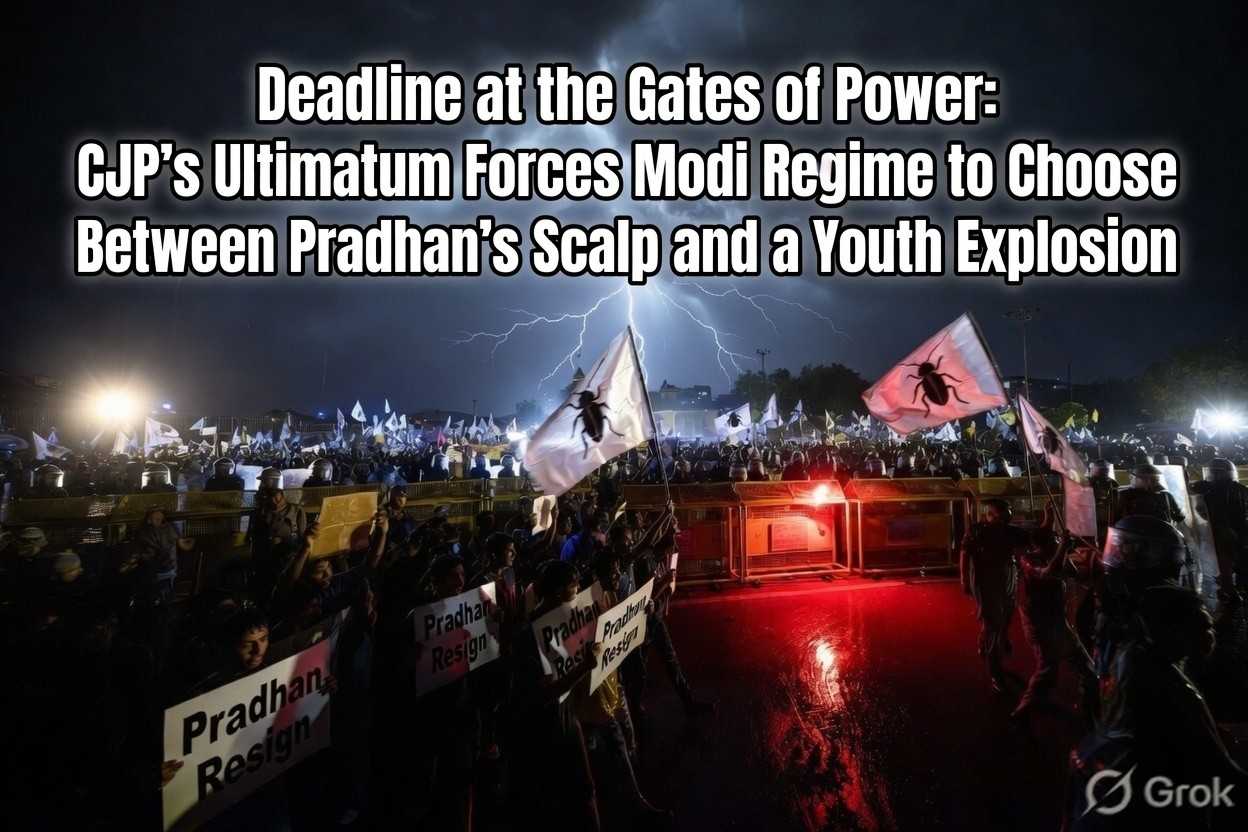
The July 20 attempt by protesters to march toward Parliament was met with the familiar response of this regime: force. Lathi charges, tear gas, injuries on both sides, and a heavy police presence that turned the heart of the capital into a fortified zone. Internet suspensions, metro station closures, facial-recognition cameras — the full apparatus of state power deployed against young people demanding accountability. Sonam Wangchuk’s 26-day hunger strike ended only after assurances that FIRs against protesters would not be pressed further. That concession was extracted under the shadow of medical risk and public pressure, not generosity.
In Friday’s nearly two-hour meeting with Health Minister JP Nadda and Minister of State Jitendra Singh, the government offered in-principle agreement on two demands: ₹1 crore compensation for families of students who died by suicide linked to the NEET fiasco, and withdrawal of legal cases against protesters. On the third and central demand — Pradhan’s resignation — it asked for time until Saturday afternoon. CJP spokespersons Ashutosh Ranka and Saurav Das made the position plain: the resignation is non-negotiable. If the answer today is no, the movement will escalate. Another nationwide call is already being prepared.
The government’s parallel moves look like classic damage control. A draft bill promising up to ten years in prison and ₹10 crore fines for paper leaks was cleared by the Cabinet. The education secretary was quietly shifted. Prime Minister Modi released a late-night video promising fast-track courts and “strictest action.” None of these steps addresses the political responsibility that sits at the top of the ministry. Sources close to the government continue to signal that Pradhan’s exit is not under serious consideration. The message is clear: the minister is protected; the students are negotiable.
This is the true face of the system. A government that lectures the country on aspirational India cannot protect the single most important gateway examination for medical education. It responds to peaceful protest with force, then offers partial concessions while protecting the political face of the failure. The same pattern repeats across sectors — hollow announcements, delayed accountability, and an assumption that the young will eventually tire and go home. The Cockroach Janta Party’s refusal to accept that bargain has exposed the emptiness of the claim that this administration listens to youth.
Abhijeet Dipke and the CJP leadership have kept the movement deliberately non-partisan in rhetoric, even as opposition parties try to claim proximity. Their five-point reform agenda on examination integrity has been placed on the table, but only after the three core demands are met. That sequencing is deliberate. Without political accountability, technical fixes become theatre.
As the afternoon deadline approaches, the choice before the government is stark. It can continue shielding a minister whose ministry has become synonymous with institutional failure, or it can finally acknowledge that the cost of protecting one politician is the permanent alienation of an entire generation. The students camping at Jantar Mantar in the rain have already made their position clear. They are not asking for dialogue as a substitute for justice. They are demanding the head of the person who presided over the collapse of trust.
The system that treats young lives as disposable is the system that is now being forced to answer. Whether it answers with honesty or with more delay will decide how much larger this fire becomes.
"The decisions we make today will shape the world for generations to come."