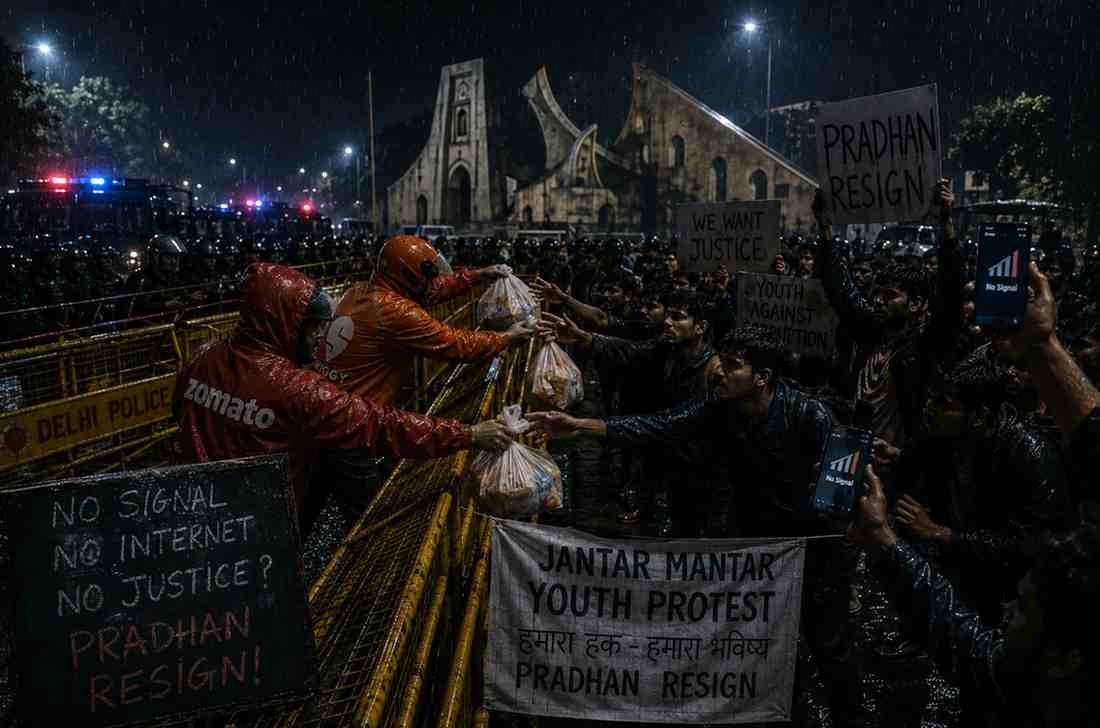
The streets around Jantar Mantar are not starving. Bags of biryani, pizzas from Dubai, sanitary pads, toothbrushes, cold drinks and even fans keep arriving on the backs of Zomato, Swiggy, Blinkit and Zepto riders. Delivery partners openly describe the site as a regular stop. One Swiggy rider told reporters he is simply told to distribute the order among whoever needs it. Another from Zomato and Zepto called it “student service.” Orders have come from across India and from abroad. The protest organisers themselves had to appeal to supporters to stop sending more food because the volume had become unmanageable.
Yet a persistent rumour claims the government has suspended these delivery services to the protest site. That claim is false. The apps are still operating. The riders are still coming. What the government has done is far more revealing.
On 23 July 2026 the Ministry of Home Affairs ordered mobile internet services suspended in a 1.5 km radius around Jantar Mantar from 4 pm to midnight. Telecom operators complied. Vendors and restaurants in the area suddenly could not accept digital payments. The official justification was “public order” and preventing “incitement.” This is the same playbook used earlier on 20 July when the Cockroach Janta Party tried to march toward Parliament: metro stations shut, heavy police deployment, baton charges that left dozens injured, and an earlier internet disruption. Ten FIRs have been registered against the protesters. Earlier in the agitation, organisers alleged police blocked access to water, washrooms and even tarpaulins during rain.
The government is not stopping food delivery because it cannot easily do so without openly admitting it wants to starve a peaceful sit-in. Instead it is choking the digital oxygen that allows supporters outside Delhi to organise, donate, and coordinate. Internet blackouts make it harder for people at the site to communicate and for distant supporters to place those very orders that keep the camp alive. It is a quieter, more bureaucratic form of siege.
What the regime actually wants is simple and ugly. It wants the resignation demand against Education Minister Dharmendra Pradhan to die. The CJP protest erupted after the NEET-UG paper leak scandal that disrupted the futures of roughly two million students. The movement, born out of bitter satire after a judicial remark comparing unemployed youth to cockroaches, has turned into a sustained challenge to the entire examination system’s credibility. Repeated paper leaks, delayed results, and the absence of meaningful accountability have fuelled genuine rage among a generation that sees its one shot at mobility being repeatedly compromised.
Rather than accept political responsibility, the response has been classic: label the movement the “B team of a terrorist organisation,” deploy force when numbers grow, register cases, and now cut mobile data. The goal is not public safety. It is to prevent a student-led camp in the heart of the capital from becoming a broader symbol of systemic failure. Paper leaks are not accidents. They are symptoms of a procurement and invigilation culture that has repeatedly failed under the same political establishment. Forcing a minister to resign would admit that failure. Keeping the internet dark and the police present is cheaper than facing that admission.
The delivery apps have become an unintended lifeline precisely because the state has tried to isolate the protesters physically and digitally. Supporters who cannot travel still participate by feeding the camp. That quiet solidarity has so far outpaced the government’s ability to shut it down. The internet ban of 23 July is therefore not a technical measure. It is an admission that the regime fears sustained visibility more than it fears hunger at the protest site.
A government confident in its handling of education and youth aspirations does not need to black out mobile data around a designated protest ground. A government that treats student anger as a law-and-order problem rather than a governance problem will keep reaching for these tools. The food keeps arriving. The demand for accountability has not gone away. The blackout only makes the desperation clearer.
"The decisions we make today will shape the world for generations to come."