Imagine a passenger train gliding almost silently along the tracks, powered not by the familiar roar of diesel engines or the constant pull of overhead electric wires, but by a clean chemical reaction whose only visible signature is a faint trail of water vapour. On July 17, 2026, that vision becomes reality in India.
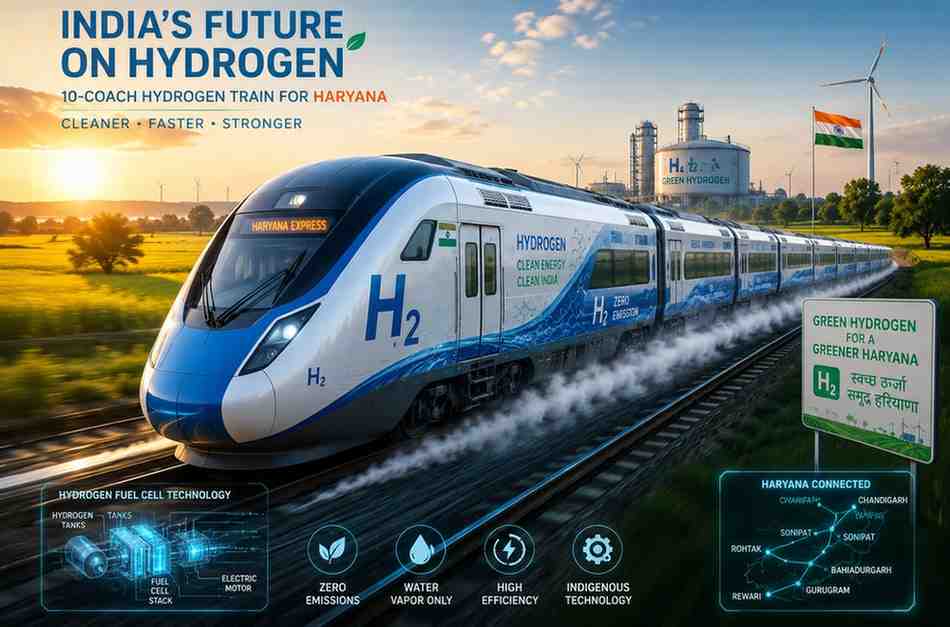
Prime Minister Narendra Modi is scheduled to flag off the country’s first indigenous hydrogen fuel-cell train from Jind station in Haryana. The 10-coach trainset will operate on the 89-km Jind–Sonipat section of Northern Railway, marking India’s formal entry into the small global club of nations running hydrogen-powered passenger services.
This is no modest prototype. Two Driving Power Cars, each generating 1,200 kW, deliver a combined 2,400 kW of traction power — currently the highest output of any hydrogen trainset running on broad-gauge tracks anywhere in the world. Eight passenger coaches provide seating for 682 and a total capacity of around 2,600 people. During trials the train reached 120 km/h; in regular service it will run at a controlled maximum of 75 km/h, covering the route in roughly two hours with stops at 12 intermediate stations. Two round trips a day will log approximately 356 km.
The technology is elegant in its simplicity. Compressed green hydrogen stored on board reacts with oxygen drawn from the air inside polymer-electrolyte membrane fuel cells. The reaction produces electricity that drives the motors; the only by-products are water vapour and heat. Lithium-iron-phosphate batteries smooth power delivery and recover energy during braking. An on-site electrolysis plant at Jind, powered by renewable sources, produces the hydrogen, while advanced leak detectors, flame sensors and continuous monitoring systems satisfy stringent safety requirements approved by the Petroleum and Explosives Safety Organisation.
The project is deeply rooted in the National Green Hydrogen Mission and the “Hydrogen for Heritage” programme. A ₹111.83-crore pilot converted an existing Diesel Electric Multiple Unit into a hydrogen trainset, with propulsion systems developed by Medha Servo Drives in partnership with Canadian fuel-cell expertise and manufacturing support from the Integral Coach Factory in Chennai. Design and standards work was led by the Research Designs and Standards Organisation. Every major component was engineered under the Atmanirbhar Bharat umbrella, turning a technology still considered experimental in many countries into a high-capacity, operational reality.
The strategic logic is clear. Indian Railways has electrified the majority of its network, yet thousands of kilometres of branch, heritage and hill lines remain diesel-dependent. Full electrification of every route is neither economical nor always feasible. Hydrogen trains offer a flexible, zero-emission alternative that can be deployed without the massive capital outlay of catenary infrastructure. Success on the Jind–Sonipat corridor is expected to unlock a pipeline of up to 35 additional hydrogen trainsets, initially targeted at scenic and heritage routes where preserving the landscape is as important as cutting emissions.
The environmental and economic dividends are substantial. Each day of operation avoids the carbon dioxide, nitrogen oxides and particulate matter that a comparable diesel train would emit. Local production of green hydrogen reduces dependence on imported fossil fuels. The manufacturing and maintenance ecosystem creates skilled jobs and builds domestic capability in fuel-cell systems, high-pressure storage and electrolyser technology — competencies that can later be exported.
Challenges remain. The cost of green hydrogen is still higher than diesel on a pure energy-content basis, infrastructure for large-scale production and distribution needs expansion, and rigorous operational data from the first months of service will be essential. Yet the careful sequencing of this pilot — train and refuelling facility developed in parallel, extensive safety validation completed before passenger service — significantly de-risks the technology.
For the passengers who will ride the Jind–Sonipat service in the coming weeks, the experience will be quieter, cleaner and symbolically powerful. For Indian Railways and the wider energy transition, the train represents something larger: proof that a large, complex public system can move from ambition to operational reality in a technology still considered frontier. The hydrogen era on Indian rails has begun. Its success will be measured not only in kilometres run and emissions avoided, but in how quickly the model scales across the network and inspires similar leaps elsewhere.
Official Sources of Data: Ministry of Railways / Railway Board circulars and communications (May–July 2026); Press Information Bureau releases; Northern Railway operational schedules; Research Designs and Standards Organisation trial reports; statements by senior Railway Board officials reported by PTI and leading national media as of 16–17 July 2026.
"The decisions we make today will shape the world for generations to come."