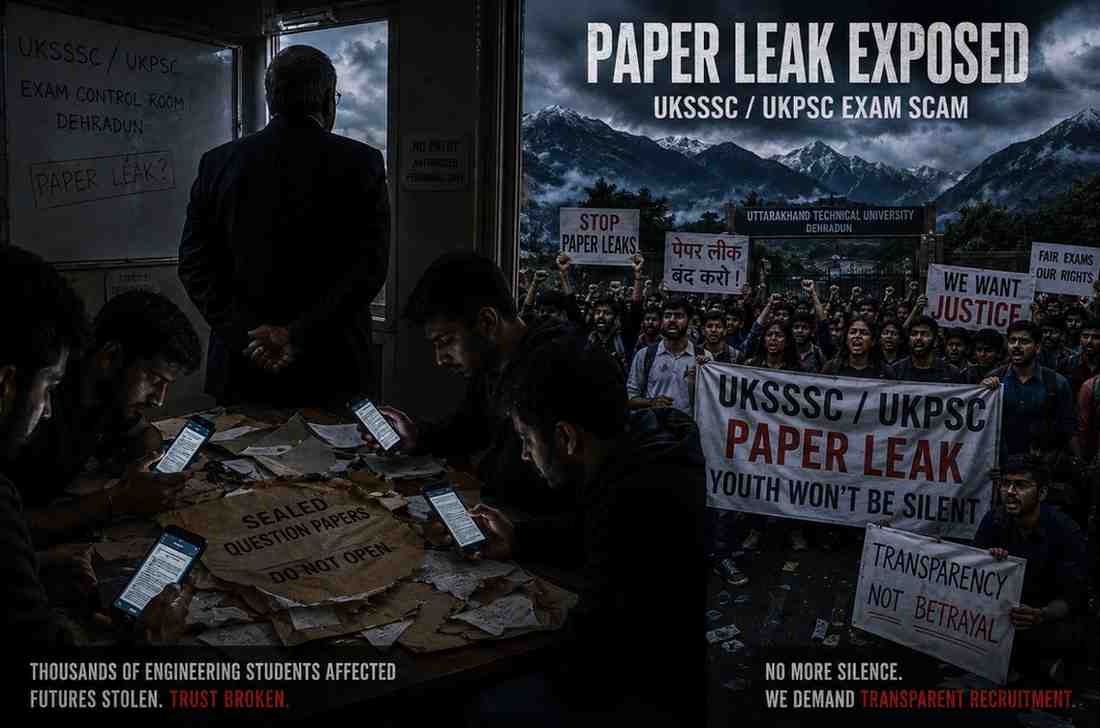
Yet another chapter in Uttarakhand’s endless exam-shame story has unfolded at Veer Madho Singh Bhandari Uttarakhand Technical University. Two engineering semester papers from the even semester 2025-26 — Machine Learning for Internet of Things and Electromagnetic Field Theory — reached students before the scheduled examinations. The university has now cancelled both papers and ordered re-exams in the third week of August.
The man at the centre of this mess is Assistant Professor Ashish Kumar Gupta of Shivalik College of Engineering, Dehradun. He was not some outsider or middleman. He was the external paper setter for these very subjects and even served as an external invigilator for one of them. According to the university’s own high-level inquiry, Gupta shared the question papers with students through the college’s internal portal and WhatsApp groups well before the exams. The leak was not sophisticated hacking or a printing-press racket. It was a straightforward betrayal by the person entrusted with the most sensitive job in the entire process.
Once the complaint reached the university, a probe confirmed the breach. Both exams were scrapped to protect whatever little credibility remains. Gupta has been barred from any examination-related work with VMSB UTU for the next seven years. Shivalik College has been warned to tighten its systems. On paper, the university has acted. In reality, this is the same old damage-control drill that Uttarakhand has perfected over the years.
This is not an isolated lapse. Uttarakhand has watched paper leaks and exam irregularities become a recurring feature under successive governments, but the pattern has grown uglier in recent years. Recruitment exams conducted by the state’s subordinate services commission have repeatedly collapsed under similar scandals. Printing-press leaks, phone photos smuggled out of centres, professors solving papers for money — the methods keep changing, the outcome stays the same. Honest students lose months or years of preparation while a parallel economy of cheats and facilitators thrives.
The deeper failure is structural. Technical universities like VMSB UTU are supposed to produce the engineers who will build the state’s infrastructure, power projects and industries. When the person setting the paper is also the one leaking it, the degree itself becomes suspect. Employers, higher-education institutions and even the public start questioning the value of a Uttarakhand technical degree. That damage lasts far longer than a cancelled exam.
The state government has passed tough-sounding anti-cheating laws and repeatedly promises “zero tolerance.” Yet the same system continues to produce the same results. When a professor inside an affiliated college can casually share papers on WhatsApp and the college portal, it exposes how hollow the monitoring mechanisms really are. Flying squads, CCTV claims and inquiry committees arrive only after the damage is done. Prevention remains an afterthought.
Students at affiliated colleges will now prepare again for the August re-exams. Their academic calendars are disrupted, stress levels rise, and families bear the emotional and financial cost. The university’s regret statement does nothing to erase that. Meanwhile, the larger ecosystem that allows paper setters to become paper sellers stays intact.
This latest episode at VMSB UTU is a reminder that paper leaks in Uttarakhand are no longer shocking. They have become expected. Until the political and administrative leadership treats the examination system as a matter of institutional integrity rather than a public-relations problem to be managed after every scandal, the cycle will continue. Students will keep paying the price, and the state’s technical education will keep sliding deeper into disrepute.
"The decisions we make today will shape the world for generations to come."